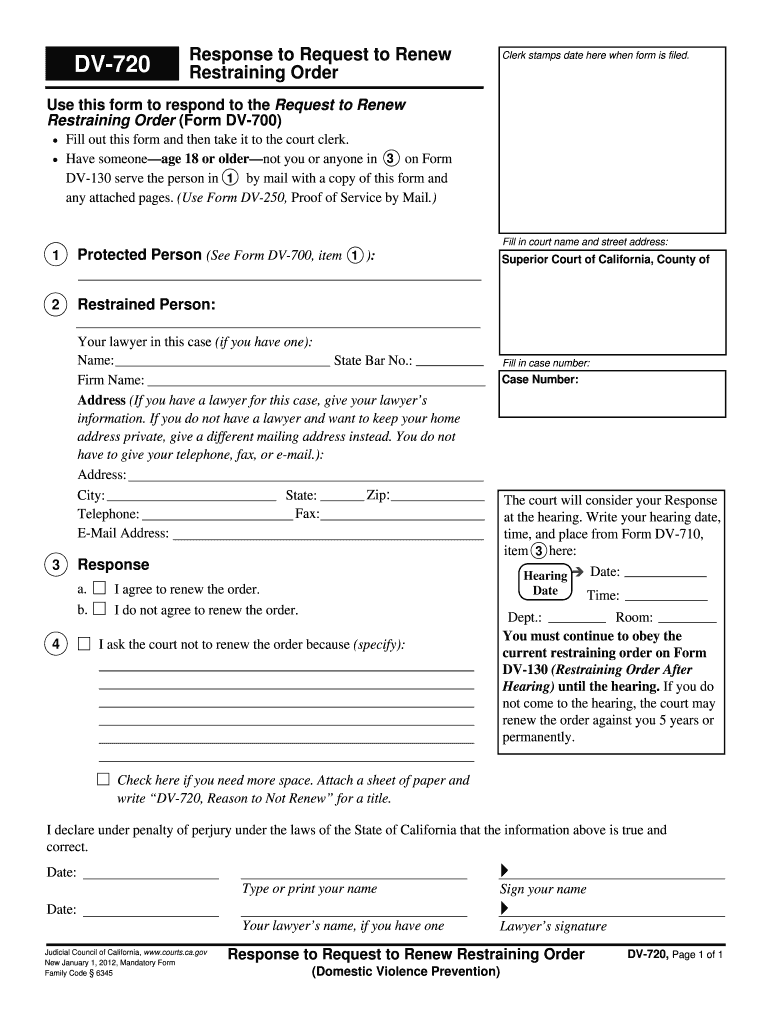
Orm and then take it to the court clerk. Have someone age 18 or older not you or anyone in 3 on Form DV-130 serve the person in 1 by mail with a copy of this form and any attached pages. (Use Form DV-250, Proof of Service by Mail.) Fill in court name and street address: 1 Protected Person (See Form DV-700, item 1 ): 2 Restrained Person: Superior Court of California, County of Your lawyer in this case (if you have one): Name: State Bar No.: Firm Name: Address (If you have a lawyer f.
Loading

Open form follow the instructions

Easily sign the form with your finger

Send filled & signed form or save
How to fill out the CA DV-720 online
The CA DV-720 form is essential for responding to a request to renew a restraining order. This guide provides step-by-step instructions to assist you in filling out the form accurately and confidently.
Follow the steps to complete the CA DV-720 form online.
- Click 'Get Form' button to obtain the form and open it in your preferred document editor.
- Fill in the court name and street address at the top of the form, ensuring accuracy to avoid any delays in processing.
- Enter the information for the protected person as referenced in Form DV-700, item 1. This is important for identifying the individual under protection.
- Provide the details of the restrained person, which is crucial for the court's understanding of the case.
- If applicable, include the information of your lawyer. List their name, State Bar number, firm name, complete address, and omit your phone number and email if you prefer privacy.
- Fill in the case number to ensure the court can link this form to the correct case.
- Write the date, time, and location of your upcoming hearing as stated in Form DV-710, item 3. This information keeps your hearing organized.
- Indicate whether you agree to renew the order by checking the appropriate box. If you do not agree, provide a reason in the designated space.
- If you need more space for your explanation, check the box and attach a separate sheet of paper, titled 'DV-720, Reason to Not Renew.'
- Finally, sign and date the form to affirm that the information is true and correct under penalty of perjury.
- After completing the form, you may save your changes, download the document, print it, or share it as needed.
Complete your documentation online today to ensure it's ready for submission.
Experience a faster way to fill out and sign forms on the web. Access the most extensive library of templates available.
Related content
Jan 1, 2024 — Instructions: Use this form if the protected person has asked to renew the...
by LT Pelegrina · 2015 · Cited by 9 — Abstract. We have previously observed that...
CUIDADO: ○ Esta câmera de vídeo destina-se a ser utilizada com sinais de TV a cores...
Get answers to your most pressing questions about US Legal Forms API.
How do I write a letter to the judge to drop charges?
To write a letter to the judge asking to drop charges, start by clearly stating your request at the beginning of the letter. Provide your reasons, such as lack of evidence or a resolution with the other party. Include any relevant information, such as case details and contact information, to facilitate communication. Utilizing a CA DV-720 template from US Legal Forms can guide you in structuring your letter effectively.
Can I write a letter to the judge to dismiss a case?
Yes, you can write a letter to the judge requesting the dismissal of a case. In your letter, clearly state your request and the reasons behind it, such as changed circumstances or a mutual agreement with the other party. It is important to present your case respectfully and concisely, adhering to any court protocols. Leveraging templates from US Legal Forms can assist you in crafting your letter related to a CA DV-720.
Can a father continue visitation when a restraining order is in effect?
Whether a father can continue visitation during a restraining order depends on the terms of the order itself and the specific circumstances involved. In some cases, visitation rights may be explicitly protected despite the order. However, it is essential to review the legal language of the CA DV-720 to ensure compliance. Seeking guidance through resources like US Legal Forms can provide clarity on this matter.
What happens if both parties don't show up for a restraining order?
If both parties fail to appear at the scheduled hearing for a restraining order, the court typically dismisses the case. This means that the restraining order remains in effect unless otherwise specified. It's crucial to understand your responsibilities regarding court appearances to avoid unexpected outcomes. If needed, US Legal Forms can help you draft the appropriate documentation related to your CA DV-720 case.
How do I write a letter to remove a restraining order?
To write a letter requesting the removal of a restraining order, begin with a clear statement of your request. Explain your reasons for wanting to lift the order, emphasizing any positive changes that have occurred since it was issued. Be sure to include relevant details, such as case numbers and dates, to avoid confusion. Utilizing resources from US Legal Forms can simplify the creation of your CA DV-720 letter.
What does dissolving a protective order mean?
Dissolving a protective order means officially terminating the legal restrictions imposed by the order. This action can restore freedom of movement and communication between the parties involved. When you dissolve a protective order, you regain the ability to interact without legal barriers. Understanding the process of modifying a CA DV-720 will help you achieve this goal smoothly.
What is an ex parte restraining order in California?
An ex parte restraining order is a legal order issued by a judge without the other party present in court. In California, this type of order provides immediate protection for individuals facing threats or violence. It is meant for urgent situations where waiting for a hearing is not feasible. Knowing how to effectively navigate the CA DV-720 process for ex parte orders can enhance your safety.
What are good reasons to drop a restraining order?
There are several valid reasons to consider dropping a restraining order. For instance, if the circumstances that led to the order have changed, such as improved communication with the other party, it may no longer be necessary. Additionally, if you find that the order affects your daily life significantly, such as limiting access to shared spaces, it can be beneficial to pursue a resolution. Understanding the implications of dismissing a CA DV-720 can help you make an informed decision.
How do I drop a restraining order in California?
To drop a restraining order in California, you will need to file a request with the court. Complete the necessary forms, including a section of the CA DV-720, and submit them to the judge. It’s wise to attend the hearing if required and explain why you're seeking to drop the order. Successfully doing so may restore your freedom of communication with the other party.
Can I contact someone I put a restraining order on?
Once a restraining order is in place, contacting the individual may violate the terms of the order. It is crucial to review the details outlined in the CA DV-720 and adhere to its guidelines. If you need to communicate for legal reasons or emergencies, consider seeking legal advice beforehand. Abiding by the order helps protect your rights and wellbeing.
Use professional pre-built templates to fill in and sign documents online faster. Get access to thousands of forms.
If you believe that this page should be taken down, please follow our DMCA take down process here.