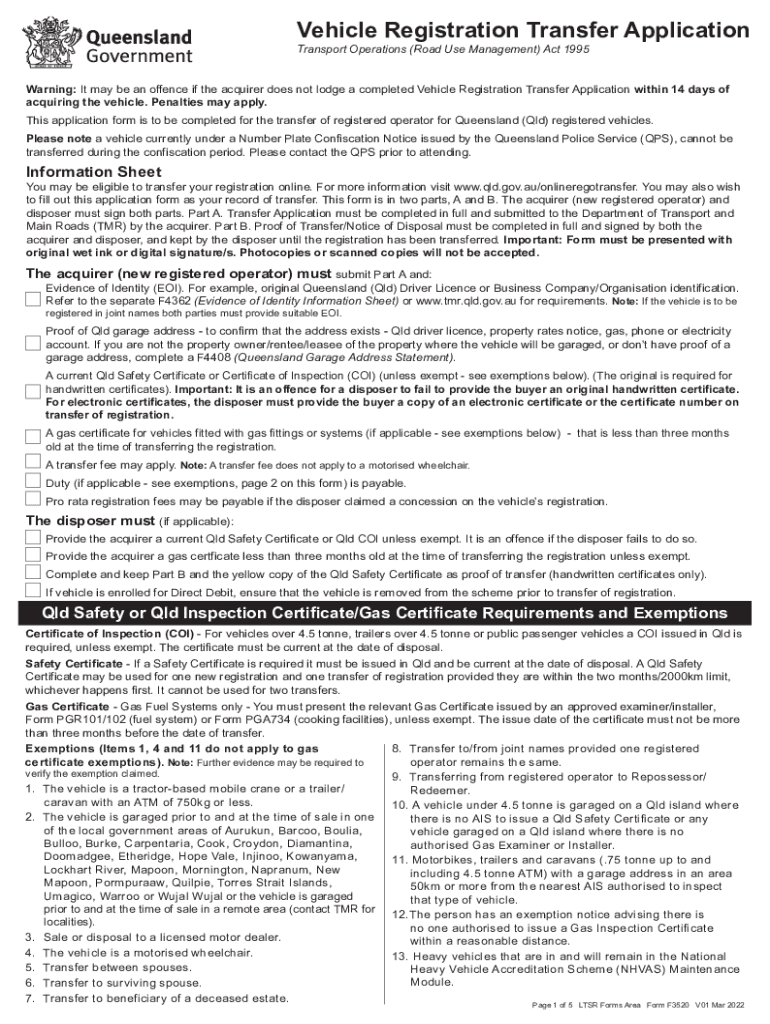
Print FormVehicle Registration Transfer ApplicationReset FormTransport Operations (Road Use Management) Act 1995Warning: It may be an offence if the acquirer does not lodge a completed Vehicle Registration.
Loading

Open form follow the instructions

Easily sign the form with your finger

Send filled & signed form or save
How to fill out the 23.pdf - Print Form Vehicle Registration Transfer... online
Completing the vehicle registration transfer application is essential for properly transferring the ownership of a registered vehicle. This guide will provide you with clear and professional instructions to help you navigate the process of filling out the 23.pdf form online.
Follow the steps to complete the vehicle registration transfer application.
- Use the ‘Get Form’ button to access the 23.pdf form digitally and open it in the appropriate application.
- In Part A, begin by entering the registration details. Indicate if the individual or organization has a customer reference number (CRN) and confirm if the vehicle's registration is current.
- Next, provide details about the vehicle itself, including registration/plate number and Vehicle Identification Number (VIN).
- Fill in the acquirer’s details, including full name, email address, and mobile number. Ensure to tick the appropriate box for the registered operator category.
- If the vehicle is being registered under joint names, complete the second registered operator’s details, including their CRN and personal information.
- Specify the purpose of the vehicle usage from the list provided, and state the dutiable value of the vehicle at the time of disposal.
- Complete the declaration section by signing the form and ensuring all signatures are original. Remember that photocopies are not accepted.
- After filling out Part A, save changes to your application. You can then download, print, or share the form as needed.
Complete your vehicle registration transfer online to ensure a smooth transition of ownership.
Experience a faster way to fill out and sign forms on the web. Access the most extensive library of templates available.
Related content
Mar 23, 2023 — Duplicate · You must complete the Application for Title (TR-2/TR-9)...
FMCSA Forms · Online Updates for USDOT Number, Operating Authority (MC/MX/FF Numbers)...
“Vehicle Sales and Use Tax Return/application for Registration” . ... vehicle...
Get answers to your most pressing questions about US Legal Forms API.
What is the purpose of a marital trust?
A marital trust is an irrevocable trust that lets you transfer a deceased spouse's assets to the surviving spouse without incurring any taxes. The trust also protects assets from creditors and future spouses the surviving spouse may encounter.
Why is the establishment of a credit shelter trust fund considered a good estate planning technique?
The primary benefit of CSTs is that the surviving spouse can use the trust's principal and income during the remainder of their lifetime, for example, for medical or educational expenses. The remaining assets then pass to the beneficiaries and are not subject to estate taxes.
Who is the beneficiary of a credit shelter trust?
A credit shelter trust (CST) is a trust created after the death of the first spouse in a married couple. Assets placed in the trust are generally held apart from the estate of the surviving spouse, so they may pass tax-free to the remaining beneficiaries at the death of the surviving spouse.
What are the different types of marital trusts?
There are three types of marital trusts: a general power of appointment, a qualified terminable interest property (QTIP) trust, and an estate trust. A martial trust protects the assets and benefits of a surviving spouse and children.
What is the primary purpose of a credit shelter trust?
A credit shelter trust (CST) is a trust created after the death of the first spouse in a married couple. Assets placed in the trust are generally held apart from the estate of the surviving spouse, so they may pass tax-free to the remaining beneficiaries at the death of the surviving spouse.
What are the three types of trust?
To help you get started on understanding the options available, here's an overview the three primary classes of trusts. Revocable Trusts. Irrevocable Trusts. Testamentary Trusts.
Can surviving spouse be sole trustee of credit shelter trust?
May the Surviving Spouse Act as Trustee? Yes, the surviving spouse may serve as trustee of the credit shelter trust. If the spouse serves as the sole trustee he or she must be restricted to using income and principal for needs related to health, education, support and maintenance.
What is a credit Trust in Washington State?
A credit shelter trust is a trust that is established in the will or living trust of the first to die of a married couple, most often for the benefit of a surviving spouse. It is generally created to avoid estate taxes at a first spouse's death by taking advantage of the available federal estate tax credit.
What is another name for a bypass trust?
The B trust is known by many names. These include the Bypass Trust, Decedent's Trust, Exemption Trust, Credit Shelter Trust, and/or the Non-Marital Trust. Often, a formula will dictate how much of the assets must go into the A trust, and how much must go into the B trust after the first death.
What is the difference between a credit shelter trust and a marital trust?
Credit Shelter Trust vs Marital Trust - Is a Marital Trust the Same as a Credit Shelter Trust? No. A Marital Trust is a type of Credit Shelter Trust. You and your spouse can use a Marital Trust to pass assets to a surviving spouse, children or grandchildren.
Use professional pre-built templates to fill in and sign documents online faster. Get access to thousands of forms.
If you believe that this page should be taken down, please follow our DMCA take down process here.
This form is available in several versions. Select the version you need from the drop-down list below.