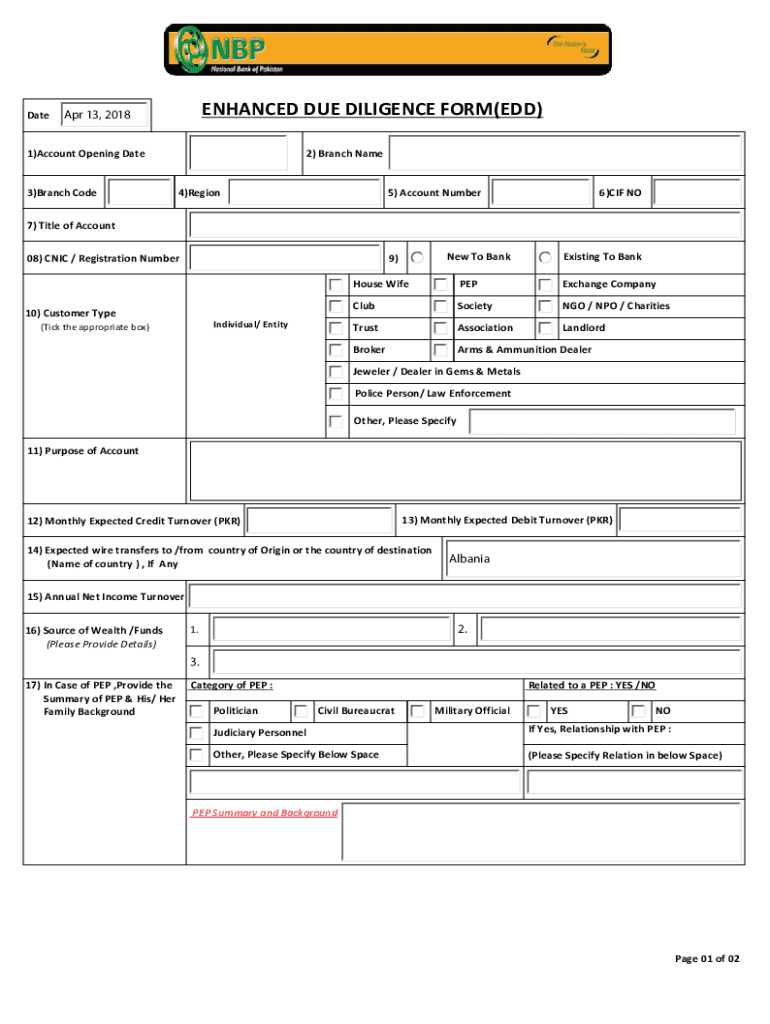
DateENHANCED DUE DILIGENCE FORM(EDD)Apr 13, 20181)Account Opening Date 3)Branch Code2) Branch Name 4)Region5) Account Number6)CIF NO7) Title of Account 08) CNIC / Registration Numbered To Bank9)10).
Loading

Open form follow the instructions

Easily sign the form with your finger

Send filled & signed form or save
How to fill out the PK NBP Enhanced Due Diligence (EDD) online
Filling out the PK NBP Enhanced Due Diligence (EDD) form online is a critical process to ensure compliance and thorough verification. This guide provides clear and supportive instructions to help you navigate through each section of the form.
Follow the steps to complete the PK NBP Enhanced Due Diligence (EDD) form.
- Press the ‘Get Form’ button to retrieve the form and open it in your selected editor.
- Fill in the 'Account Opening Date' in the designated field to record when the account is being opened.
- Enter the 'Branch Code' to specify the code associated with your bank branch.
- Provide the 'Branch Name' to identify the branch where the account is opened.
- In the 'Region' field, indicate the geographical area of the branch.
- Enter your 'Account Number' to uniquely identify your account.
- Input your 'CIF NO' which is the Customer Information File number assigned to you.
- Select a 'Title of Account' and provide either a CNIC or Registration Number in the corresponding field.
- Tick the appropriate box to indicate if you are 'New To Bank' or 'Existing To Bank.'
- Select your 'Customer Type' by ticking the appropriate box, choosing from categories such as Individual, Entity, House Wife, PEP, and others.
- Provide the 'Purpose of Account' in the next field to clarify the intent for opening this account.
- Fill in your 'Monthly Expected Credit Turnover (PKR)' to estimate incoming funds.
- Add your 'Monthly Expected Debit Turnover (PKR)' to estimate outgoings.
- If applicable, state the 'Expected wire transfers to/from country of Origin or the country of destination' and specify the country.
- Enter your 'Annual Net Income Turnover' to provide a financial overview.
- Detail your 'Source of Wealth/Funds' in the designated section.
- If applicable, summarize information regarding PEP status and family background, including related categories.
- Assess if a personal visit to the business premises is required by branch officials if the entity is deemed high risk, and indicate with 'Yes' or 'No.'
- Add any branch comments or recommendations in the 'Branch Comments' field.
- Review the declaration statement affirming that all provided information is accurate, then fill in and sign the sections for 'Prepared by,' 'Reviewed & Approved by,' along with their names and SAP IDs.
- Finally, ensure to save any changes, download a copy, print it out, or share it as required.
Complete the PK NBP Enhanced Due Diligence (EDD) form online today!
Experience a faster way to fill out and sign forms on the web. Access the most extensive library of templates available.
Related content
Importantly, this accretive transaction delivers significant value to our shareholders...
This upcoming RPP aims to develop and validate a training curriculum in burn care...
AN EXTENSION CORD MAY BE USED WITH CARE: HOWEVER, THE MARKED ELECTRICAL RATING SHOULD BE...
Get answers to your most pressing questions about US Legal Forms API.
What is the enhanced due diligence?
Enhance Due Diligence In Banking EDD in banking is a critical component of the KYC compliance procedure. It entails gathering information to authenticate clients' identities and quantify the amount of money laundering risk each customer poses.
What is customer due diligence and enhanced due diligence?
It usually involves collecting and verifying personal information about prospective and current customers. Enhanced due diligence (EDD) refers to protocols that are followed when an individual or transaction is deemed to carry a higher risk of money laundering or other financial crime.
What is the difference between due diligence and enhanced due diligence?
CDD vs EDD If a customer is judged to be low risk, they might also only be subject to simplified customer due diligence, where the only requirement is to identify the customer, but not verify their identity. EDD is required as an additional type of step-up KYC process for customers who are deemed to be high-risk.
What is EDD enhanced due diligence?
Enhance Due Diligence In Banking EDD in banking is a critical component of the KYC compliance procedure. It entails gathering information to authenticate clients' identities and quantify the amount of money laundering risk each customer poses.
What is the difference between CDD and ECDD?
Enhanced CDD shall be applied to the customers categorized as high risk. ECDD includes higher degree of CDD that requires collection of additional information and documents as well as surveillance in every stage of transaction.
What is enhanced due diligence an approach taken by the bank to?
EDD in banking involves gathering information in order to verify the identity of customers and calculate the exact level of money laundering risk each customer poses.
What is a customer due diligence?
The Customer Due Diligence meaning, often abbreviated as CDD, is a process that financial institutions, businesses, and other organisations use to gather information about their customers and clients in order to identify and mitigate risks such as money laundering, financing terrorism, and other illicit activities.
What is enhanced due diligence on a customer?
Enhanced due diligence (EDD) is an extension of know your customer (KYC) and customer due diligence (CDD) that applies when high-risk prospects and customers, who may be involved in money laundering, have been identified.
Use professional pre-built templates to fill in and sign documents online faster. Get access to thousands of forms.
If you believe that this page should be taken down, please follow our DMCA take down process here.