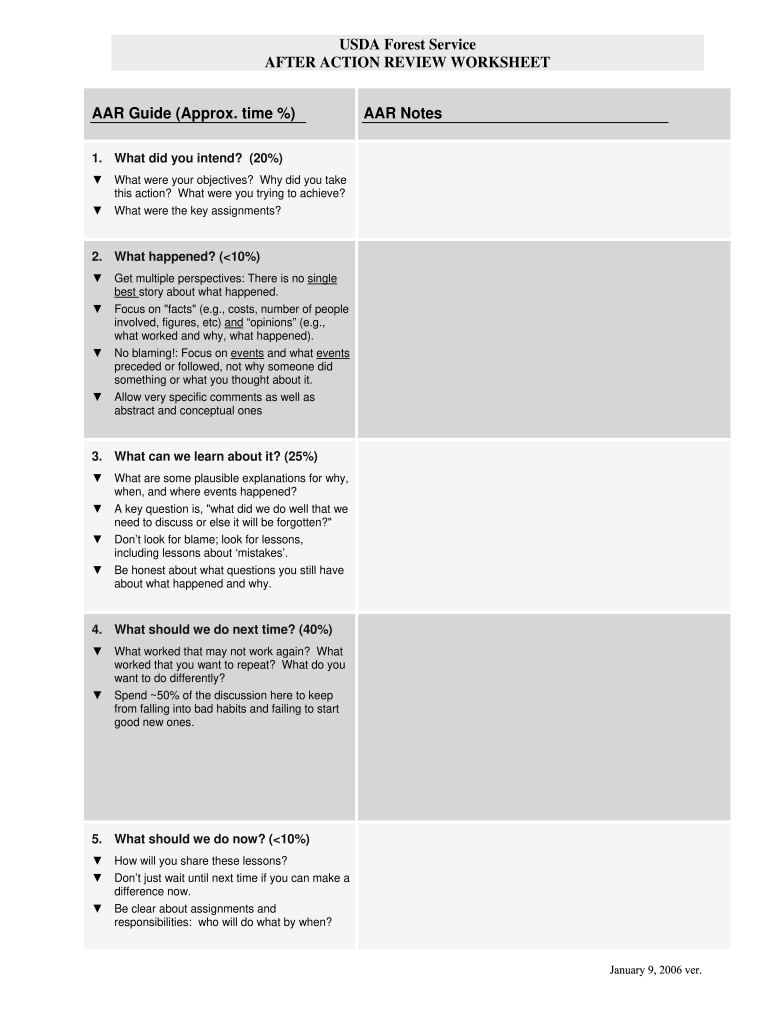
USDA Forest Service AFTER ACTION REVIEW WORKSHEET AAR Guide (Approx. time %) AAR Notes 1. What did you intend? (20%) What were your objectives? Why did you take this action? What were you trying to.
Loading

Open form follow the instructions

Easily sign the form with your finger

Send filled & signed form or save
How to fill out the After Action Review Template online
The After Action Review Template is an essential tool for evaluating actions and outcomes in various projects. This guide will provide you with clear instructions on how to effectively fill out the form online, ensuring that you capture valuable insights and lessons learned.
Follow the steps to complete the After Action Review Template online.
- Click ‘Get Form’ button to obtain the form and open it in the editor.
- Begin by filling out the 'What did you intend?' section. Clearly articulate your objectives and the purpose of the action taken. Include key assignments to provide context.
- Move to the 'What happened?' section. Gather multiple perspectives and focus on both facts and opinions. Document the relevant figures and experiences shared, avoiding any blame while emphasizing events.
- In the 'What can we learn about it?' section, reflect on plausible reasons for the events and identify significant lessons learned. Be candid about any remaining questions to ensure a comprehensive review.
- Complete the 'What should we do next time?' section. Discuss what strategies were successful and how they may vary in the future. Ensure to devote adequate time to this discussion to cultivate positive habits.
- Conclude with the 'What should we do now?' section. Outline how the lessons learned will be communicated and clarify assignments and responsibilities, specifying who will take action and by when.
- Finally, save your changes, and if needed, download, print, or share the completed form with relevant stakeholders.
Start filling out your After Action Review Template online today to enhance your project's effectiveness.
Experience a faster way to fill out and sign forms on the web. Access the most extensive library of templates available.
Related content
The After-Action Report/Improvement Plan (AAR/IP) aligns exercise objectives with...
The After-Action Review (AAR) process should be implemented following an exercise ... The...
An after action review (AAR) is a structured review or de-brief (debriefing) process for...
Get answers to your most pressing questions about US Legal Forms API.
What are the 5 questions of the after action review?
Beginning—The AAR will seek to answer five key questions: 1) what was supposed to happen, 2) what was the reality, 3) what went well, 4) what did not go well, and 5) what should be changed for next time.
What are the 4 parts of an AAR?
The four focal points of the AAR: what was expected to occur, what really happened, what went wrong and why did it go wrong, what went well and why did this go well.
What are the key components of an after action report?
Although after-action reports may vary, here are the main components you need to be sure to include: Incident overview. What happened, when did it happen, how did it happen, etc. Analysis.
What is the AAR review process?
An after action review (AAR) is a technique for improving process and execution by analyzing the intended outcome and actual outcome of an action and identifying practices to sustain, and practices to improve or initiate, and then practicing those changes at the next iteration of the action AARs in the formal sense ...
How do you write a good after action review?
Here are some of the key elements of an effective AAR: Discuss the purpose and rules – The AAR does not seek to criticize negatively, or find fault. ... Encourage active participation – When setting the rules, talk about trust. ... Use a facilitator – A neutral party helps focus the discussion.
What does an AAR consist of?
An after action review (AAR) is used to debrief a project or event and understand what took place, why it happened the way it did, and how to improve on it. It can highlight areas of strength or concern in your project and in your team. Read on to learn how to use AARs to learn from the past and improve for the future.
What are the 4 parts of an after action review?
The four focal points of the AAR: what was expected to occur, what really happened, what went wrong and why did it go wrong, what went well and why did this go well.
What are the four steps of the AAR process?
The four steps in the execution sequence of an after action review are planning, preparation, conduct, and follow-up.
Use professional pre-built templates to fill in and sign documents online faster. Get access to thousands of forms.
If you believe that this page should be taken down, please follow our DMCA take down process here.