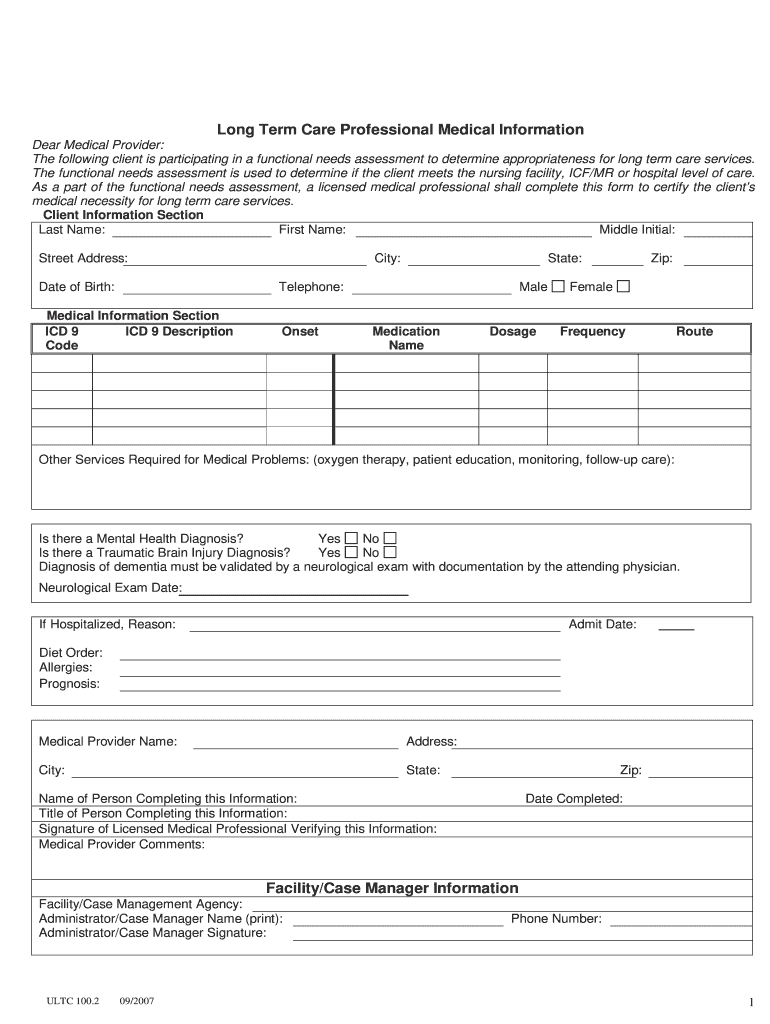
The functional needs assessment is used to determine if the client meets the nursing facility, ICF/MR or hospital level of care. As a part of the functional needs assessment, a licensed medical professional shall complete this form to certify the client s medical necessity for long term care services. Client Information Section Last Name: First Name: Middle Initial: Street Address: Date of Birth: City: State: Telephone: Medical Information Section ICD 9 ICD 9 Description Code Onset Male.
Loading

Open form follow the instructions

Easily sign the form with your finger

Send filled & signed form or save
How to fill out the Long Term Care Professional Medical Information online
Completing the Long Term Care Professional Medical Information form is an essential process for assessing a client's eligibility for long term care services. This guide provides clear, step-by-step instructions to help you fill out the form accurately and efficiently.
Follow the steps to complete the form successfully.
- Press the ‘Get Form’ button to access the Long Term Care Professional Medical Information form and open it in your online editor.
- Begin by filling in the Client Information Section. Provide the client's last name, first name, middle initial, street address, date of birth, city, state, telephone number, and zip code. Ensure that all details are accurate to avoid delays.
- In the Medical Information Section, enter the ICD 9 code and its description. Include the onset date of the medical condition and mark the appropriate gender by selecting 'Male' or 'Female'.
- List any medications the client is taking. Include the medication name, dosage, frequency of dosage, and the method of administration (route).
- Address any other services that may be required for medical problems, such as oxygen therapy or patient education. Indicate if there is a mental health diagnosis or a traumatic brain injury diagnosis, specifying 'Yes' or 'No'.
- For diagnoses of dementia, provide the date of the neurological exam and include documentation from the attending physician.
- If the client has been hospitalized, note the reason for hospitalization and the admission date.
- Complete the diet order and document any allergies the client may have along with their prognosis.
- Fill in the Medical Provider section by entering the name, address, city, state, and zip code of the medical provider. Additionally, include the name and title of the person completing the form, along with their signature as a licensed medical professional.
- Add any comments from the medical provider and ensure the date of completion is noted.
- In the Facility/Case Manager Information section, provide the name of the facility or case management agency, and enter the case manager's name. Ensure the case manager's signature is included, along with a contact phone number.
- Once all sections are filled, review the form for accuracy, then save changes, download, print, or share the form as needed.
Start filling out the Long Term Care Professional Medical Information form online today to ensure prompt processing of your client's functional needs assessment.
Experience a faster way to fill out and sign forms on the web. Access the most extensive library of templates available.
Related content
Long Term Care Professional Medical Information Page (PMIP). Dear Medical Provider: The...
The information presented in the Financial Caregiving Series is for general educational...
Items 7 - 13 — Long Term Care Survey Process (LTCSP) Procedure Guide. Effective February...
Get answers to your most pressing questions about US Legal Forms API.
What is the difference between long term care and nursing home?
Long term care isn't meant to provide the same level of medical care as skilled nursing, but there will likely be access to medical practitioners should they be needed. Because long term care is more of a permanent residence than skilled nursing, it isn't typically covered by insurance, Medicare, or Medicaid.
What is the most common setting where long term care is delivered?
Most long-term care is provided at home by unpaid family members and friends. It can also be given in a facility such as a nursing home or in the community, for example, in an adult day care center.
What qualifies as long term care?
Long-term care involves a variety of services designed to meet a person's health or personal care needs during a short or long period of time. These services help people live as independently and safely as possible when they can no longer perform everyday activities on their own.
What elements are essential in the delivery of long term care?
Long term care services must be individualized, integrated, and coordinated. Why and why are these elements essential in the delivery of long term care? Long term care services must be integrated because the services require appropriate interfacing with the delivery of primary care, mental health care, and acute care.
What are LTSS services?
Long-term services and supports (LTSS) encompass a variety of health, health-related, and social services that assist individuals with functional limitations due to physical, cognitive, or mental conditions or disabilities. ... The goal of LTSS is to facilitate optimal functioning among people with disabilities.
What do long term care facilities provide?
Facility-based long-term care services include: board and care homes, assisted living facilities, nursing homes, and continuing care retirement communities. Some facilities have only housing and housekeeping, but many also provide personal care and medical services.
What are the three basic levels of long term care?
Care usually is provided in one of three main stages: independent living, assisted living, and skilled nursing.
What are the levels of long term care?
Care usually is provided in one of three main stages: independent living, assisted living, and skilled nursing.
What is a ULTC?
The ULTC 100.2 is an assessment of current support needs. While some Case Management Agencies may choose to include historic information within the narrative sections of this assessment, only the current support needs should be used to determine the score.
What is considered long term care?
What is long-term care? Long-term care generally refers to non-medical care (ie, custodial care) for patients who need assistance with basic daily activities such as dressing, bathing and using the bathroom. Long-term care may be provided at home or in facilities that include nursing homes and assisted living.
Use professional pre-built templates to fill in and sign documents online faster. Get access to thousands of forms.
If you believe that this page should be taken down, please follow our DMCA take down process here.