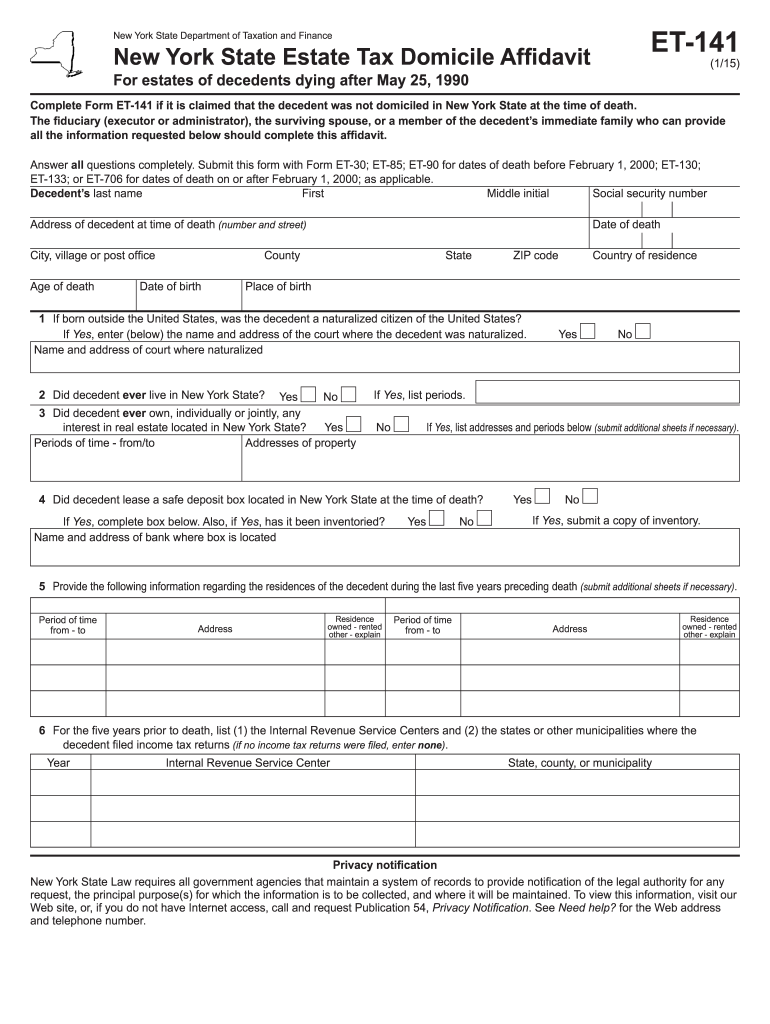
Aimed that the decedent was not domiciled in New York State at the time of death. The fiduciary (executor or administrator), the surviving spouse, or a member of the decedent s immediate family who can provide all the information requested below should complete this affidavit. Answer all questions completely. Submit this form with Form ET-30; ET-85; ET-90 for dates of death before February 1, 2000; ET-130; ET-133; or ET-706 for dates of death on or after February 1, 2000; as applicable. Decede.
Loading

Open form follow the instructions

Easily sign the form with your finger

Send filled & signed form or save
How to fill out the NY DTF ET-141 online
Filling out the NY DTF ET-141 online can seem overwhelming, but this guide will provide you with clear and concise instructions to ensure you complete the process confidently. This form is essential for declaring that a decedent was not domiciled in New York State at the time of their death.
Follow the steps to complete the form easily and accurately.
- Press the ‘Get Form’ button to access the NY DTF ET-141 and open it in your editor for online completion.
- Begin by entering the decedent's last name, first name, and middle initial in the designated fields. Next, fill in the social security number, address at the time of death, and the corresponding city, ZIP code, and country of residence.
- Provide the decedent's age, date of birth, place of birth, and date of death. Make sure all information is accurate to avoid any complications.
- Answer the questions regarding the decedent’s citizenship and residency history. If they were born outside the U.S., indicate if they were naturalized and provide the name and address of the court if applicable.
- Detail any residences the decedent had over the last five years, including whether these were owned or rented. Include all addresses and periods of residency.
- Indicate if the decedent filed income tax returns within the last five years and provide the respective IRS centers along with any states or municipalities involved.
- List any states in which the decedent was registered to vote during the last five years, ensuring to mention the years of registration.
- Outline the decedent’s employment or business activities over the past five years, noting if any occurred in New York State.
- Specify if the decedent had any professional licenses, including details such as types and issuing office.
- Provide additional information to support the claim of the decedent not being domiciled in New York State, along with the applicant’s name, address, relationship to the decedent, and any relevant connections to the estate.
- Review the filled-in information for accuracy before submitting the form. Once finalized, save your changes, download, print, or share the form as needed.
Complete your documents online today to ensure accuracy and compliance with state requirements.
Experience a faster way to fill out and sign forms on the web. Access the most extensive library of templates available.
Related content
Oct 2, 2024 — ET-141, Instructions on form, New York State Estate Tax Domicile Affidavit...
by GB Born · Cited by 82 — The New York Convention. 141 obligations enforceable in...
This manual provides information essential for persons who have the responsibility to...
Get answers to your most pressing questions about US Legal Forms API.
How do I get a tax clearance certificate in NY?
To obtain a tax clearance certificate in New York, you need to request one from the New York State Department of Taxation and Finance. This certificate confirms that you have fulfilled all tax obligations and is often required for various business transactions. Be sure to have your NY DTF ET-141 and other relevant documents ready for a smooth process.
How do I get a NY withholding identification number?
You can get a NY withholding identification number by registering your business with the New York State Department of Taxation and Finance. This step is critical for any employer who needs to withhold state income tax from employees. Using this number, you can properly file the NY DTF ET-141 and meet your tax obligations.
What is DTF payment NY?
DTF payment NY refers to tax payments made to the New York State Department of Taxation and Finance. These payments cover various tax liabilities, including income and sales taxes. It’s essential for taxpayers to manage these payments correctly to avoid penalties, and using the NY DTF ET-141 form can help streamline this process.
How do I get a New York State withholding account number?
To obtain a New York State withholding account number, you need to register with the New York State Department of Taxation and Finance. This process can often be completed online through their website. Once registered, you will receive your account number, enabling you to report withholding taxes effectively on forms like the NY DTF ET-141.
Where can I get NYS tax forms?
You can obtain NYS tax forms directly from the New York State Department of Taxation and Finance website. They provide a comprehensive library of forms that includes the NY DTF ET-141 and others relevant to your tax needs. Additionally, you may find these forms in local government offices and tax preparation businesses.
What does NYS DTF tax payment mean?
The NYS DTF tax payment refers to the payments made to the New York State Department of Taxation and Finance. These payments include various types of taxes such as income tax, sales tax, and corporate tax. When filing your taxes, you may use forms like the NY DTF ET-141 to report and remit these payments accurately.
Do I have to file an estate tax return in NY?
Yes, an estate tax return is required in New York if the estate exceeds the state's exemption limit. Filing the return helps properly manage an estate’s tax obligations and ensures compliance. The NY DTF ET-141 serves as a critical tool in fulfilling these requirements.
Do all estates have to file form 706?
Not all estates are required to file Form 706. Only estates that exceed federal or state thresholds must file this comprehensive estate tax return. Using the NY DTF ET-141 ensures clarity in determining your responsibilities and avoiding unnecessary filings.
What triggers an estate tax return?
An estate tax return is triggered when the estate’s gross value exceeds the exemption threshold set by the IRS or state laws. Other factors may also include distributions to beneficiaries or changes in the property’s valuation. The NY DTF ET-141 can provide insight into these requirements.
Do I have to file a NY nonresident return?
Yes, if you earned income from New York sources as a non-resident, you need to file a NY nonresident return. This ensures that you report all income accurately and fulfill your tax obligations. The NY DTF ET-141 is a useful resource for non-resident filing.
Use professional pre-built templates to fill in and sign documents online faster. Get access to thousands of forms.
If you believe that this page should be taken down, please follow our DMCA take down process here.