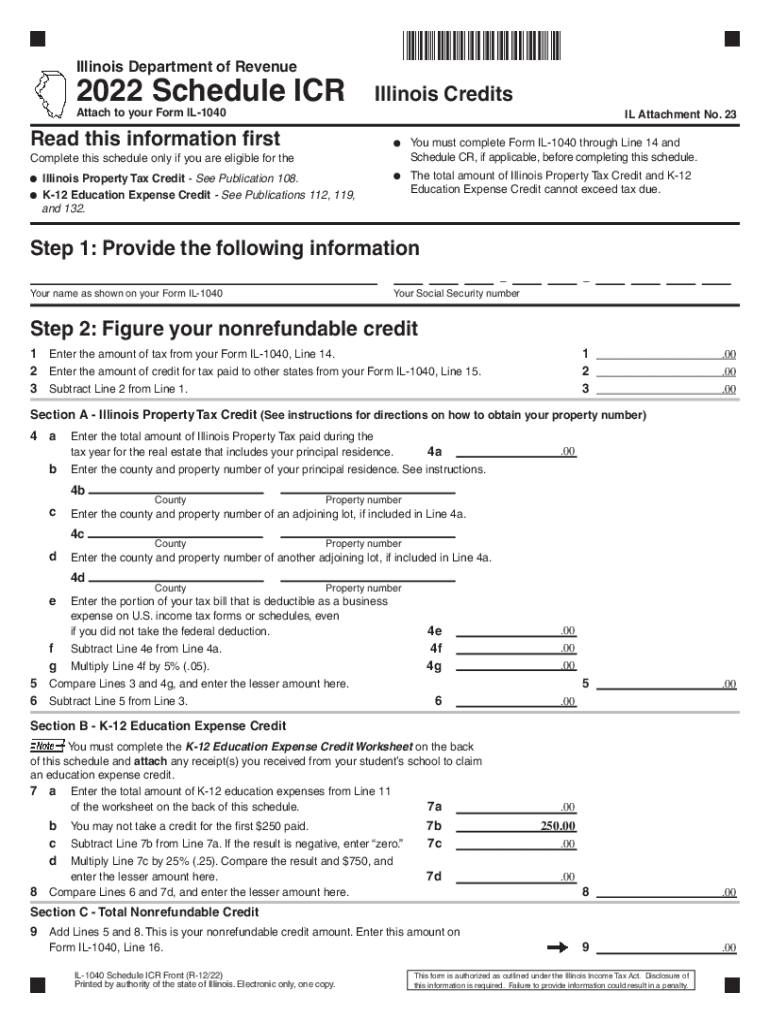
Use your mouse or Tab key to move through the fields. Use your mouse or space bar to enable check boxes. 60512211W*Illinois Department of Revenue2021 Schedule ICR Attach to your Form IL1040Illinois.
Loading

Open form follow the instructions

Easily sign the form with your finger

Send filled & signed form or save
How to fill out the IL IL-1040 Schedule ICR online
Filling out the IL IL-1040 Schedule ICR is essential for claiming specific tax credits in Illinois. This guide will provide clear, step-by-step instructions to help users complete the form accurately and effectively.
Follow the steps to complete your Schedule ICR online.
- Click ‘Get Form’ button to obtain the form and open it in the editor.
- Enter your name as it appears on your Form IL-1040 in the designated space. This ensures that your credits are accurately matched to your tax return.
- Provide your Social Security number. This is necessary for identity verification and is used throughout the filing process.
- Figure out your nonrefundable credit by following these steps: First, from your Form IL-1040, Line 14, enter the amount of tax. Then, from Line 15, enter the credit for tax paid to other states. Finally, subtract Line 2 from Line 1 to obtain the result.
- Complete Section A for the Illinois Property Tax Credit. Start by entering the total amount of Illinois Property Tax paid for your principal residence. Follow instructions to provide the county and property number for your principal residence as well as any additional adjoining lots.
- In Section A, calculate the deductible portion of your tax bill as a business expense. Subtract this amount from Line 4a, then multiply the result by 5% (.05). This amount should be compared to the total nonrefundable credit calculated earlier.
- Move to Section B to calculate the K-12 Education Expense Credit. Enter the total K-12 education expenses as detailed in the worksheet on the back of the schedule and include any supporting receipts.
- Determine any eligible credits by performing the necessary subtractions and multiplications as instructed in Section B. This will help identify your maximum eligible credit.
- In Section C, add the amounts calculated in Line 5 and Line 8 to determine your total nonrefundable credit amount. This is the amount you will need to enter on your Form IL-1040, Line 16.
- After completing the form, you have the option to save changes, download, print, or share your completed Schedule ICR for your records.
Complete your forms online for a seamless filing experience.
Experience a faster way to fill out and sign forms on the web. Access the most extensive library of templates available.
Related content
IL-1040-ES, 2019 Estimated Income Tax Payments for Individuals Use this form for...
Jul 21, 2017 - These changes are effective July 1, 2017. ... The personal income tax rate...
... ensure the client accepts the project. Factors affecting a CCB's decision can include...
Get answers to your most pressing questions about US Legal Forms API.
Is mortgage interest deductible for 2018?
The mortgage interest deduction is one of them. Starting in 2018, mortgage interest on total principal of as much as $750,000 in qualified residence loans can be deducted, down from the previous principal limit of $1,000,000. ... It's worth pointing out that this limit only applies to new loans originated after 2017.
Is mortgage interest still deductible in 2019?
The Mortgage Interest Deduction allows homeowners to reduce their taxable income by the amount of interest paid on a qualified residence loan. The law regarding the Mortgage Interest Deduction has been revised by the Tax Cuts and Jobs Act, and the changes will take effect beginning with returns filed in 2019.
Is mortgage interest tax deductible in Illinois?
The GOP tax plan caps the mortgage interest deduction (MID) at $750,000 and limits the state, local and property tax deduction to $10,000. Under current law, interest paid on up to $1 million in mortgage loans can be deducted.
Can I write off mortgage interest in 2019?
The Mortgage Interest Deduction allows homeowners to reduce their taxable income by the amount of interest paid on a qualified residence loan. The law regarding the Mortgage Interest Deduction has been revised by the Tax Cuts and Jobs Act, and the changes will take effect beginning with returns filed in 2019.
Can you claim your house on taxes for 2018?
The answer: It's still a deduction, but most taxpayers won't be able to use it. The bottom line is that yes, property taxes are still deductible in 2018 and beyond. However, the Tax Cuts and Jobs Act has severely limited the deduction, especially for taxpayers in states where they're likely to need the deduction most.
How does property tax deduction work?
The main tax benefit of owning a house is that the imputed rental income homeowners receive is not taxed. Although that income is not taxed, homeowners still may deduct mortgage interest and property tax payments, as well as certain other expenses from their federal taxable income.
Are property taxes deductible in 2019?
For the 2019 tax season, there's a new limit: You may deduct up to $10,000 ($5,000 if married filing separately) for a combination of property taxes and either state and local income taxes or sales taxes. You might be able to deduct property and real estate taxes you pay on your: Primary home.
What is a property tax credit?
Property tax relief credit. The property tax relief credit directly reduces your property tax burden if you are a qualifying homeowner. ... receive either the Basic or Enhanced STAR exemption or credit, have an income of $275,000 or less, and.
Who qualifies for homestead exemption in Illinois?
Under the Illinois exemption system, a homeowner can exempt up to $15,000 of equity in a home or other property covered by the homestead exemption. The Illinois homestead exemption requires that you be a legal owner of record to claim the exemption. Your name must be listed on the deed to the property.
Do seniors get a property tax break in Illinois?
Senior citizens. If you are 65 or older, you can have your assessed value lowered by up to $5,000 (or $8,000 in Cook County). You can also apply for an assessment freeze that limits the amount of future assessment increases. (See 35 ILCS 200/15-170, 15-172.)
Use professional pre-built templates to fill in and sign documents online faster. Get access to thousands of forms.
If you believe that this page should be taken down, please follow our DMCA take down process here.
This form is available in several versions. Select the version you need from the drop-down list below.