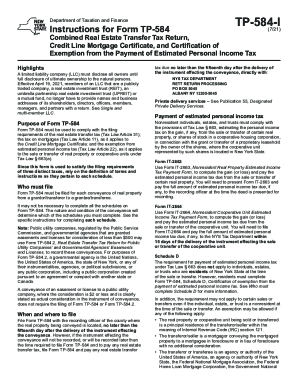
TP584I (7/21)Department of Taxation and FinanceInstructions for FormTP584Combined Real Estate Transfer TaxReturn, Credit Line Mortgage Certificate, and Certification of Exemption from the Payment.

How it works
  • Open form

    Open form follow the instructions

  • Easily sign form

    Easily sign the form with your finger

  • Share form

    Send filled & signed form or save

How to fill out the NY TP-584-I online

Filling out the NY TP-584-I is essential for complying with New York transfer tax regulations. This guide provides comprehensive instructions to help users fill out the form accurately and efficiently in an online format.

Follow the steps to complete the NY TP-584-I online.

  1. Press the ‘Get Form’ button to obtain the form and open it in the editor.
  2. Begin by entering the names and addresses of the grantor and grantee as they appear in your instrument. Ensure to include the Social Security number or employer identification number for all parties.
  3. Provide the location and description of the property being conveyed. This includes the tax map designation and Statewide Information System Code (SWIS Code). Contact your local tax assessor if you do not know the SWIS Code.
  4. Indicate the type of property being conveyed by marking the appropriate checkbox. This could be a single-family house, a multi-family house, or a cooperative apartment.
  5. Fill in the percentage of real property that is residential, if applicable. This is calculated based on the total area being conveyed.
  6. Mark any conditions applicable to the conveyance in the provided checkboxes. Ensure that you complete any additional necessary schedules indicated based on your selections.
  7. Once all fields are filled, double-check the information for accuracy. After confirming that everything is correct, proceed to save your changes. Users have the option to download, print, or share the completed form as needed.

Complete your documents online to ensure compliance and efficiency.

Get form

Experience a faster way to fill out and sign forms on the web. Access the most extensive library of templates available.

Related content

Real estate transfer and mortgage recording tax...

Jun 7, 2019 - TP-584-NYC Fill-in · TP-584-NYC-I (Instructions), Combined Real Estate...

Learn more
NY State Combined Real Estate Transfer Tax Return...

Description: New York State Department of Taxation and Finance form TP-584: Combined Real...

Learn more
Questions & Answers

Get answers to your most pressing questions about US Legal Forms API.

Contact support

What is NY transfer tax?

What is a transfer tax? A transfer tax is a one-time fee imposed on the transfer of property, usually paid by the seller. Both New York City and New York state already have one. Statewide, the tax is imposed on any property transfer over $500 at a flat rate of $2 for every $500, or 0.4 percent.

Transfer tax is a tax imposed by states, counties, and cities on the transfer of the title of real property from one person (or entity) to another within the jurisdiction. It is based on the property's sale price and is paid by the buyer, seller, or both parties upon transfer of real property.

The second cost is the NY STATE TRANSFER TAX, the SELLER is usually required to pay the transfer tax due on the sale of the property. The NYS transfer tax is computed at a rate of .4% of the sales price or $4 per thousand of the sale price.

The transfer tax is a tax imposed on the seller (or grantor ) during the conveyance of real property so it is typically their responsibility to pay. If the seller finds a way to not pay the tax (or just disappears), the responsibility to pay falls on the buyer. One way or another, the tax is going to get paid.

The buyer is usually responsible for the 1% additional real estate transfer tax on properties worth $1 million or more. That said, if the buyer is exempt, the seller must pay. Whatever the situation whether the buyer or seller pays New York requires the full tax amount be paid.

1) The most obvious purchase a property for $999,999 or less. If you do so, you won't pay the mansion tax. 2) For deals slightly above 1 million dollars, you can get creative.

Who pays the tax. The base tax and additional base tax are paid by the seller (grantor). However, if the seller doesn't pay the tax, or is exempt from the tax, the buyer (grantee) must pay the tax. The mansion tax and supplemental tax are paid by the buyer.

New Jersey enacted a 'mansion tax' in 2004 that applies to residential properties, including condos and co-ops, said Robert Tierman, a real estate lawyer who has offices in Hackensack, N.J. and New York City. The tax is equal to 1 percent of the total consideration if the purchase price exceeds $1 million.

Anyone who buys a piece of real estate for $1 million or more is subject to the mansion tax. The tax rate is a simple percentage of the purchase price.

However, if the seller doesn't pay or is exempt from the tax, the buyer must pay. The buyer is usually responsible for the 1% additional real estate transfer tax on properties worth $1 million or more. That said, if the buyer is exempt, the seller must pay.

Get This Form Now!

Use professional pre-built templates to fill in and sign documents online faster. Get access to thousands of forms.

If you believe that this page should be taken down, please follow our DMCA take down process here.

Get NY TP-584-I