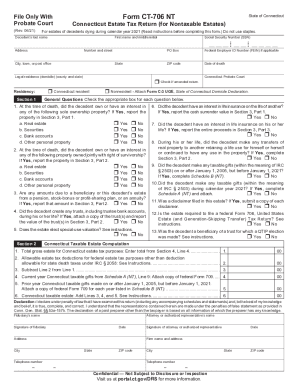
Reset FormPrint FormSave FormFile Only With Probate CourtForm CT706 NTState of Connecticut(Rev. 06/21)Connecticut Estate Tax Return (for Nontaxable Estates)For estates of decedents dying during calendar.
Open form follow the instructions
Easily sign the form with your finger
Send filled & signed form or save
How to fill out the CT DRS CT-706 NT online
The CT DRS CT-706 NT form is an essential document for reporting estate tax for nontaxable estates in Connecticut. This guide provides you with clear, step-by-step instructions on how to accurately complete the form online, ensuring compliance and aiding in the estate settlement process.
Follow the steps to successfully complete the CT-706 NT form online.
- Press the ‘Get Form’ button to access the CT DRS CT-706 NT form and begin filling it out in the designated online editor.
- Enter the decedent’s last name, first name, and middle initial in the appropriate fields. Include their full address, Social Security Number (SSN), and, if applicable, Federal Employer Identification Number (FEIN).
- Specify the date of death and the legal residence (domicile) of the decedent, including the county and state.
- Indicate whether this is an amended return by checking the appropriate box, if applicable.
- Choose the residency status of the decedent by selecting either the ‘Connecticut resident’ or ‘Nonresident’ option, and attach Form C-3, if needed.
- Answer the general questions by checking 'Yes' or 'No' for each question regarding the decedent's property and financial interests. Follow the instructions provided for each item.
- In Section 3, report the property and proceeds for Connecticut estate tax purposes, detailing solely-owned property, jointly-owned property, and life insurance proceeds.
- Complete Section 4 by calculating the total gross estate for Connecticut estate tax purposes, adding relevant lines from previous sections.
- If applicable, complete additional sections for residential and non-residential estates, detailing property located inside or outside Connecticut.
- Review all entries to ensure accuracy. Once completed, you can save your changes, download a copy, print the form, or share it as needed.
Complete your estate tax return online today to ensure a smooth and efficient process.
Experience a faster way to fill out and sign forms on the web. Access the most extensive library of templates available.
Related content
Name. Description. Revised Date. Due Date. CT-706/709, 2019 Connecticut Estate and Gift...
University of Connecticut Archives & Special Collections ...... Mixed Materials, 17: 706...
Jan 5, 2015 - accordance with the instructions, may cause harmful interference to radio...
Get answers to your most pressing questions about US Legal Forms API.
How much does probate cost in Connecticut?
Probate Fees Probate fees fall into four principal categories: Filing fees. For all matters other than decedents' estates and accountings, the petitioner pays a filing fee for each petition, application or motion. The current fee is $150 and will increase, for most matters, to $225 on January 1, 2016.
How long does probate take in Connecticut?
Connecticut has a simplified and expedited probate process for settling small decedent's estates. The entire process can be completed within 30 days, instead of six months or longer as is normally required for the regular probate process.
What is the inheritance tax threshold for 2019 20?
In the 2019/20 tax year, everyone is allowed to leave an estate valued at up to £325,000 plus the new 'main residence' band of £150,000 giving a total allowance of £475,000 per person. For estates worth less than this, beneficiaries won't pay inheritance tax.
What is the estate tax for 2019?
The Internal Revenue Service announced today the official estate and gift tax limits for 2019: The estate and gift tax exemption is $11.4 million per individual, up from $11.18 million in 2018.
What is the current estate tax?
New tax laws passed by Congress in 2017 are now in effect. Each individual person can leave behind $11.18 million before having his or her estate subject to Federal estate taxes, which are levied at a rate of 40% for amounts over the exemption.
What is the Colorado state income tax rate for 2019?
As of January 2019, state individual income taxes for flat tax states include: Colorado: 4.63 percent.
What is Indiana income tax rate for 2019?
Indiana Income Tax. Indiana has a flat state income tax rate of 3.23% for the 2018 tax year, which means that all Indiana residents pay the same percentage of their income in state tax.
What is the CT state income tax rate?
Please change your search criteria and try again. The state of Connecticut generates most of its revenue through an individual income tax and a statewide sales tax. Income tax rates range from 3% to 6.99%; that top rate ranks as slightly above the U.S. average.
What is CT state income tax rate 2019?
Connecticut Income Tax. Connecticut's personal income tax is a relatively recent development: Up until 1991, only capital gains, interest and dividends were taxed. Today, those income sources, as well as wages and salaries, are taxed at marginal rates between 3% and 6.99%.
What is the estate tax exemption in CT?
In 2017, the exemption in Connecticut was $2,000,000. Under the new law, the exemption increased to $2,600,000 in 2018 and then to $3,600,000 in 2019. In 2020 and beyond, the Connecticut exemption will match the federal estate and gift tax exemption.
Use professional pre-built templates to fill in and sign documents online faster. Get access to thousands of forms.
If you believe that this page should be taken down, please follow our DMCA take down process here.