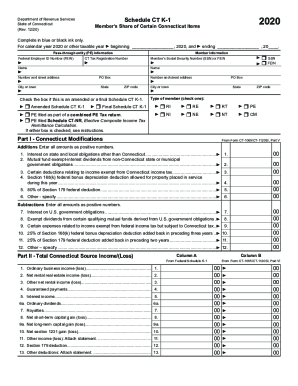
Department of Revenue Services State of Connecticut (Rev. 12/20)2020Schedule CT K1Members Share of Certain Connecticut ItemsComplete in blue or black ink only. For calendar year 2020 or other taxable.
Open form follow the instructions
Easily sign the form with your finger
Send filled & signed form or save
How to fill out the CT DRS Schedule CT K-1 online
This guide provides clear and supportive instructions for users looking to fill out the CT DRS Schedule CT K-1 online. By following each step, you can easily navigate the components of the form and ensure accurate completion.
Follow the steps to successfully complete the Schedule CT K-1.
- Click ‘Get Form’ button to obtain the form and open it in the editor.
- Begin by entering the calendar year for which you are filing in the designated fields, indicating the start and end dates.
- Fill out the member information section, including the member’s Social Security Number (SSN) or Federal Employer Identification Number (FEIN), while checking the appropriate box.
- Complete the pass-through entity (PE) information by entering the PE’s FEIN, CT Tax Registration Number, name, address, city, state, and ZIP code.
- Indicate if this is an amended or final Schedule CT K-1 by checking the appropriate box.
- In Part I, include any Connecticut modifications by entering amounts as needed. Ensure that all entries are made as positive numbers.
- Proceed to Part II to report total Connecticut source income or loss by transferring entries based on Form CT-1065 or Form CT-1120SI.
- Complete Part III to report Connecticut PE Tax Credit information; ensure accurate amounts are transferred from the appropriate tax documents.
- If applicable, complete Part IV for Elective Composite Income Tax payments for nonresident individuals.
- In Part V, summarize the Connecticut income tax credits earned by the member.
- Finally, review all sections for accuracy. Once complete, you can save changes, download, print, or share the form as needed.
Complete your documents online with confidence and accuracy today.
Experience a faster way to fill out and sign forms on the web. Access the most extensive library of templates available.
Related content
CT-1065/CT-1120SI, 2018 Connecticut Pass-Through Entity Tax Return, 11/2018 ... Schedule...
You must file a Connecticut resident income tax return if you were a resident of CT...
Get answers to your most pressing questions about US Legal Forms API.
How much is property tax on cars in CT?
Motor Vehicle Property Tax. Motor vehicles are subject to a local property tax under Connecticut state law, whether registered or not. Motor vehicles are assessed according to State statutes at 70% of the Clean Retail value through the use of the NADA Guides and other resources.
How is tax calculated on a car?
The excise due is calculated by multiplying the value of the vehicle by the motor vehicle tax rate. The tax rate is fixed at $25 per one thousand dollars of value. The value of a vehicle is determined as a percentage of the manufacturer's suggested retail price for that vehicle based on the year of manufacture.
How is CT car tax calculated?
Sales From Licensed Dealers - If the vehicle was purchased from a licensed dealer, the 6.35% (or 7.75% for vehicles over $50,000) sales and use tax is based on the purchase price. Full trade-in credit is allowed when computing the Connecticut Sales and Use tax, if the vehicle was purchased from a licensed dealer.
How is CT motor vehicle tax calculated?
Motor vehicle taxes are determined by taking 70 percent of the car's value also known as the assessed value and then multiplying that number by the tax rate, which is measured in mills. ... Because Salisbury's tax rate is just 10.2 mills but Hartford's is 74.29 mills.
Can you deduct vehicle property tax?
To deduct the value-based portion of your registration fee, you must itemize your deductions using federal Schedule A. Car fees go on the line for "personal property taxes." ... Nevertheless, if the fee is value-based and assessed on a yearly basis, the IRS considers it a deductible personal property tax.
Does CT allow itemized deductions?
Connecticut does not have any tax deductions. However, if you itemize your deductions on your 2017 federal income tax return, you can deduct Connecticut income taxes actually paid in 2017. ... According to Connecticut state income tax laws, capital gains are taxed at the same rate as the rest of your income.
Can I deduct car taxes in CT?
Is my local Motor Vehicle Tax in Connecticut deductible on my federal taxes? Yes. You can take a deduction on your federal tax return for the personal property tax that you paid in 2016 as long as you qualify to itemize your deductions.
What is CT property tax credit?
PROGRAM DESCRIPTION: State law provides a property tax credit program for Connecticut homeowners who are elderly or totally disabled, and whose incomes do not exceed certain limits. Property tax credit can be up to $1,250 for married couples and $1,000 for single people. Credits are based on a graduated income scale.
Is property tax deductible in CT?
Connecticut is one of several states, including New York, New Jersey, Maryland and California, that will be most affected by the new cap on the deductibility of state and property taxes residents pay. The new federal tax law, called the Tax Cuts and Jobs Act capped those deductions at $10,000.
Are vehicle registration fees tax deductible in 2018?
To deduct the value-based portion of your registration fee, you must itemize your deductions using federal Schedule A. Car fees go on the line for "personal property taxes." ... Nevertheless, if the fee is value-based and assessed on a yearly basis, the IRS considers it a deductible personal property tax.
Use professional pre-built templates to fill in and sign documents online faster. Get access to thousands of forms.
If you believe that this page should be taken down, please follow our DMCA take down process here.
This form is available in several versions. Select the version you need from the drop-down list below.