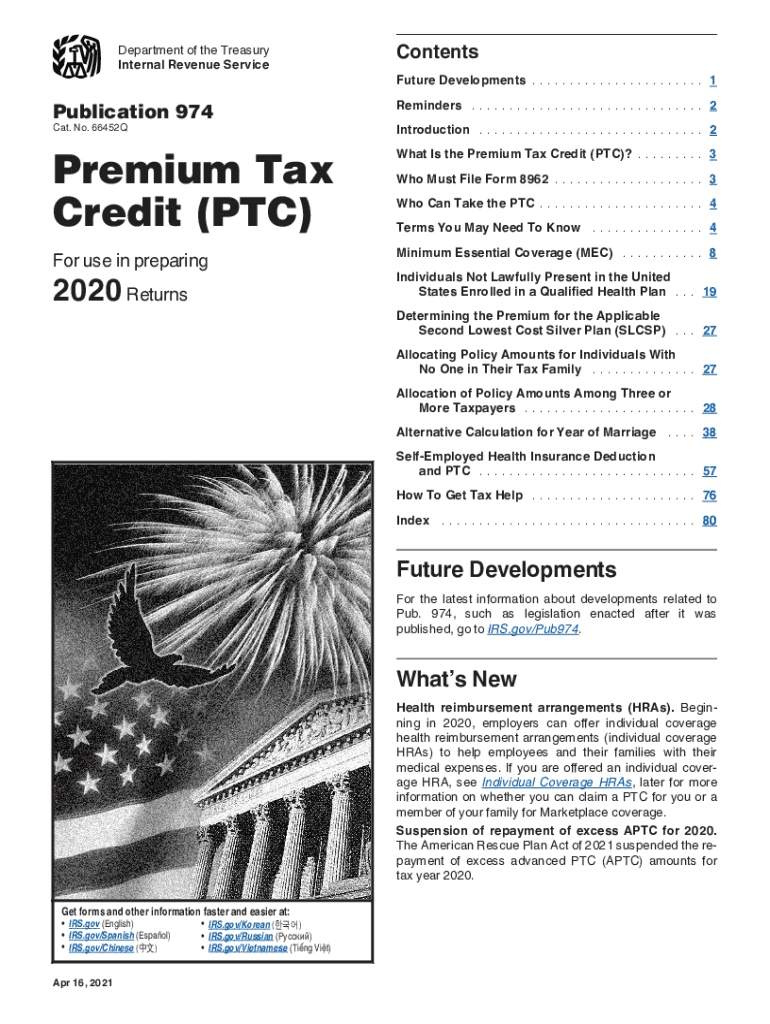
Department of the Treasury Internal Revenue Service Publication 974 Contents Future Developments . . . . . . . . . . . . . . . . . . . . . . . 1 Reminders . . . . . . . . . . . . . . . . . . . . .
Loading

Open form follow the instructions

Easily sign the form with your finger

Send filled & signed form or save
How to fill out the IRS Publication 974 online
This guide provides clear and supportive instructions for filling out the IRS Publication 974, focusing on the Premium Tax Credit (PTC) and its details. It aims to assist users at all experience levels in navigating the form online with confidence.
Follow the steps to complete IRS Publication 974 effectively.
- Click the ‘Get Form’ button to obtain the IRS Publication 974 online and access the form in an editable format.
- Begin by filling out your personal information, including your name, social security number, and tax filing status, as this is essential for determining eligibility.
- Locate the section on the Premium Tax Credit (PTC) and read the definitions provided to fully understand your eligibility. Fill out the necessary details regarding your coverage family.
- Complete the monthly premium calculations by inputting the enrollment premiums and the amount of Advanced Payment of Premium Tax Credit (APTC) received.
- Answer all relevant questions about changes in circumstances, potential eligibility for the PTC, and whether you need to allocate policy amounts if your tax situation involves multiple taxpayers.
- Finish the form by adding up all calculated amounts, ensuring accuracy in your entries. Review the document for any additional notes or disclaimers related to unique filing situations.
Complete your IRS Publication 974 online today and ensure your tax matters are handled efficiently.
Experience a faster way to fill out and sign forms on the web. Access the most extensive library of templates available.
Related content
Jan 8, 2020 · 2019. TAX YEAR. Department of the Treasury Internal Revenue Service...
Get answers to your most pressing questions about US Legal Forms API.
How can I avoid paying back my premium tax credit?
The easiest way to avoid having to repay a credit is to update the marketplace when you have any life changes. Life changes influence your estimated household income, your family size, and your credit amount. So, the sooner you can update the marketplace, the better. This ensures you receive the correct amount.
Do I have to pay back the advance premium tax credit?
Advance Premium Tax Credit (APTC) If at the end of the year you've taken more premium tax credit in advance than you're due based on your final income, you'll have to pay back the excess when you file your federal tax return. If you've taken less than you qualify for, you'll get the difference back.
What are the income guidelines for Marketplace insurance?
What is the Federal poverty level? The Federal poverty level varies by family size. For Marketplace coverage in 2020, the poverty level used is $12,490 for a single adult and $25,750 for a family of 4.
How can I avoid paying back Obamacare?
You can avoid having to repay your ACA subsidies by letting your health exchange know about any changes in your income or family composition during the year. This way, your subsidies can be adjusted during the year to reflect your actual income.
How does a premium tax credit work?
The size of your premium tax credit is based on a sliding scale. Those who have a lower income get a larger credit to help cover the cost of their insurance. ... The credit is refundable because, if the amount of the credit is more than the amount of your tax liability, you will receive the difference as a refund.
What happens if I don't use my premium tax credit?
If you use more advance payments of the tax credit than you qualify for based on your final yearly income, you must repay the difference when you file your federal income tax return. If you use less premium tax credit than you qualify for, you'll get the difference as a refundable credit when you file your taxes.
What are the income limits for premium tax credit?
To be eligible for the premium tax credit, your household income must be at least 100 but no more than 400 percent of the federal poverty line for your family size, although there are two exceptions for individuals with household income below 100 percent of the applicable federal poverty line.
What is the maximum income to qualify for affordable care act?
(For 2020 coverage, that upper income cap is $49,960 for a single person and $103,000 for a family of four.) But as premiums have grown, there are some areas of the country where coverage can easily exceed 25 percent of household income for a family just a little above 400 percent of the poverty level.
What is a specified premium?
Specified premiums are the premiums for a specified qualified health plan or plans for which you may otherwise claim as a self-employed health insurance deduction on line 29 of Schedule 1 (Form 1040) or Form 1040NR. Generally, these are the premiums paid for the months you were self-employed.
Use professional pre-built templates to fill in and sign documents online faster. Get access to thousands of forms.
If you believe that this page should be taken down, please follow our DMCA take down process here.