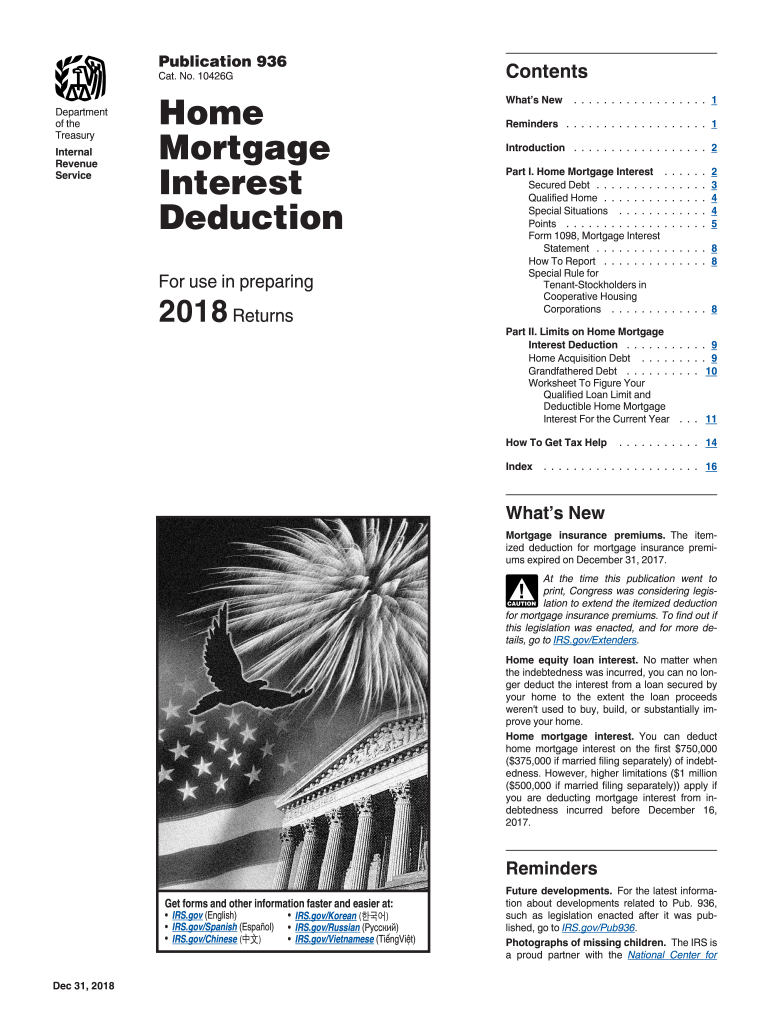
Turn. Part II explains how your deduction for home mortgage interest may be limited. It contains Table 1, which is a worksheet you can use to figure the limit on your deduction. Comments and suggestions. We welcome your comments about this publication and your suggestions for future editions. You can send us comments through IRS.gov/FormComments. Or you can write to: Internal Revenue Service Tax Forms and Publications 1111 Constitution Ave. NW, IR-6526 Washington, DC 20224 Although we can t re.
Loading

Open form follow the instructions

Easily sign the form with your finger

Send filled & signed form or save
How to fill out the IRS Publication 936 online
This guide provides comprehensive, step-by-step instructions on filling out the IRS Publication 936 online, focusing on home mortgage interest deduction rules. Whether you have previous experience or are new to tax filing, this user-friendly guide supports your understanding of the necessary sections and fields.
Follow the steps to fill out IRS Publication 936 online.
- Click ‘Get Form’ button to obtain the form and open it in your editor.
- Carefully review the introduction section, which outlines the purpose and key updates regarding home mortgage interest deductions.
- Move to Part I, which discusses the general rules for deducting home mortgage interest. Ensure you meet the conditions listed.
- Proceed to the category section where you must identify and disclose the category of your mortgage — grandfathered debt or home acquisition debt.
- If applicable, utilize the worksheet provided in Part II to figure your qualified loan limit and deductible home mortgage interest for the current year.
- Make sure to report any points paid on the mortgage, and check the instructions for their deductibility based on the payment year.
- After ensuring all fields are accurately filled out, you can save your changes, download the document, print it, or share it as needed.
Complete your filing of IRS Publication 936 online to secure your home mortgage interest deductions efficiently.
Experience a faster way to fill out and sign forms on the web. Access the most extensive library of templates available.
Related content
Dec 5, 2011 — Amounts over the $1,000,000 limit ($500,000 if married filing separately)...
Jan 31, 2018 — Publication 936 discusses rules for deducting home mortgage interest...
Get answers to your most pressing questions about US Legal Forms API.
How to fill out an Employee Withholding Exemption Certificate?
Filling out an Employee Withholding Exemption Certificate requires you to provide specific personal information and claim any exemptions applicable. Ensure you understand your withholding needs to make informed decisions while filling out the certificate. For additional support and templates, platforms like US Legal Forms can offer user-friendly resources.
What is the IRS Code 936?
IRS Code 936 pertains to the rules and regulations regarding qualified home mortgage interest. It specifies the criteria for what qualifies as deductible interest and any limitations involved. To fully grasp how IRS Code 936 affects your taxes, refer to IRS Publication 936, which offers detailed insights and examples.
What is IRS publication 936?
IRS Publication 936 is a document that provides guidance on home mortgage interest deductions. It helps taxpayers understand how to calculate and claim mortgage interest on their tax returns. This publication is your go-to resource for navigating home-related tax obligations. If you're looking for detailed information, explore IRS Publication 936 for further assistance.
What are the IRS reject codes?
IRS reject codes are error codes received when tax returns do not meet specific requirements. These codes help identify the issues that led to a rejection, allowing you to correct them and resubmit your return. Understanding these codes is essential for ensuring successful tax filing. For further guidance, consult resources including IRS Publication 936 or platforms like US Legal Forms.
What is the 936 tax code?
The 936 tax code refers to the Internal Revenue Code section that deals with the mortgage interest deduction for qualified home mortgages. This section outlines the eligibility criteria and limitations for taxpayers. Understanding this tax code is crucial for effectively navigating your tax obligations. IRS Publication 936 provides comprehensive information on how this tax code applies to you.
What is the IRS primary residence exemption?
The IRS primary residence exemption allows homeowners to exclude a portion of their capital gains from taxable income when selling their primary residence. To qualify, you must have owned and lived in the home for at least two of the last five years. This provision is vital in minimizing tax liabilities. For more insights, refer to IRS Publication 936, which details home mortgage interest deductions.
What is the IRS home improvement deduction?
The IRS does not have a specific home improvement deduction, but certain home improvements can increase your home's basis, potentially affecting capital gains tax upon sale. Additionally, some improvements may qualify for energy efficiency tax credits. It's important to consult IRS guidelines or IRS Publication 936 to understand the tax advantages of home improvements.
What is IRS Publication 946?
IRS Publication 946 focuses on how to depreciate property, which is important for business owners and investors. While it is different from IRS Publication 936, it provides critical insights into the tax implications of property ownership. Homeowners in need of depreciation information should reference this publication for comprehensive guidelines.
What is Section 936 of the IRS?
Section 936 refers to a different aspect of IRS regulations, often confused with IRS Publication 936. It pertains to the tax treatment of certain activities and does not relate to mortgage interest deduction guidelines. Instead, focus on IRS Publication 936 for detailed information regarding mortgage interest deductions. If you have further questions about Section 936, a tax professional can clarify its implications for your situation.
Can one person claim all mortgage interest?
Typically, joint homeowners can claim the mortgage interest deduction on their tax returns, but specific rules apply. As described in IRS Publication 936, only the owner responsible for the mortgage can claim the interest. It's important to clarify ownership and responsibility when preparing to file your taxes. Utilize US Legal Forms for documents that clearly outline ownership agreements.
Use professional pre-built templates to fill in and sign documents online faster. Get access to thousands of forms.
If you believe that this page should be taken down, please follow our DMCA take down process here.
This form is available in several versions. Select the version you need from the drop-down list below.