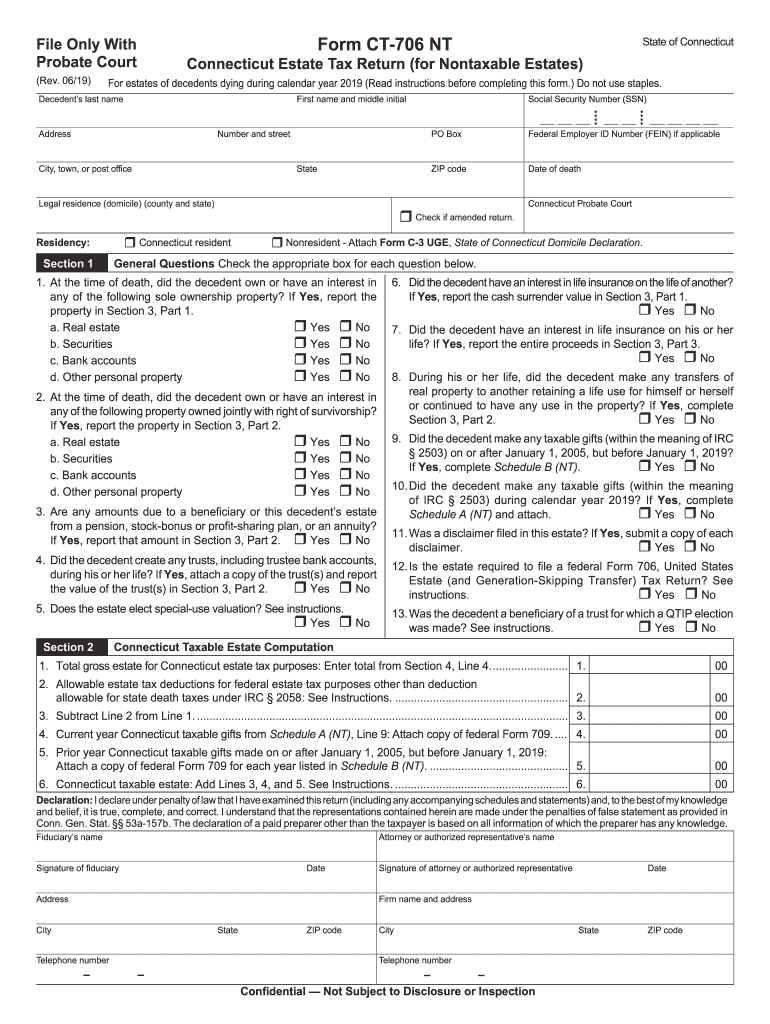
Y of each disclaimer. Yes No 12. Is the estate required to file a federal Form 706, United States Estate (and Generation-Skipping Transfer) Tax Return? See instructions. Yes No 13. Was the decedent a beneficiary of a trust for which a QTIP election was made? See instructions. Yes No Connecticut Taxable Estate Computation 1. Total gross estate for Connecticut estate tax purposes: Enter total from Section 4, Line 4.......................... 1. 00 2. Allowable e.
Loading

Open form follow the instructions

Easily sign the form with your finger

Send filled & signed form or save
How to fill out the CT DRS CT-706 NT online
The CT DRS CT-706 NT is a form used for the Connecticut estate tax return specifically for nontaxable estates of decedents who passed away during 2019. This guide will provide you with a clear, step-by-step approach to completing the form online, ensuring all required information is accurately reported.
Follow the steps to fill out the CT DRS CT-706 NT online.
- Click ‘Get Form’ button to obtain the CT DRS CT-706 NT and access it in an editable format.
- Begin by entering the decedent's last name, first name, and middle initial in the designated fields.
- Provide the full address, including street number, city, state, and ZIP code of the decedent.
- Input the social security number (SSN) and, if applicable, the federal employer ID number (FEIN) of the decedent.
- Document the date of death and the legal residence, specifying both the county and state.
- If this is an amended return, check the designated box.
- Indicate the residency status by choosing either 'Connecticut resident' or 'Nonresident' and ensure to attach Form C-3 UGE if applicable.
- Answer the general questions by checking 'Yes' or 'No' for each applicable item, reporting any properties or interests owned by the decedent.
- Proceed to Section 3 to report various properties owned, separating them into solely-owned, jointly-owned, and life insurance proceeds.
- Complete Sections 4, 5, and 6 by calculating the total gross estate and actual values passing to the spouse.
- Sign and date the declaration section, ensuring that the fiduciary or authorized representative has appropriately filled in their information.
- Once all fields are populated accurately, you can save your changes, download, print, or share the completed form as needed.
Complete your estate tax documents online to ensure timely and accurate filing.
Experience a faster way to fill out and sign forms on the web. Access the most extensive library of templates available.
Related content
Form CT-706 NT (Rev. 06/22). Page 2 of 5. Part 1 - Solely-Owned Property. A. Item. No. B...
2021 Form CT-706 NT Instructions: Connecticut Estate Tax Return (for Nontaxable Estates)...
Major software offered includes: DRS,a data base management system with ... a catalog...
Get answers to your most pressing questions about US Legal Forms API.
How to file an estate tax return in CT?
To file an estate tax return in Connecticut, obtain and complete the CT 706 form, ensuring all estate assets are properly reported. After preparing the form, submit it to the Connecticut Department of Revenue Services along with any required documentation. Utilize the CT DRS CT-706 NT effectively to guide you through the filing process smoothly.
Where to file CT 706 NT?
The CT 706 NT should be filed with the Connecticut Department of Revenue Services. It is important to send your completed form to the correct address as specified on the form’s instructions. Relying on resources like the CT DRS CT-706 NT ensures you have the latest filing details and requirements.
Can I file my CT tax return online?
Yes, Connecticut residents can file their tax returns online through the Department of Revenue Services (DRS) website. Filing online offers convenience and efficiency, making it easier to submit your information securely. The CT DRS CT-706 NT has options for electronic submission, which streamline the process.
Does Connecticut require an inheritance tax waiver?
Connecticut does not implement an inheritance tax, but it does require compliance with estate tax regulations. Obtaining a tax waiver can help facilitate estate transfer and distribution. By understanding the CT DRS CT-706 NT, you can ensure that all necessary waivers and filings are correctly handled.
Who needs to file form 706?
Form 706 must be filed by estate executors if the estates fall above a specific value set by federal law. This includes both gross estate values and adjusted taxable gifts made during the deceased's lifetime. Using the CT DRS CT-706 NT can assist in properly filling out this essential tax document.
Who is subject to Connecticut estate tax?
Individuals with estates that exceed the established Connecticut estate tax exemption amount must file for estate tax. This applies regardless of the residency status of the deceased. Familiarizing yourself with the CT DRS CT-706 NT will help you navigate these requirements effectively.
Who must file CT 706?
The CT 706 form is required for estates valued at over a specified threshold as determined by the Connecticut estate tax law. Executors or administrators of estates must complete this form to report the estate’s assets. If you are involved in estate management, understanding the CT DRS CT-706 NT is essential for proper filing and compliance.
Who must file a Connecticut income tax return?
In Connecticut, individuals must file a state income tax return if they earn more than a certain amount in gross income. This includes both residents and part-time residents, along with certain non-residents. For your convenience, utilizing the CT DRS CT-706 NT can streamline this process and ensure compliance.
Who must file a CT estate tax return?
Any estate valued over $12.92 million must file a CT estate tax return in Connecticut. Executors or administrators of estates in this category have the responsibility to file the appropriate forms. It's crucial to be proactive about compliance to prevent potential complications. Using CT DRS CT-706 NT can help guide you through the filing process efficiently.
What is CT gift tax?
CT gift tax applies to the transfer of property or assets where the donor does not receive equivalent value in return. In Connecticut, certain gifts may be subject to state gift tax. It's important to be aware of the annual exclusion amounts and how they pertain to filing requirements. For those navigating these complexities, uslegalforms offers valuable resources and forms to simplify the process.
Use professional pre-built templates to fill in and sign documents online faster. Get access to thousands of forms.
If you believe that this page should be taken down, please follow our DMCA take down process here.
This form is available in several versions. Select the version you need from the drop-down list below.