------------- Enfield; Somers; Stafford; Union PD-12 Ellington ------------------------------------------ Ellington; Vernon PD-13 Greater Manchester -------------------------- Andover; Bolton; Columbia; Manchester PD-14 Region #14 - ------------------------------------- East Haddam; East Hampton; Marlborough; Portland PD-15 Middletown -------------------------------------- Cromwell; Durham; Middlefield; Middletown PD-16 Meriden ------------------------------------------- Merid.

Open form follow the instructions

Easily sign the form with your finger

Send filled & signed form or save
How to fill out the CT DRS CT-706 NT EXT online
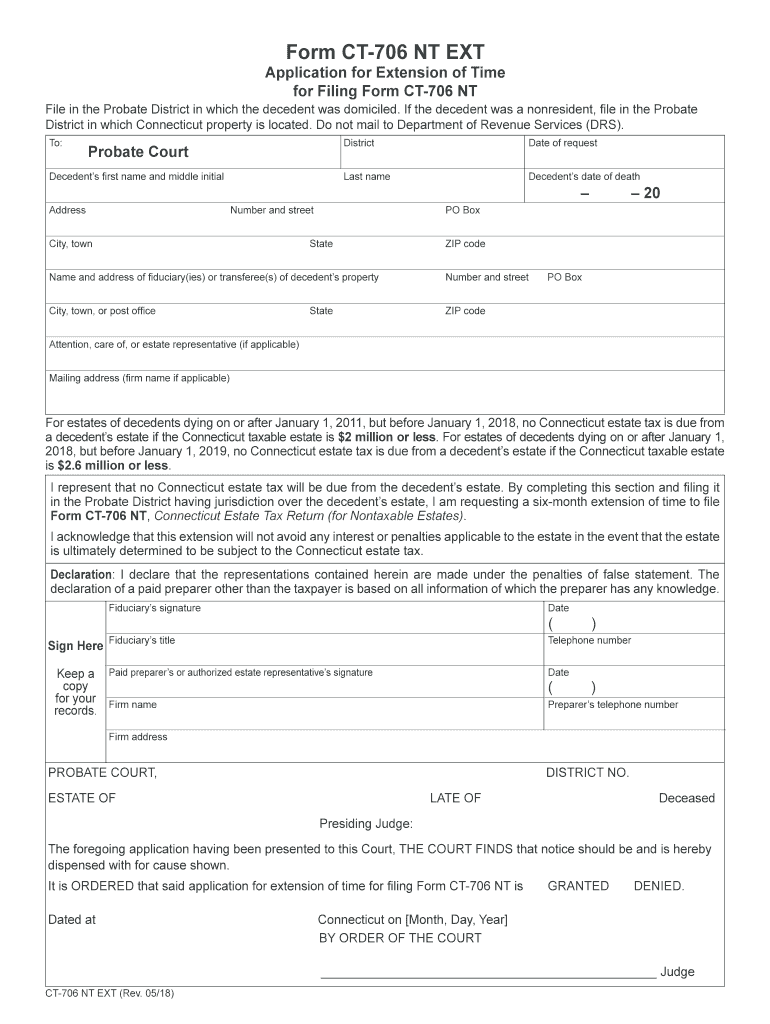
Completing the CT DRS CT-706 NT EXT is an essential step for individuals requesting an extension to file the Connecticut Estate Tax Return for nontaxable estates. This guide aims to provide clear instructions for successfully filling out this form online, ensuring you understand each section and its requirements.
Follow the steps to complete your form accurately
- Click ‘Get Form’ button to obtain the form and open it in the editor.
- Identify the appropriate Probate District where the decedent was domiciled or where Connecticut property is located. Enter this information in the relevant section.
- Fill in the decedent's first name, middle initial, and last name along with their address, including the number and street, city or town, state, and ZIP code.
- Provide the decedent’s date of death, which is crucial for processing the extension request.
- Input the name and address of the fiduciary or transferee managing the decedent's property. Ensure to include a care of or estate representative if applicable.
- Declare that no Connecticut estate tax will be due from the decedent’s estate by filling out the specified declaration. Acknowledge that this form is a request for a six-month extension for filing the CT-706 NT.
- Sign the form where indicated. If applicable, also ensure the paid preparer or authorized estate representative provides their signature and details.
- Review all filled sections for accuracy before submitting. Remember to keep a copy for your records.
- Submit the completed form to the Probate Court before the original due date of Form CT-706 NT.
- If granted, the Probate Court will return the form with their decision. Ensure to check the returned form for confirmation.
Complete your document online today to ensure timely submission!
Experience a faster way to fill out and sign forms on the web. Access the most extensive library of templates available.
Related content
Form CT-706 NT EXT, Application for Extension of Time for Filing Form CT-706 NT, must be...
2021 Form CT-706 NT Instructions: Connecticut Estate Tax Return (for Nontaxable Estates)...
KEY PART NUMBER. U/M DESCRIPTION. 135420-09-000. EA RADIO-AM/FM/CASS/CD COMBO-AUX/CD...
Get answers to your most pressing questions about US Legal Forms API.
How do I file a CT extension?
To file a CT extension, complete the CT DRS CT-706 NT EXT form either online or by paper. Make sure to provide all the necessary details, including your payment if applicable. Submitting this form will grant you additional time to complete your tax return. Utilize platforms like uslegalforms to simplify the filing process.
Does Connecticut have automatic extension?
Yes, Connecticut provides an automatic extension if you file the CT DRS CT-706 NT EXT form. However, this extension only applies to filing deadlines, not payment deadlines. Therefore, it’s important to make any necessary tax payments on time. Keep track of both deadlines to maintain compliance with state tax laws.
What is the process for filing an extension?
Filing an extension in Connecticut begins with completing the CT DRS CT-706 NT EXT form. This form can be mailed to the Connecticut Department of Revenue Services or submitted online. It is important to file your extension before the original due date of your tax return to avoid penalties. Ensure that any required payments accompany your extension request.
Who must file CT-706?
You must file the CT-706 if the deceased’s estate exceeds Connecticut’s estate tax exemption limit. This requirement applies regardless of whether the estate is settled in probate or not. Filing the CT DRS CT-706 NT EXT can ensure your estate meets all state obligations. It's essential to consult with a tax professional for specific situations.
How to file an estate tax return in CT?
To file an estate tax return in Connecticut, you need to complete the CT-706 form. This form is vital for reporting any taxable estate over the threshold amount set by the state. Accurate completion of the CT DRS CT-706 NT EXT is crucial to avoid penalties. Consider using an online platform like uslegalforms to streamline this process.
Has CT extended tax deadline?
Connecticut does offer extensions for tax deadlines, which may apply under specific circumstances. If you file a CT DRS CT-706 NT EXT, you may receive an automatic extension. However, it's essential to check the current year’s regulations as they can change. Always verify the latest deadlines to ensure compliance.
Can I file my CT tax return online?
Yes, you can file your Connecticut tax return online. The Connecticut Department of Revenue Services provides an online portal to facilitate this process. This makes it easier to submit your CT DRS CT-706 NT EXT and other forms without using paper. Online filing is often faster and more efficient.
Where to mail a Connecticut extension payment?
You should mail your Connecticut extension payment to the address specified on the CT DRS CT-706 NT EXT form. Make sure to send it to the appropriate department to avoid delays. Include all required information, such as your Social Security number and any associated forms. This ensures your payment is processed correctly.
How much can you inherit in CT without paying taxes?
In Connecticut, one can inherit up to a certain threshold without incurring estate tax, which often changes. As of now, estates exceeding this threshold are subject to taxation. To stay current with tax laws and manage your inheritance effectively, consider exploring uslegalforms for guidance in completing relevant forms like the CT DRS CT-706 NT EXT.
What is the difference between a 706 and 709 return?
A 706 return focuses on reporting estate taxes post-death, while a 709 return addresses gift taxes during a person's lifetime. Each serves distinct purposes in tax reporting, and understanding these differences can help taxpayers navigate their obligations efficiently. Using tools like uslegalforms can simplify these processes as you assess your tax responsibilities.
Use professional pre-built templates to fill in and sign documents online faster. Get access to thousands of forms.
If you believe that this page should be taken down, please follow our DMCA take down process here.
This form is available in several versions. Select the version you need from the drop-down list below.