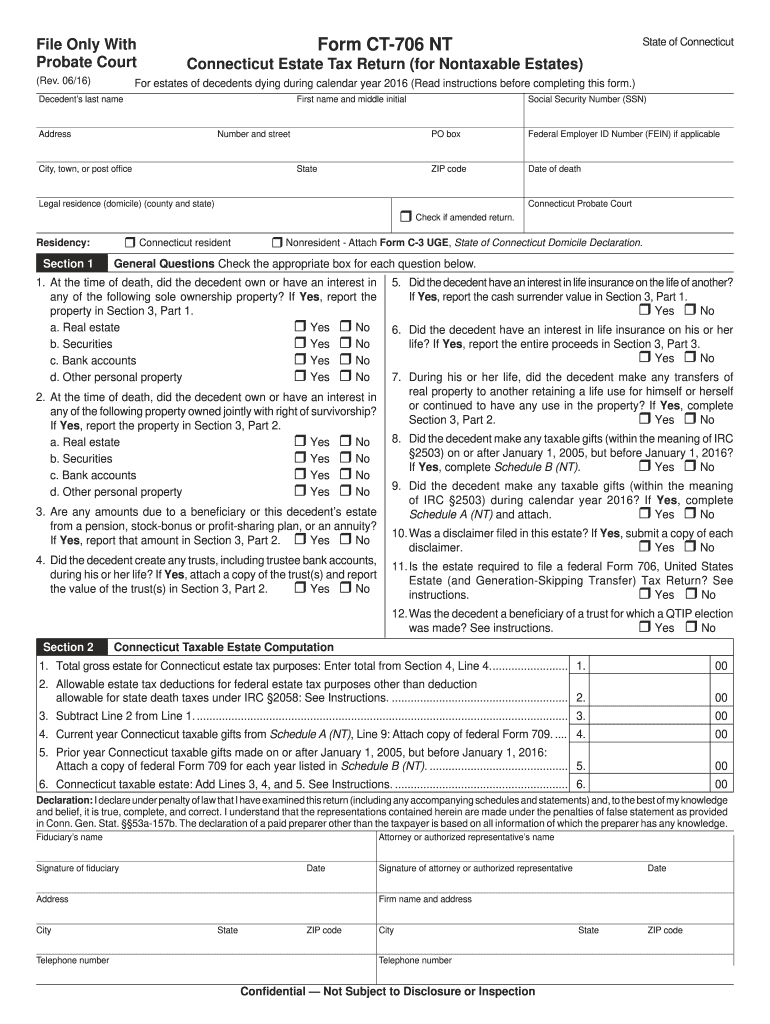
1. Total gross estate for Connecticut estate tax purposes: Enter total from Section 4, Line 4. ........................ 1. 00 2. Allowable estate tax deductions for federal estate tax purposes other than deduction allowable for state death taxes under IRC 2058: See Instructions. ........................................................ 2. 00 3. Subtract Line 2 from Line 1. .
Loading

Open form follow the instructions

Easily sign the form with your finger

Send filled & signed form or save
How to fill out the CT DRS CT-706 NT online
Filling out the CT DRS CT-706 NT form is an essential step in managing estate taxes for nontaxable estates in Connecticut. This guide will provide you with clear, step-by-step instructions to help you complete the form accurately and efficiently.
Follow the steps to complete your form effectively.
- Press the ‘Get Form’ button to acquire the form and open it in your selected editor.
- Begin by entering the decedent’s last name, first name, middle initial, and residential address. Include details such as the postal box, state of legal residence, county, and the date of death.
- Indicate whether this is an amended return by checking the appropriate box as needed. Also, select if the decedent was a Connecticut resident.
- Complete the general questions in Section 1 by checking 'Yes' or 'No' for each item related to properties owned by the decedent at the time of death. This includes real estate, securities, bank accounts, and other personal properties.
- Proceed to Section 2 to calculate the Connecticut taxable estate. Enter the total gross estate, allowable estate tax deductions, and the final taxable estate amount.
- Fill out Section 3, where you will report all property and proceeds for Connecticut estate tax purposes. Provide full descriptions, fair market values, and ownership percentages for all property owned by the decedent.
- Continue to Section 4 to summarize the total gross estate as it will be valued for Connecticut estate tax purposes by adding the amounts from previous sections.
- If applicable, complete Section 5 (for resident estates) or Section 6 (for nonresident estates) as guided, ensuring to report real and tangible personal property located in or outside Connecticut.
- Complete any schedules as necessary, like Schedule A for current year taxable gifts or Schedule B for gifts from prior periods, ensuring alignment with federal gift tax rules.
- Finally, review all sections for accuracy. Once complete, save your changes, and choose to download, print, or share the finalized form.
Begin your online submission for the CT DRS CT-706 NT form today to ensure timely compliance.
Experience a faster way to fill out and sign forms on the web. Access the most extensive library of templates available.
Related content
Form CT-706 NT (Rev. 06/22). Page 2 of 5. Part 1 - Solely-Owned Property. A. Item. No. B...
2021 Form CT-706 NT Instructions: Connecticut Estate Tax Return (for Nontaxable Estates)...
KEY PART NUMBER. U/M DESCRIPTION. 135420-09-000. EA RADIO-AM/FM/CASS/CD COMBO-AUX/CD...
Get answers to your most pressing questions about US Legal Forms API.
Who must file CT-706?
Any executor or administrator of an estate that exceeds the filing threshold must file the CT-706 with the Connecticut Department of Revenue Services (CT DRS). This includes estates of residents and non-residents if they have taxable property in Connecticut. It is important to determine if the estate meets the criteria set by CT DRS to avoid penalties. For additional resources or filing assistance, consider using platforms optimized for legal forms, like uslegalforms.
What is CT-706 NT?
The CT-706 NT is the Connecticut estate tax return for non-resident decedents. This form must be filed by estates of individuals who were not residents of Connecticut but owned taxable property in the state. By completing the CT-706 NT accurately, you ensure compliance with the estate tax laws in Connecticut. For detailed guidelines and filing help, check resources provided by the CT DRS or platforms like uslegalforms.
Where do I send CT tax return?
You should send your CT tax return to the Connecticut Department of Revenue Services (CT DRS) using the address specified for your form type. Each form might have a unique submission address, so it is critical to verify this information on the CT DRS website. Ensuring that you send your return to the correct location helps facilitate prompt processing by the CT DRS. Always double-check the mailing address based on the latest updates.
Can I file my CT tax return online?
Yes, you can file your CT tax return online, which offers a convenient option for many taxpayers. The Connecticut Department of Revenue Services (CT DRS) provides an online filing system that allows you to submit your return quickly and securely. Additionally, utilizing online resources can help you track your submission status and payment options. Consider using uslegalforms for easy navigation through the online filing process.
Where to file CT-706 NT?
The CT-706 NT must be filed with the Connecticut Department of Revenue Services (CT DRS) at the designated address specified for estate tax returns. Submitting this form ensures that you meet your obligations regarding the estate tax in Connecticut. Refer to the CT DRS website for the most current filing address and other important instructions. A timely and correct submission can prevent any potential penalties.
Where do I file my CT 706?
You need to file your CT 706 with the Connecticut Department of Revenue Services (CT DRS). It is essential to submit this return to the right address to ensure proper processing. Generally, you can find all submission guidelines and exact locations on the CT DRS website. Proper filing helps you stay compliant with Connecticut state tax regulations.
Where do I file my CT amended return?
To file your CT amended return, you should send it to the Connecticut Department of Revenue Services (CT DRS). Ensure you use the correct form, which is the CT-1040X, and include any required documentation. Mailing your amended return to the appropriate address helps avoid any delays in processing. You can find all required details and instructions on the CT DRS website.
How to avoid estate tax in Connecticut?
To minimize estate tax in Connecticut, consider strategic estate planning. This may include making gifts during your lifetime or establishing trusts. Consulting with a tax professional or using platforms like USLegalForms can help you navigate the complexities associated with estate tax and properly file your CT DRS CT-706 NT.
Is CT tax registration number the same as EIN?
A CT tax registration number is not the same as an Employer Identification Number (EIN). While the CT registration number is specific to Connecticut for state tax purposes, the EIN is used by the IRS for federal tax identification. Both are essential depending on the jurisdiction and the type of filings you are performing.
Is a tax registration number the same as a tax ID number?
Yes, a tax registration number is often referred to as a tax ID number in Connecticut. Both terms refer to the unique identifier assigned to a business for tax purposes. This number is crucial when filing tax forms, including the CT DRS CT-706 NT.
Use professional pre-built templates to fill in and sign documents online faster. Get access to thousands of forms.
If you believe that this page should be taken down, please follow our DMCA take down process here.
This form is available in several versions. Select the version you need from the drop-down list below.