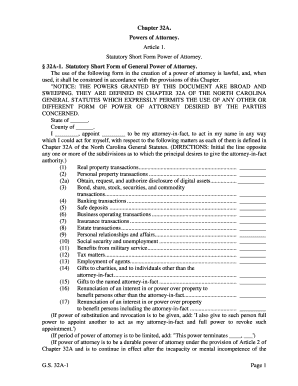
He use of the following form in the creation of a power of attorney is lawful, and, when used, it shall be construed in accordance with the provisions of this Chapter. "NOTICE: THE POWERS GRANTED BY THIS DOCUMENT ARE BROAD AND SWEEPING. THEY ARE DEFINED IN CHAPTER 32A OF THE NORTH CAROLINA GENERAL STATUTES WHICH EXPRESSLY PERMITS THE USE OF ANY OTHER OR DIFFERENT FORM OF POWER OF ATTORNEY DESIRED BY THE PARTIES CONCERNED. State of . County of . I , appoint to be my a.

How it works
  • Open form

    Open form follow the instructions

  • Easily sign form

    Easily sign the form with your finger

  • Share form

    Send filled & signed form or save

How to fill out the NC G.S. 32A-1 online

The NC G.S. 32A-1 form is a statutory short form of general power of attorney in North Carolina. This guide provides clear instructions for filling out the form online, ensuring that users can effectively grant authority to their appointed attorney-in-fact.

Follow the steps to complete the NC G.S. 32A-1 form online.

  1. Click the ‘Get Form’ button to obtain the form and access it in your preferred editing platform.
  2. Begin by entering the 'State' and 'County' in the designated fields at the top of the form.
  3. In the first blank space, enter your name as the principal appointing the attorney-in-fact.
  4. In the second blank space, enter the name of the person you are appointing as your attorney-in-fact.
  5. Review the list of powers granted to your attorney-in-fact. Initial the line next to any powers you wish to grant, which can include transactions related to real and personal property, banking, and more.
  6. If you want to allow the attorney-in-fact to appoint another attorney-in-fact or revoke their authority, include the specified statement in your document.
  7. If the power of attorney should be limited to a specific timeframe, indicate the termination date in the appropriate section.
  8. To make the power of attorney durable, add the specified statement which ensures it remains effective even if you become incapacitated.
  9. Finish by signing the document in the provided space and dating it accordingly.
  10. Have your signature notarized by a notary public, ensuring all necessary fields are completed and the official seal is included.
  11. Once you have completed all required sections, save your changes, and download or print the form for your records.

Complete your NC G.S. 32A-1 form online today for a straightforward way to establish a power of attorney.

Get form

Experience a faster way to fill out and sign forms on the web. Access the most extensive library of templates available.

Related content

G.S. 32A-1

Chapter 32A. Powers of Attorney. Article 1. Statutory Short Form Power of Attorney. §§...

Learn more
Judicial Relief under the New GS Chapter 32A, the...

Sep 1, 2017 — This new law goes into effect on January 1, 2018 and applies to powers of...

Learn more
Series VNA - content.smcetech.com - /

When the power to the pilot solenoid valve is turned off (or when fluid is exhausted from...

Learn more
Questions & Answers

Get answers to your most pressing questions about US Legal Forms API.

Contact support

What is GS 1a 1 Rule 5 NC?

GS 1A-1 Rule 5 in North Carolina addresses the requirements for service of process. This rule ensures that the opposing party receives proper notification of legal actions against them, which is essential for due process. Understanding this rule is crucial for anyone involved in a legal dispute to ensure fair proceedings. For assistance with legal forms and process serving, check out uslegalforms as a supportive tool.

In North Carolina, typically only the principal, who granted the power of attorney, can revoke or override it while they are still competent. If the principal becomes incapacitated, a court may appoint a guardian to manage their affairs, potentially overriding the authority given to the attorney-in-fact, depending on the circumstances. Understanding the specificities of NC G.S. 32A-1 can provide clarity in these situations. For thorough insight, consider consulting uslegalforms.

The GS for breaking and entering in North Carolina is found under NC G.S. 14-54. This law specifies what constitutes breaking and entering, as well as the legal definitions associated with the crime. Familiarizing yourself with this statute is essential for understanding the legal implications if you or someone else faces such charges. Leverage resources like uslegalforms for guidance and necessary forms.

GS 14-17 in North Carolina describes the laws regarding murder and manslaughter. This statute outlines the definitions and classifications of these serious offenses. Understanding this code can be crucial for anyone implicated in a related case. For those seeking legal information or assistance, consider using uslegalforms as a reliable resource.

In North Carolina, the minimum sentence for breaking and entering can vary based on the circumstances of the crime and the defendant's prior record. Generally, this offense carries significant penalties under NC G.S. 14-54. Understanding the specific statutes can provide clarity on your rights and potential legal outcomes. Consulting a knowledgeable platform like uslegalforms may help you navigate these laws effectively.

To obtain power of attorney in NC for a parent with dementia, you first need to ensure that your parent is still capable of understanding the implications of granting this authority. According to NC G.S. 32A-1, a valid power of attorney requires the principal to be competent at the time of signing. It often helps to consult with an attorney or a service like uslegalforms to draft proper documentation tailored to your needs.

The NC G.S. 15-12 relates to the legal framework for appealing in criminal cases in North Carolina. This statute outlines the procedures for defendants to seek a review of their case after a conviction. Understanding this law can significantly impact your rights and options post-conviction. If you find yourself navigating the legal system, resources like uslegalforms can help clarify these processes.

A legal power of attorney in North Carolina cannot make decisions regarding divorce, vote in elections, or create or revoke a will on behalf of the principal. It is crucial to understand these limitations when designating a power of attorney to ensure that your expectations align with what NC G.S. 32A-1 allows. For clarity on these boundaries, you may also consult reliable resources like uslegalforms.

Yes, in North Carolina, a health care power of attorney must be notarized to be valid. This requirement enhances the document's credibility in medical situations, ensuring that healthcare providers recognize your designated agent's authority. Following the specifications of NC G.S. 32A-1 will help safeguard your healthcare decisions.

In North Carolina, if you decide to file your power of attorney, you would generally do this at the local Register of Deeds office. This step can be particularly important if your POA involves real estate transactions. By adhering to the provisions outlined in NC G.S. 32A-1, you can easily ensure your document is properly handled.

Get This Form Now!

Use professional pre-built templates to fill in and sign documents online faster. Get access to thousands of forms.

If you believe that this page should be taken down, please follow our DMCA take down process here.

Get NC G.S. 32A-1