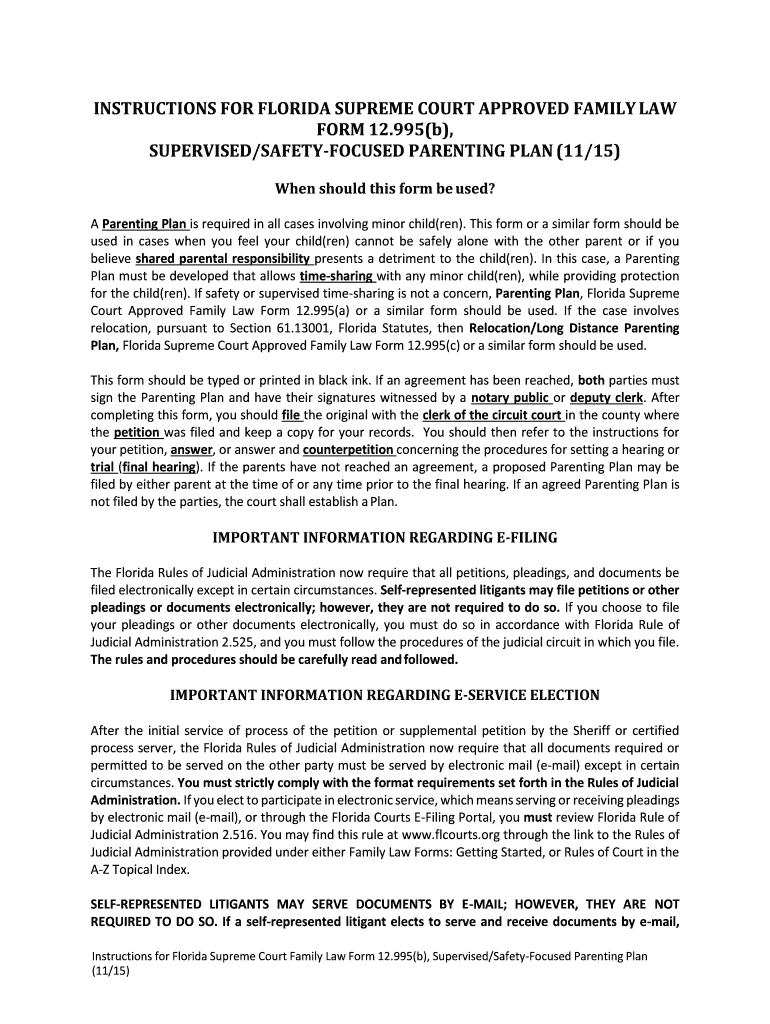
Icial Administration 2.516. You may find this rule at www.flcourts.org through the link to the Rules of Judicial Administration provided under either Family Law Forms: Getting Started, or Rules of Court in the A-Z Topical Index. SELF-REPRESENTED LITIGANTS MAY SERVE DOCUMENTS BY E-MAIL; HOWEVER, THEY ARE NOT REQUIRED TO DO SO. If a self-represented litigant elects to serve and receive documents by e-mail, Instructions for Florida Supreme Court Family Law Form 12.995(b), Supervised/Safety-Focused.
Loading

Open form follow the instructions

Easily sign the form with your finger

Send filled & signed form or save
How to fill out the FL 12.995(b) online
Filling out the FL 12.995(b) form, also known as the Supervised/Safety-Focused Parenting Plan, is a critical process for parents involved in custody arrangements where safety is a concern. This guide provides step-by-step instructions to assist users in completing this form online, ensuring clarity and compliance with legal requirements.
Follow the steps to successfully complete your Parenting Plan online.
- Click ‘Get Form’ button to obtain the form and open it in the editor.
- Indicate the type of Parenting Plan by choosing one of the three options: submitted with agreement, proposed by one parent, or established by the court.
- Fill in the parents' details, including names, addresses, contact numbers, and email addresses. Ensure to mark if any address is confidential.
- List the children involved, providing their names and dates of birth.
- Specify the jurisdiction, confirming the United States as the country of habitual residence and Florida as the home state.
- Select the appropriate parental responsibility arrangement: sole or shared, and provide details on decision-making authority.
- Outline the time-sharing schedule, selecting from options such as no time-sharing, supervised time-sharing, or restricted time-sharing, detailing specifics as needed.
- Identify who will supervise the time-sharing if necessary and clarify the responsibilities related to transportation and exchange of the child.
- Complete the communication section, specifying how parents will communicate and handle messages with the child.
- Discuss the child’s safety rules and any restrictions that must be adhered to during time-sharing.
- Review all sections, ensuring that all necessary information is accurate and complete before finalizing.
- Once completed, save changes, and download, print, or share the Parenting Plan as necessary.
Start your document preparation process today and complete your Parenting Plan online with ease.
Experience a faster way to fill out and sign forms on the web. Access the most extensive library of templates available.
Related content
Form 12.995(b) is used when a child cannot be safely alone with the other parent, or...
Supervised/Safety Focused Parenting Plan, Form 12.995(b) If the parents have reached an...
Chapter 3 - Transmit, Receive & Audio Circuit Boards. BTR-200 Instrument Disassembly. 3-1...
Get answers to your most pressing questions about US Legal Forms API.
What happens when a parent refuses to co-parent?
When a parent refuses to co-parent, it can create significant challenges and may complicate matters in court. Under FL 12.995(b), refusal to collaborate can result in a judge taking actions to ensure compliance with the parenting plan. This could include enforced mediation or adjustments to custody arrangements. Parents should seek assistance from platforms like US Legal Forms to understand their rights and explore solutions to encourage cooperation.
Can keeping a child away from the other parent backfire?
Yes, keeping a child away from the other parent can have serious repercussions, especially under FL 12.995(b). This behavior can lead to legal consequences, including altered custody arrangements or loss of parenting rights. Courts typically encourage maintaining a relationship between the child and both parents. It’s vital to consider the long-term effects on the child’s emotional health and the family dynamic.
What is considered an unstable parent in Florida?
A parent may be deemed unstable in Florida if their actions or behaviors pose a risk to the child's well-being. Factors such as substance abuse, frequent involvement with law enforcement, or erratic living situations can contribute to this assessment. Courts consider these aspects seriously, especially in light of FL 12.995(b). Understanding these definitions can help parents present their situation more clearly in legal matters.
What is the new parenting law in Florida?
The new parenting law in Florida emphasizes collaborative parenting and shared responsibilities. Under FL 12.995(b), the law encourages both parents to maintain a strong relationship with their child, aiming for solutions that work for everyone involved. This change reflects a growing recognition of the importance of both parents in a child’s life. Staying informed about these updates can help parents navigate their rights and responsibilities effectively.
What happens if a parent doesn't follow the parenting plan in Florida?
If a parent does not comply with the parenting plan outlined in FL 12.995(b), they can face legal consequences. This may include court-imposed sanctions, limitations on parenting time, or even a modification of custody arrangements. The court prioritizes the child's best interest, so consistent non-compliance could negatively impact the parent's rights. It's essential to address any concerns about the plan directly and promptly.
What are the disadvantages of 50/50 custody?
While 50/50 custody arrangements can work well, FL 12.995(b) also highlights potential challenges. Some disadvantages may include logistical complications, especially if parents live far apart, and the emotional strain on children who may struggle with transitions. USLegalForms can help you better understand these implications and provide guidance in establishing a custody plan that addresses your family's unique needs.
What is the new Florida law on 50/50 custody?
Under the new Florida law, FL 12.995(b), 50/50 custody arrangements have gained recognition as a beneficial option for many families. This law advocates for a balanced time-sharing agreement, allowing children to maintain strong relationships with both parents. To learn more about setting up a 50/50 custody plan, consider exploring the tools available at USLegalForms, designed to simplify the process.
What is the new law on child custody in Florida?
The new law on child custody in Florida, referenced as FL 12.995(b), emphasizes the importance of shared parenting. This law encourages parents to develop a plan that promotes the child's best interests through equal involvement from both parents. If you seek to understand how this impacts your situation, USLegalForms provides resources that can help you navigate these changes effectively.
How to file for full custody of a child in Florida?
To file for full custody of a child in Florida, you will need to complete specific legal forms, including FL 12.995(b), which relates to custody petitions. Your application should demonstrate why full custody is in the best interest of the child, considering factors such as stability and parental involvement. It is advisable to consult a legal professional to strengthen your filing and ensure proper procedure.
How to prepare for a contempt hearing?
Preparing for a contempt hearing involves gathering evidence that supports your claims of non-compliance with a court order. Collect documents, communications, and any records that demonstrate the other party's failure to adhere to the parenting plan. Additionally, reviewing FL 12.995(b) can provide insight into the relevant legal standards that the court will consider.
Use professional pre-built templates to fill in and sign documents online faster. Get access to thousands of forms.
If you believe that this page should be taken down, please follow our DMCA take down process here.
This form is available in several versions. Select the version you need from the drop-down list below.