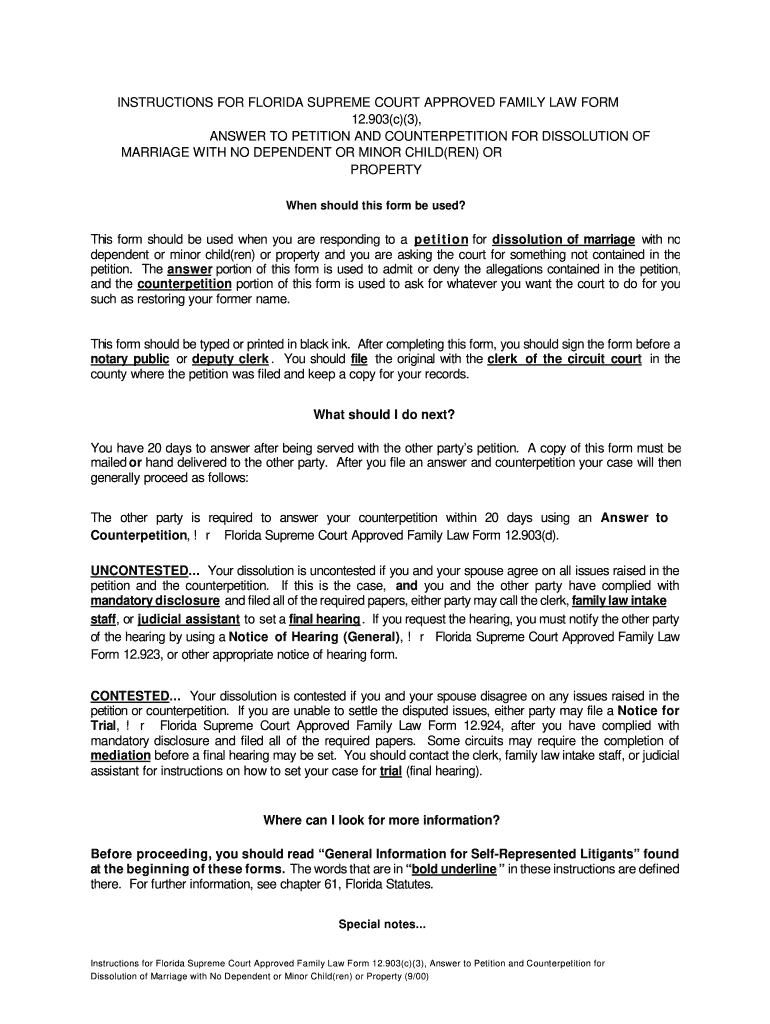
Should this form be used? This form should be used when you are responding to a petition for dissolution of marriage with no dependent or minor child(ren) or property and you are asking the court for something not contained in the petition. The answer portion of this form is used to admit or deny the allegations contained in the petition, and the counterpetition portion of this form is used to ask for whatever you want the court to do for you such as restoring your former name. This form shou.
Loading

Open form follow the instructions

Easily sign the form with your finger

Send filled & signed form or save
How to fill out the FL 12.903(c)(3) online
Filling out the FL 12.903(c)(3) form is a crucial step in responding to a petition for dissolution of marriage without minor children or property. This guide provides clear, step-by-step instructions to help you complete this form online accurately and efficiently, ensuring you meet all necessary requirements.
Follow the steps to fill out the FL 12.903(c)(3) form online effectively.
- Click the ‘Get Form’ button to obtain the form and open it in the editor.
- Begin by carefully entering your full legal name at the top of the form. Ensure that this matches the name on official documents.
- In the 'Answer to Petition' section, review the petition and indicate your agreement or disagreement with each numbered paragraph. Be sure to specify the section and paragraph number as applicable.
- Complete the 'Counterpetition for Dissolution of Marriage' section. Confirm your residency in Florida, along with details of your marriage, such as the date and place of marriage.
- Indicate that there are no dependent children, and select whether any party is a member of the military service.
- State the reasons your counterpetition should be granted by selecting one of the provided options regarding the condition of the marriage.
- Fill out the section summarizing your request, specifically any relief you are seeking, such as restoring a former name.
- Review your completed form for accuracy and clarity. Ensure your signature is present in the appropriate section and that date fields are filled.
- After finalizing your form, either download it, print it, or save your changes as needed. Make sure to keep a copy for your records before submitting it.
Begin filing your documents online today to ensure a smoother process.
Experience a faster way to fill out and sign forms on the web. Access the most extensive library of templates available.
Related content
These family law forms contain a Final Judgment of Dissolution of Marriage with. No...
Dec 16, 2010 — Dependent or Minor Child(ren), Florida Supreme Court Approved Family Law...
Get answers to your most pressing questions about US Legal Forms API.
How long do you have to be separated in Florida to get a divorce?
In Florida, there is no legal requirement for a separation period before filing for divorce. However, living apart for a period may help with negotiations and settling terms. Researching FL 12.903(c)(3) provides insight into divorce filings and can make the process smoother.
What are the requirements for divorce in Florida?
To obtain a divorce in Florida, you must meet specific criteria, including residency and grounds for dissolution. One spouse must have lived in Florida for at least six months, and you can file for either a no-fault divorce or based on other grounds. Using FL 12.903(c)(3) can help you understand the necessary documentation and procedures to follow.
What is Florida Rule of Criminal Procedure 3.180 A )( 3?
Florida Rule of Criminal Procedure 3.180 A )( 3 focuses on the defendant's rights during criminal proceedings, particularly addressing the presence of witnesses. Although it may not directly relate to divorce, understanding your rights within legal procedures is vital. For divorce matters, consider exploring FL 12.903(c)(3) for clear guidance on procedural rights.
What are the rules for a Florida divorce?
The rules for a Florida divorce include residency requirements, grounds for divorce, and the way assets are divided. At least one spouse must reside in Florida for six months before filing. Also, understand how FL 12.903(c)(3) clarifies the process regarding spousal support and asset division.
What is my wife entitled to in a divorce in Florida?
In Florida, during a divorce, your wife may be entitled to equitable distribution of marital assets. This includes property acquired during the marriage and can also cover income, real estate, and retirement accounts. It's essential to review each asset's value and any debts shared. Consulting FL 12.903(c)(3) can guide you on how these distributions work.
Is a financial affidavit required for uncontested divorce in Florida?
Yes, a financial affidavit is typically required for an uncontested divorce in Florida. According to FL 12.903(c)(3), even if both parties agree on terms, the court still needs a complete financial overview to finalize the divorce. Submitting this affidavit helps streamline the process and can facilitate a quicker resolution.
How do I file a habeas corpus in Florida?
To file a habeas corpus in Florida, you must prepare a petition outlining your reasons for filing and submit it to the appropriate court. While this process doesn’t specifically involve a financial affidavit, it can be crucial to understand your rights and obligations as part of the legal process. For assistance with related documents, platforms like Uslegalforms can provide guidance tailored to your specific needs.
Do I have to file a financial affidavit in Florida?
Yes, in most cases, you are required to file a financial affidavit in Florida. This requirement is especially true in family law matters as stipulated by FL 12.903(c)(3). It is essential to comply with this requirement to avoid any delays in your case and to ensure the court has the necessary information to proceed.
What is a financial affidavit in Florida?
A financial affidavit in Florida is a legal document that details an individual's income, expenses, assets, and liabilities. This affidavit is crucial in divorce and child support cases as outlined in FL 12.903(c)(3). By accurately representing your finances, you assist the court in making decisions that reflect your true financial situation.
What is the affidavit rule in Florida?
The affidavit rule in Florida requires individuals to provide sworn statements regarding their financial circumstances, particularly in family law cases. These affidavits, like the one outlined in FL 12.903(c)(3), ensure that all parties present accurate financial information. The court uses these affidavits to make informed decisions on support and custody matters.
Use professional pre-built templates to fill in and sign documents online faster. Get access to thousands of forms.
If you believe that this page should be taken down, please follow our DMCA take down process here.
This form is available in several versions. Select the version you need from the drop-down list below.