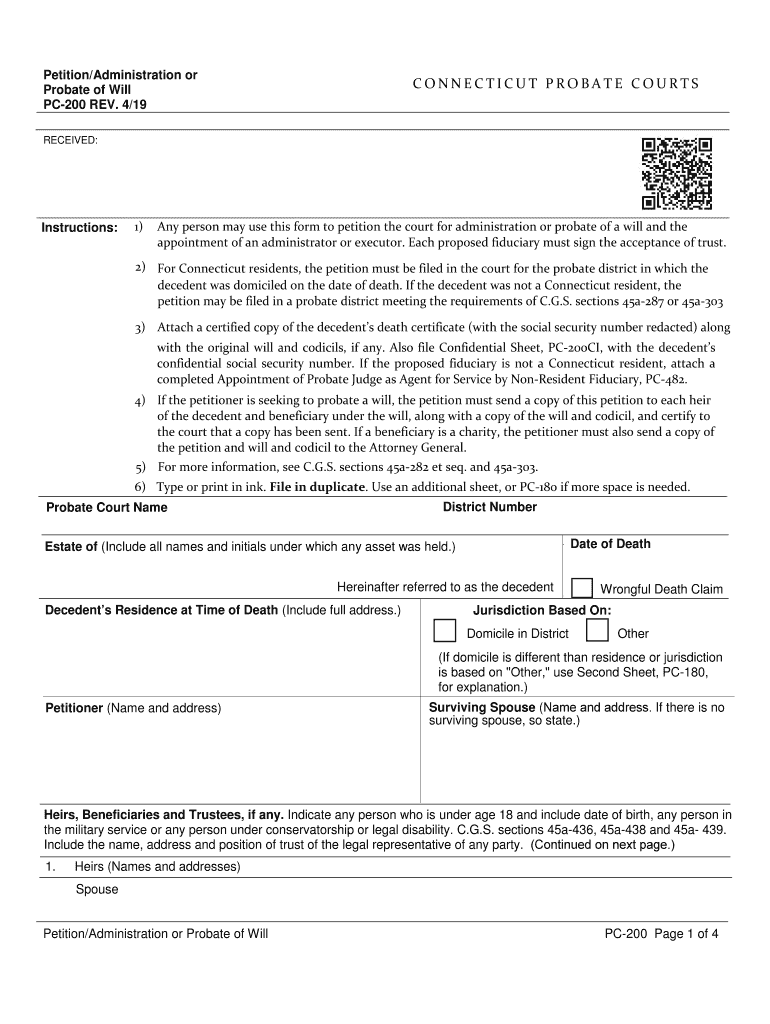
Ldren, list surviving parents If NO spouse, children, grandchildren or parents, list brother(s) and sister(s) or children of any deceased brother or sister (Identify relationship to decedent.) If NONE of the above apply, please refer to C.G.S. section 45a-439(a)(3) and provide a family tree. 2. Beneficiaries under the will, including nominated testamentary trustees and inter vivos trustees. (List name and address and include paragraph in will where interest in the estate arises. It is not nec.
Loading

Open form follow the instructions

Easily sign the form with your finger

Send filled & signed form or save
How to fill out the CT PC-200 online
The CT PC-200 is a crucial document for petitioning the court for administration or probate of a will in Connecticut. This guide provides a comprehensive, step-by-step approach to assist users in accurately completing the form online.
Follow the steps to efficiently complete your CT PC-200 online.
- Click ‘Get Form’ button to download the CT PC-200 form and open it in the editor.
- Begin by entering the district number and the name of the probate court you are filing with. Ensure that this matches the district where the decedent was domiciled at their time of death.
- Input the date of death of the decedent and their full name as it appears on any asset held.
- Provide the decedent’s residence at the time of death, ensuring to include the complete address.
- If applicable, identify whether this is a wrongful death claim and select the appropriate jurisdiction based on domicile or other criteria.
- Fill out the petitioner’s information, including names and addresses. If applicable, add details for the surviving spouse or indicate their absence.
- List all heirs, beneficiaries, and trustees. Include names, addresses, and any relevant details such as dates of birth for minors or status in military service.
- If applicable, indicate whether there are any children of a deceased child or surviving parents. If necessary, list additional family members such as siblings.
- Document beneficiaries under the will, noting their names and addresses along with the related paragraphs in the will that detail their interest.
- Confirm efforts made to identify or locate any unknown person by providing details of these efforts in the designated section.
- Review the representations required by the court, filling in any necessary information about the decedent’s assets, previous aid received, or any changes in familial status.
- Sign and date the form at the bottom to affirm the accuracy of the information provided. Ensure the proposed fiduciary also signs and provides their details.
- Finalize the process by saving, downloading, or printing the completed form for submission. You may also share it as necessary.
Start completing your CT PC-200 form online today!
Experience a faster way to fill out and sign forms on the web. Access the most extensive library of templates available.
Related content
1) Any person may use this form to petition the court for administration or probate of a...
Obteve-se o custo operacional para os modelos PC 200 e PC 228 de R$ 156,95 e R$ 168,84 por...
Feb 6, 2020 — By inputting the ground line of the equipment to CT input or direct...
Get answers to your most pressing questions about US Legal Forms API.
How long do creditors have to collect a debt from an estate in CT?
Creditors typically have one year from the decedent's date of death to collect debts owed by the estate. This timeframe is crucial for creditors to take action while ensuring that the estate administration is not delayed. Documenting all claims with forms such as the CT PC-200 can facilitate smoother communication between the estate executor and creditors. Understanding these rules helps maintain clarity during the estate settlement process.
How long does a creditor have to file a claim against an estate in Connecticut?
In Connecticut, creditors have a maximum of six months from the date of the probate notice to file claims against an estate. This window is established to ensure timely resolution of debts. Using forms like the CT PC-200 can help manage the claims process, ensuring all submissions are correctly documented. Being aware of these timelines can help protect the estate and its beneficiaries.
How do I get a letter of testamentary in CT?
You can obtain a letter of testamentary in Connecticut by filing a probate petition with the appropriate court. This process involves submitting necessary forms, including the CT PC-200, to prove the validity of the will. After the court reviews your submission, they will issue the letter, granting you authority to act on behalf of the estate. This document is essential for handling estate matters efficiently.
How long can creditors go after an estate?
Creditors can pursue claims against an estate for a period specified under Connecticut law, typically up to one year from the date of the decedent's passing. This timeline is critical, as it ensures that debts are settled efficiently. With proper documentation, such as the CT PC-200, you can manage any claims against an estate effectively. Knowing these time limits helps streamline the estate administration process.
Can you avoid probate in Connecticut?
Yes, you can avoid probate in Connecticut through various estate planning techniques. Establishing trusts, designating beneficiaries, and holding assets in joint names are all effective methods to bypass the probate process. Utilizing the CT PC-200 form can streamline this planning process, ensuring your estate is managed according to your wishes while minimizing potential delays and complications.
Do joint bank accounts go through probate in CT?
Joint bank accounts generally do not go through probate in Connecticut. Instead, these accounts pass directly to the surviving account holder upon the death of one owner. This seamless transfer can alleviate some of the challenges associated with probate, making the use of the CT PC-200 form less relevant for joint accounts. Consider discussing your account structure with a legal expert to ensure your intentions are clear.
How to avoid probate in CT?
You can avoid probate in Connecticut by utilizing several tools. Establishing a living trust, joint ownership of assets, and naming beneficiaries on accounts are effective strategies. Each of these options can help ensure that your assets transfer smoothly after your passing without going through the probate process. The CT PC-200 form can serve as an important part of your planning to simplify estate management.
Do all estates have to go through probate in CT?
Not all estates require probate in Connecticut. If the estate's assets are below a certain threshold, it may qualify for a simplified process. Using the CT PC-200 form can help expedite this procedure and lessen the burden on your loved ones during a difficult time. It's essential to check the specifics of your situation to determine whether probate is necessary.
What assets go through probate in CT?
Assets that typically go through probate in Connecticut include real estate owned solely by the deceased, bank accounts without a designated beneficiary, and personal belongings. These assets must be accounted for to ensure lawful distribution according to the will or state laws. The CT PC-200 can help simplify the identification and management of these assets during probate.
How much does an estate have to be worth to go to probate in CT?
In Connecticut, there is no specific minimum value for an estate to enter probate. However, if the estate consists of certain types of assets or has a total value that requires clearance, probate may be necessary. It's important to assess your estate's worth and to use resources like the CT PC-200 to determine the best course of action.
Use professional pre-built templates to fill in and sign documents online faster. Get access to thousands of forms.
If you believe that this page should be taken down, please follow our DMCA take down process here.