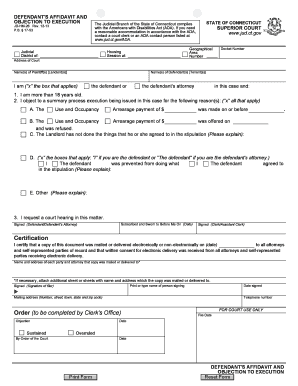
COURT www.jud.ct.gov Name(s) of Plaintiff(s) Landlord(s) Docket Number Name(s) of Defendant(s) Tenant(s) I am ("x" the box that applies) the defendant or the defendant's attorney in this case and: 1. I am more than 18 years old. 2. I object to a summary process execution being issued in this case for the following reason(s): ("x" all that apply) A. The Use and Occupancy Arrearage payment of $ was made on or before B. The Use and Occupancy Arrearage payment of $ was offere.

How it works
  • Open form

    Open form follow the instructions

  • Easily sign form

    Easily sign the form with your finger

  • Share form

    Send filled & signed form or save

How to fill out the CT JD-HM-26 online

The CT JD-HM-26 form is essential for defendants who wish to object to execution in summary process cases in Connecticut. This guide will walk you through the necessary steps to complete the form online accurately and effectively.

Follow the steps to fill out the CT JD-HM-26 form online

  1. Click the ‘Get Form’ button to access the CT JD-HM-26 form and open it in your document management system.
  2. Begin by filling in the Judicial District of and the Geographical Area Number where the case is being filed.
  3. Under the 'Housing Session' section, enter the address of the court where the case is being processed.
  4. List the names of the plaintiff(s) (landlord(s)) and the names of the defendant(s) (tenant(s)) as they appear in the case.
  5. Indicate whether you are the defendant or the defendant's attorney by marking the appropriate box.
  6. Affirm that you are over 18 years old by checking the designated box.
  7. State your objections to the summary process execution by checking all applicable reasons, such as payments made or refused, or failure of the landlord to fulfill agreed terms.
  8. Request a court hearing by checking the corresponding box to indicate your desire for a hearing on this matter.
  9. Sign the form in the designated area for the defendant or the defendant's attorney.
  10. Date the form and provide your signature, ensuring to include your telephone number and mailing address.
  11. Complete the certification section, providing details on how copies of this document have been delivered to all relevant parties.
  12. Review the completed form for accuracy, then save your changes, download a copy, print, or share as necessary.

Complete your CT JD-HM-26 form online today to ensure your objection is filed promptly.

Get form

Experience a faster way to fill out and sign forms on the web. Access the most extensive library of templates available.

Related content

DEFENDANT'S AFFIDAVIT AND OBJECTION TO EXECUTION

JD-HM-26 Rev. 4-19. P.B. § 17-53. ADA NOTICE. The Judicial Branch of the State of...

Learn more
Pediatric Radiology Normal Measurements

Normal measurements in pediatric radiology is being compiled by pediatric radiologists...

Learn more
O Novo Padrão

Design Circumaural Supra-auricular de Costas. Fechadas • Curva de EQ para Música e...

Learn more
Questions & Answers

Get answers to your most pressing questions about US Legal Forms API.

Contact support

Is it worth taking someone to small claims court?

Deciding whether to take someone to small claims court largely depends on the amount in dispute and the likelihood of successful recovery. The small claims process is designed to be accessible and less formal, making it easier to pursue smaller amounts without the complexity of higher courts. Utilizing the CT JD-HM-26 form can help streamline your case presentation. For guidance throughout this process, US Legal Forms offers useful resources and templates.

In Connecticut, the time limit to file small claims varies depending on the nature of your claim. For most cases, you generally have a period of six years under the CT JD-HM-26 guideline. It is essential to be mindful of this timeline so you can effectively pursue your claim. If you need assistance with the filing process, platforms like US Legal Forms can provide the templates you need.

In your affidavit, you can write about facts related to your case, personal observations, or any evidence you can support with documentation. It's important to be honest and precise while including only relevant information that aligns with the requirements of CT JD-HM-26. Remember, each affidavit must reflect your truthfulness and integrity.

To fill out an affidavit example, start by reviewing the CT JD-HM-26 form for guidelines. Use a clear, straightforward style while detailing the facts pertinent to your case. Each statement should be well-organized, providing context and supporting evidence where necessary to strengthen your claims.

In Connecticut, a stay of execution for eviction offers temporary relief to tenants facing eviction. Once a judgment is issued, a request can be made for a stay, allowing extra time for tenants to resolve issues or secure new housing. It's important to act quickly and understand the provisions under CT JD-HM-26 for a smooth process.

The CT JD-HM-26 affidavit follows a structured format that includes a title, an introductory statement, the body of the affidavit detailing your claims, and your signature. Ensure you include the date and location where you sign. Each section must be clear and specific to convey your message effectively.

Filling an affidavit form involves several key steps. First, ensure you have the correct version of the CT JD-HM-26 form. Next, gather all necessary information and documents, then clearly and accurately fill out each section of the form. Finally, verify your completion and sign it in front of a notary.

In criminal law, a judgment is enforced by the government. ... If a plaintiff who has been awarded money or support wishes to enforce that judgment, he will usually need to go back to court in order to do so if the other party (called the "judgment debtor") is not paying.

To get a judgment against you, a creditor or collector has to take you to court. If you don't respond to a summons, or if you lose the case, the court will issue a judgment in favor of the creditor or collection agency. ... Once that happens, the judgment is public record and will affect your credit reports.

Answer. That depends on the laws of your state, and the method that the creditor uses to try and collect on that judgment. Usually, judgments are valid for several years before they expire or lapse. In some states, a judgment is effective between five to seven years.

Get This Form Now!

Use professional pre-built templates to fill in and sign documents online faster. Get access to thousands of forms.

If you believe that this page should be taken down, please follow our DMCA take down process here.

Get CT JD-HM-26