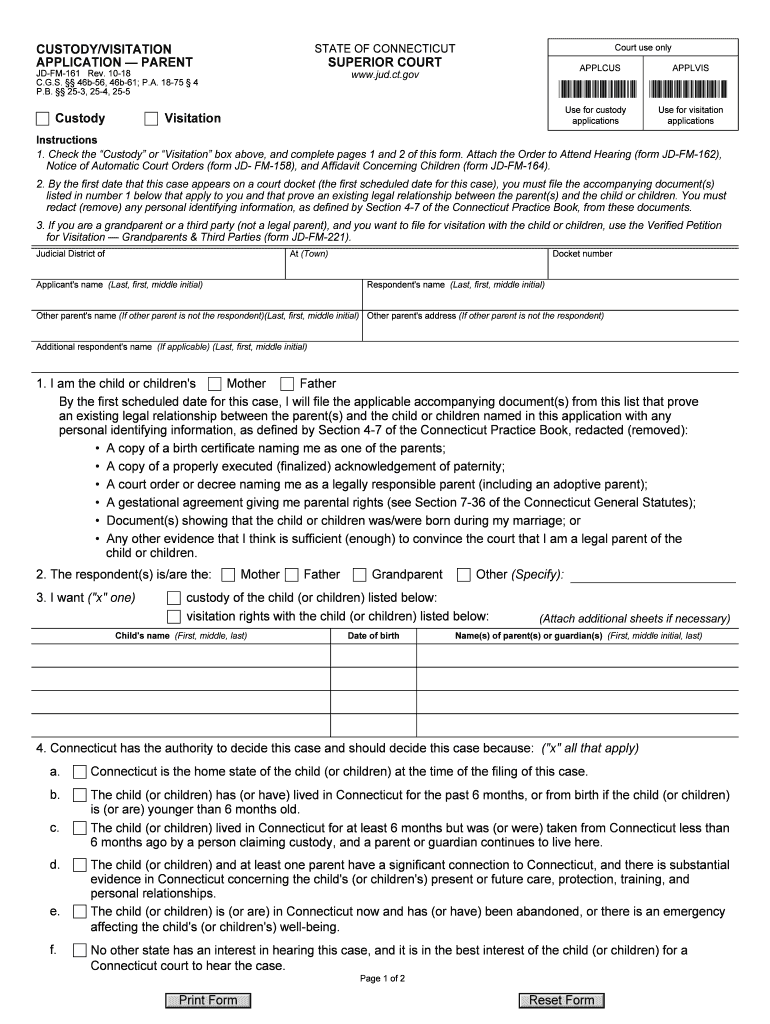
Ide this case because: ("x" all that apply) a. Connecticut is the home state of the child (or children) at the time of the filing of this case. b. The child (or children) has (or have) lived in Connecticut for the past 6 months, or from birth if the child (or children) is (or are) younger than 6 months old. The child (or children) lived in Connecticut for at least 6 months but was (or were) taken from Connecticut less than 6 months ago by a person claiming custody, and a parent or guar.
Loading

Open form follow the instructions

Easily sign the form with your finger

Send filled & signed form or save
How to fill out the CT JD-FM-161 online
Filling out the CT JD-FM-161 form is an essential step in applying for custody or visitation in Connecticut. This guide provides clear, step-by-step instructions to help you navigate the online process with ease.
Follow the steps to successfully complete your form.
- Click ‘Get Form’ button to obtain the form and open it for completion.
- Indicate whether you are applying for 'Custody' or 'Visitation' by checking the appropriate box at the top of the form. Complete the required fields on pages 1 and 2 of the form.
- Enter the judicial district of your case and the docket number if available. Provide the names of the applicant, respondent, and any additional parent or guardian involved.
- In section 1, specify your relationship to the child or children by checking the 'Mother' or 'Father' box.
- List the child or children's names and dates of birth in the appropriate fields. Attach additional sheets if necessary.
- In section 4, check all statements that apply to establish Connecticut's jurisdiction over the case, indicating the reasons why the court has authority.
- Complete section 5 regarding financial support and HUSKY health insurance. Indicate 'Yes' or 'No' as applicable.
- Proceed to the 'Claim For Relief' section, indicating all relevant requests regarding custody or visitation rights, and specify the desired arrangements.
- Review all provided information to ensure it is complete and accurate. Lastly, sign and date the application.
- Once completed, you can save changes, download the form, print it out, or share it as needed.
Start filling out your custody or visitation application online today.
Experience a faster way to fill out and sign forms on the web. Access the most extensive library of templates available.
Related content
Attach the Order to Show Cause and Notice to the. Respondent (form JD-FM-162), Notice of...
by SG Silverman · 2019 · Cited by 517 — This CT-based classification was introduced in...
4- peed Transaxle ings and Flywheel. Group 20. Camshaft, Tappc'ts and GOV (~ r. SECTION 60...
Get answers to your most pressing questions about US Legal Forms API.
How do I defend myself in child support court?
To defend yourself in child support court, gather all relevant financial documents and evidence to support your position. Clearly articulate your income and expenses, and be prepared to explain any discrepancies. Being organized and using forms like CT JD-FM-161 can help present your case in a structured manner.
What not to say in child support court?
In child support court, steer clear of blaming the other parent or discussing unrelated grievances. Stay focused on the financial aspects and your ability to fulfill your obligations. Articulating your commitment to support, along with accurate documentation, is beneficial as you navigate the court process with forms like CT JD-FM-161.
What are the chances of a father getting full custody?
A father's chances of obtaining full custody depend on various factors, including his relationship with the child and the mother’s involvement. Courts generally evaluate what arrangement serves the child's best interest. Utilizing a well-prepared application like CT JD-FM-161 can help establish a father’s case more effectively.
What is the biggest mistake in custody battle?
A common mistake in custody battles is failing to focus on the child's best interests. Engaging in negative behavior, such as speaking poorly of the other parent, can backfire during proceedings. Instead, remain concentrated on how your actions and decisions align with what is best for your child, especially when using forms like CT JD-FM-161 to present your case.
Who are the best witnesses for a custody case?
The best witnesses in a custody case include individuals who can speak to your parenting abilities and the child’s needs. Friends, family members, or professionals, like teachers and counselors, can provide valuable insights. Their testimonies can significantly impact the court's understanding of your suitability, particularly when presenting documentation like CT JD-FM-161.
What not to say to a family court judge?
When speaking to a family court judge, avoid disrespectful language or personal attacks. Stay focused on the facts of your case, and do not express anger or frustration. It is essential to keep your comments relevant to the case at hand, especially when discussing forms like CT JD-FM-161.
Can I get sole custody without going to court?
Obtaining sole custody without going to court is possible, but it requires mutual agreement with the other parent. You may use mediation or other collaborative methods to reach an agreement documented with the CT JD-FM-161. However, having a legal professional review your situation can ensure that the agreement is enforceable. Always consider the legal implications before proceeding.
What looks bad in a custody battle?
Negative factors in a custody battle can include a history of substance abuse or neglect. Courts also frown upon behavior that demonstrates a lack of concern for the child's welfare. Using the CT JD-FM-161 effectively can help you present a responsible picture of your parenting. Stay focused on maintaining a positive approach throughout the process.
What is the biggest mistake in a custody battle?
One of the biggest mistakes in a custody battle is failing to prioritize the child's needs. Parents often let their emotions take over, which can cloud their judgment. The CT JD-FM-161 form can help clarify your intentions and provide a structured approach to your case. Always focus on what is best for your child to strengthen your position.
What is the best evidence for child custody?
The best evidence for child custody includes documentation such as school records, medical reports, and witness statements. You should focus on demonstrating your involvement in your child's life. Using the CT JD-FM-161, you can outline how your parenting skills benefit your child's well-being. Prioritize gathering relevant evidence that supports your case and highlights your commitment.
Use professional pre-built templates to fill in and sign documents online faster. Get access to thousands of forms.
If you believe that this page should be taken down, please follow our DMCA take down process here.