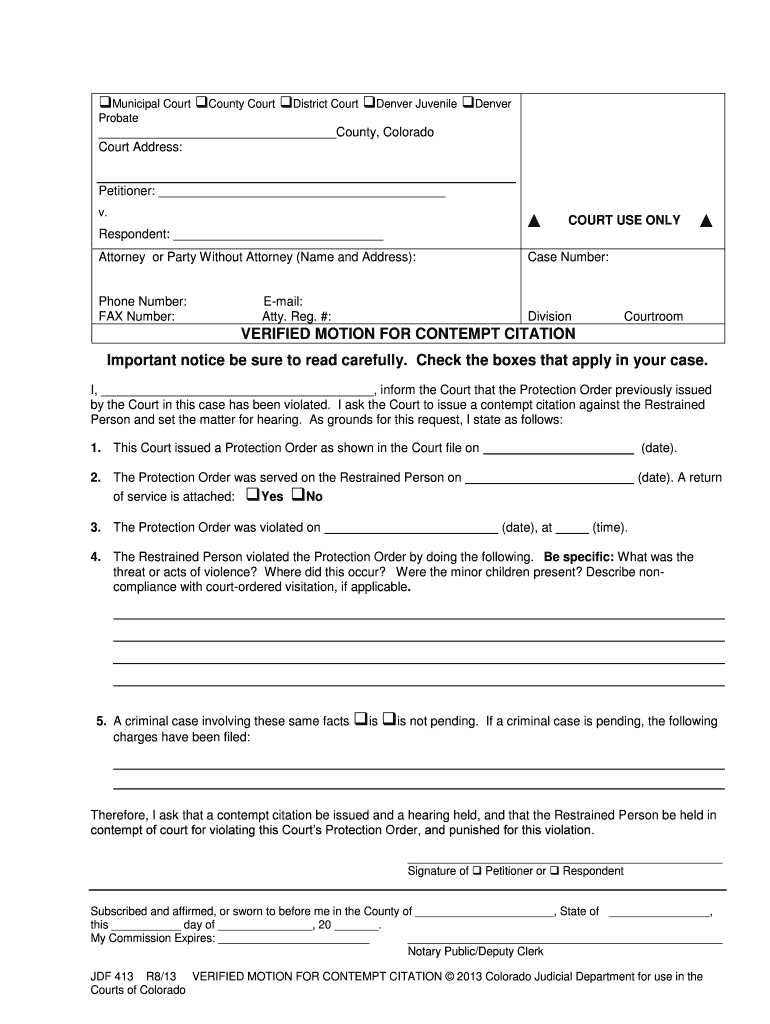
V. COURT USE ONLY Respondent: Attorney or Party Without Attorney (Name and Address): Case Number: Phone Number: FAX Number: Division E-mail: Atty. Reg. #: Courtroom VERIFIED MOTION FOR CONTEMPT CITATION Important notice be sure to read carefully. Check the boxes that apply in your case. I, , inform the Court that the Protection Order previously issued by the Court in this case has been violated. I ask the Court.

Open form follow the instructions

Easily sign the form with your finger

Send filled & signed form or save
How to fill out the CO JDF 413 online
The CO JDF 413 form, known as the Verified Motion for Contempt Citation, is an essential document for individuals seeking to notify the court of a violation of a protection order. This guide will assist you in completing this form online efficiently and correctly.
Follow the steps to complete the CO JDF 413 form online.
- Click ‘Get Form’ button to obtain the form and open it in the editor.
- Fill in the Court selection by checking the appropriate box for the type of court handling your case — Municipal, County, District, Denver Juvenile, or Denver Probate.
- Enter the county where the court is located, followed by the court address in the designated fields.
- Input the name of the Petitioner in the designated field, which signifies the individual filing the motion.
- Indicate the name of the Respondent, who is the individual against whom the contempt citation is sought.
- If applicable, provide the name and address of the attorney representing either party or state 'Party Without Attorney' if not represented.
- Fill in the case number, if known, as well as the contact information, including phone number, FAX number, and email address.
- Complete the section regarding the Protection Order, specifying the date it was issued and confirming service details by checking 'Yes' or 'No' regarding the attached return of service.
- Describe the violation of the Protection Order by including specific details about the incident, such as date, time, location, and nature of the violation.
- Indicate whether a criminal case pertaining to the same facts is pending, and provide any relevant details if it is.
- Conclude by signing the document in the indicated area and identifying whether you are the Petitioner or Respondent.
- Fill in the notary public section as required, including date and commission expiration.
- Once all sections are completed, review your form for accuracy, save your changes, and proceed to download, print, or share the form as needed.
Begin completing the CO JDF 413 online today to ensure your motion reaches the court effectively.
Experience a faster way to fill out and sign forms on the web. Access the most extensive library of templates available.
Related content
JDF 413 R3/18 VERIFIED MOTION FOR CONTEMPT CITATION ... I declare under penalty of perjury...
of the down-going Juan de Fuca (JdF) plate is of particular interest. With the young age...
CP/M ASSEMBLER - PROVIDED BY DIGITAL RESEARCH. BOOTSTRAP INJECTION MODULE - PART 2 OF, A...
Get answers to your most pressing questions about US Legal Forms API.
What is a restraining order and how does it work?
What is a restraining order? A restraining order is a court order intended to protect you from further harm from someone who has hurt you; to keep the abuser away from you, or to stop harassing you, or keep the abuser from the scene of the violence, which may include your home, place of work, or apartment.
What is a restraint order?
A restraining order or protective order is an order used by a court to protect a person, business, company, establishment, or entity, and the general public, in a situation involving alleged domestic violence, assault, harassment, stalking, or sexual assault.
What does a no contact order mean?
A "no contact order" means that the defendant is precluded from having any contact and or communication with the victim or the person under the protection of the no contact order. This includes but is not limited to letters, emails, text messages or messages delivered through a third party.
Can the state prosecute without a victim?
A criminal case can be filed against the abuser without the victim filing a complaint and even without their help. State and local municipalities have a responsibility to prosecute any and all crimes against their community. Domestic violence is one such crime.
How do I get a no contact order removed?
You cannot drop the charges, but as long as the judge believes that you are not being forced or coerced into dropping the No Contact order, he/she should drop it. Just go to the court that put the order in effect and ask the Clerk's office to pull the case and tell them what it is that you are seeking.
How long is a no contact order in effect?
A domestic violence restraining order entered after a hearing will usually remain in effect for three to five years. If the person who obtained the order can demonstrate a continuing need for protection, the order can be renewed for an additional five years.
What happens if you violate a no contact order?
The violation of a no contact order is a crime. The violator will be held in contempt of court and can be charged with a misdemeanor or a felony. ... If another crime is committed while violating the no contact order, such as carrying a weapon, or breaking and entering, the penalties will become more severe.
Does a no contact order go on your record?
A no contact order is found in criminal court proceedings rather than civil court cases. This means there are typically charges already being filed or pending. The no contact order doesn't include communication via phone call, email, mail, texts, or other forms of communication that do not involve being face to face.
What is a no contact agreement?
A No Contact Agreement (NCA) is a mutual agreement between two individuals who voluntarily affirm that they will not have direct contact with each other in person or electronically, or make indirect contact through third parties, except for that which is necessary for their academic or employment pursuits.
What happens if someone violates a no contact order?
The violation of a no contact order is a crime. The violator will be held in contempt of court and can be charged with a misdemeanor or a felony. ... If another crime is committed while violating the no contact order, such as carrying a weapon, or breaking and entering, the penalties will become more severe.
Use professional pre-built templates to fill in and sign documents online faster. Get access to thousands of forms.
If you believe that this page should be taken down, please follow our DMCA take down process here.