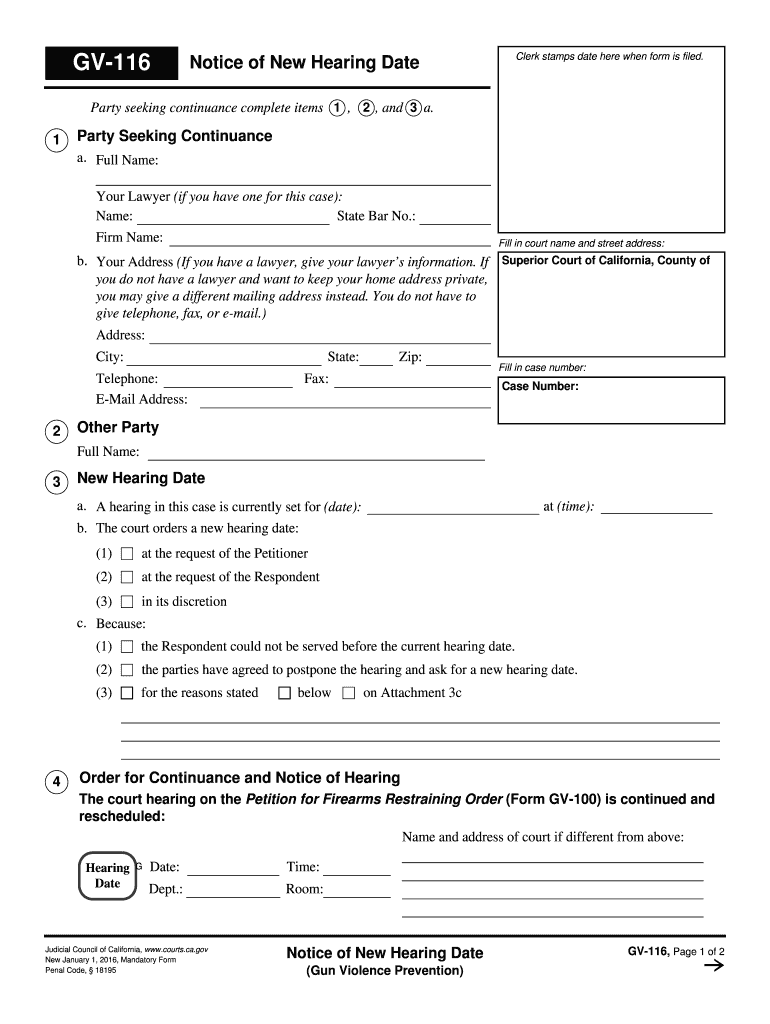
King Continuance a. Full Name: Your Lawyer (if you have one for this case): Name: State Bar No.: Firm Name: Fill in court name and street address: b. Your Address (If you have a lawyer, give your lawyer s information. If Superior Court of California, County of you do not have a lawyer and want to keep your home address private, you may give a different mailing address instead. You do not have to give telephone, fax, or e-mail.) Address: City: State: Telephone: E-Mail Address: 2 Zip: Fax:.
Loading

Open form follow the instructions

Easily sign the form with your finger

Send filled & signed form or save
How to fill out the CA GV-116 online
Filling out the CA GV-116 form is an essential step for parties seeking a continuance of a hearing regarding firearms restraining orders. This guide provides clear, step-by-step instructions to help you complete the form accurately and confidently.
Follow the steps to complete the CA GV-116 effectively.
- Click ‘Get Form’ button to retrieve the CA GV-116 and access it for editing.
- In the first section, enter your full name along with your lawyer's name, state bar number, and firm name if applicable. If you do not have a lawyer, skip to providing your preferred mailing address.
- Fill in your address, city, state, and zip code. If you want to keep your home address private, you may provide a different mailing address. You are not required to include your telephone, fax, or email.
- Next, enter the case number assigned to your case. This should be a unique identifier that allows the court to easily reference your case.
- Provide the full name of the other party involved in the case.
- Indicate the currently scheduled hearing date by filling out the corresponding date field.
- Give a brief explanation for the request to continue the hearing. You may choose from predefined options such as inability to serve, a mutual agreement to postpone, or other reasons detailed in an attachment.
- Fill in any additional court details if the hearing location differs from the court name and address provided initially.
- Note the service requirement: a copy of this order must be served to the other party a set number of days before the new hearing date.
- If applicable, include any request for accommodations for accessibility, ensuring to reach out to the clerk's office in advance.
- Lastly, review all entries for accuracy. Once satisfied, you can save changes, download, print, or share the completed form as needed.
Complete your CA GV-116 form online today for a smooth filing process.
Experience a faster way to fill out and sign forms on the web. Access the most extensive library of templates available.
Related content
A Temporary Gun Violence Restraining Order (form GV-110) is still in full force and effect...
Developmentally appropriate curriculum and environments for young children. Explores...
Este sistema oferece suporte somente a baterias desenvolvidas especificamente para ele e...
Get answers to your most pressing questions about US Legal Forms API.
What is the order on request to continue hearing DV 116?
The order on request to continue hearing DV 116 allows a party to request a delay in the proceedings regarding domestic violence restraining orders. Such requests must be made to inform the court of valid reasons for needing additional time, allowing for further evidence or preparation. It's important to properly follow the CA GV-116 guidelines when filing this request to ensure that the court considers it favorably.
What are the consequences of a restraining order in California?
The consequences of a restraining order in California can be significant, impacting various facets of life, including employment and personal relationships. Individuals with a restraining order may face limitations on their freedom, potential legal liabilities, and restrictions on communication with the protected person. Understanding the implications of a CA GV-116 order is crucial for those affected who wish to navigate this challenging legal terrain.
What does dissolving a protective order mean?
Dissolving a protective order means that the legal protections against a person are lifted, making it no longer enforceable. This can happen when the court determines that it is no longer necessary, such as after reconciliation or proof that no further risk exists. It is important to follow the proper legal steps in the CA GV-116 process when seeking to dissolve an order, ensuring that you have the correct documentation and legal clarity.
Why would a restraining order be dismissed in California?
A restraining order may be dismissed in California if the petitioner fails to demonstrate a clear need for it based on the evidence provided. If the petition lacks credibility, or if the circumstances have changed significantly—such as reconciliations or evidence of no threat—the judge might conclude that the order is no longer justified. Understanding the nuances of the CA GV-116 can assist individuals in these complex situations.
How do I fight a false restraining order in California?
To fight a false restraining order in California, you can gather evidence that disproves the claims made against you. This might include text messages, emails, or witness statements that can support your case. It's crucial to file a response to the court in a timely manner, contesting the validity of the order. Utilizing the resources available through ulslegalforms can guide you in effectively managing the CA GV-116 process.
Why would a judge dismiss a restraining order?
A judge may dismiss a restraining order if the evidence presented is insufficient to justify the need for protection. For instance, if the respondent shows that there was no threat or harassment involved, the judge might decide that the order is unnecessary. Additionally, a lack of credible witnesses or corroborating documentation can lead to dismissal. Understanding how the CA GV-116 process operates can help in navigating these situations.
What is a dv116?
A dv116 is a form used in California to request a domestic violence restraining order. This form helps articulate your experiences and request protection from the court. If you are filling out a CA GV-116, you may find that understanding the dv116 is crucial for ensuring you complete the necessary steps to receive the support you need.
What is the standard for a temporary restraining order?
The standard for a temporary restraining order requires demonstrating a reasonable belief that immediate harm will happen without legal protection. The court evaluates the urgency of the situation and the credibility of the evidence presented. When filing a CA GV-116, clarity and urgency in your application can make a significant difference.
What proof do you need for a temporary restraining order in California?
To obtain a temporary restraining order in California, you'll need sufficient proof that immediate harm may occur without the order. This proof may include specific incidents of violence or threats along with supported evidence. Utilizing resources like USLegalForms for guidance can streamline the process of preparing your CA GV-116 and gathering necessary documentation.
Can you own a gun if you have a restraining order in California?
In California, if you have a restraining order against you, it generally prohibits you from owning or possessing firearms. This restriction is designed to enhance safety for those affected by domestic violence or harassment. If you need further clarity on your rights regarding guns and a CA GV-116, consulting a legal expert is advisable.
Use professional pre-built templates to fill in and sign documents online faster. Get access to thousands of forms.
If you believe that this page should be taken down, please follow our DMCA take down process here.
This form is available in several versions. Select the version you need from the drop-down list below.