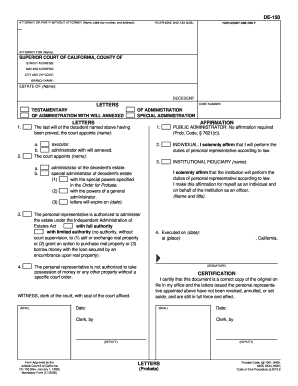
Date Clerk by DEPUTY Form Approved by the Judicial Council of California DE-150 Rev. January 1 1998 Mandatory Form 1/1/2000 California. Probate Probate Code 1001 8403 8405 8544 8545 Code of Civil Procedure 2015. DE-150 ATTORNEY OR PARTY WITHOUT ATTORNEY Name state bar number and address TELEPHONE AND FAX NOS. FOR COURT USE ONLY ATTORNEY FOR Name SUPERIOR COURT OF CALIFORNIA COUNTY OF STREET ADDRESS MAILING ADDRESS CITY AND ZIP CODE BRANCH NAME ESTATE OF Name DECEDENT CASE NUMBER LETTERS TESTAMEN.
Open form follow the instructions
Easily sign the form with your finger
Send filled & signed form or save
How to fill out the CA DE-150 online
The CA DE-150 form is essential for individuals appointed as personal representatives in probate cases in California. This guide provides clear, step-by-step instructions for completing the form online, ensuring you accurately fill out each section according to legal requirements.
Follow the steps to complete your CA DE-150 form online
- Click ‘Get Form’ button to access the CA DE-150 document. This will open the form in your editing tool, allowing you to proceed with the filling process.
- Begin with the 'Attorney or party without attorney' section. Enter your name, state bar number (if applicable), and your address. Provide a contact telephone number and fax number, ensuring all contact information is accurate for court correspondence.
- In the 'For court use only' section, leave this part blank as it is designated for court clerks to fill in necessary details related to the case.
- Fill in the 'Attorney for' section with the name of the attorney representing the estate, if applicable. Otherwise, you may leave it blank if you are filing without an attorney.
- Next, move to the 'Superior Court of California, County of' section. Enter the street address, mailing address, city, and zip code of the court where you are filing the form. Ensure the addresses are precise to avoid delays.
- In the 'Estate of' section, write the name of the decedent, the person who has passed away, followed by the case number assigned to this probate matter.
- Indicate the type of letters being requested: Letters Testamentary or Letters of Administration. Select the applicable box and provide details as required, including any special instructions or affirmations as necessary.
- Include the appropriate parties in the appointment section, providing names and titles. Note if the individual or institutional fiduciary will be handling the estate’s administration.
- Complete the affirmation section, ensuring the personal representative acknowledges their duty to perform according to the law. Sign and date where required.
- Finally, review the entire form for accuracy and completeness. Save your changes, then download, print, or share the completed form as necessary for submission.
Complete your CA DE-150 form online today to ensure your probate process proceeds smoothly.
Experience a faster way to fill out and sign forms on the web. Access the most extensive library of templates available.
Related content
I solemnly affirm that the institution will perform the duties of personal representative...
O objetivo deste trabalho foi avaliar o aporte de nutrientes pela deposição de...
Se não for utilizar o produto por um longo período, desconecte o cabo de alimentação...
Get answers to your most pressing questions about US Legal Forms API.
How long do most estates take to settle?
Most estates typically take six months to a year to settle, though this timeline can vary depending on the complexity of the estate and any disputes that arise. Factors such as asset types and existing debts influence the overall duration of the probate process. Understanding the requirements, including the CA DE-150, can help you navigate your particular situation. For additional support, explore resources from uslegalforms.
What is the purpose of a letter of testamentary?
A letter of testamentary serves as legal authorization for an executor to manage and distribute the estate according to the deceased's will. This document confirms the executor's authority in handling estate matters, such as asset collection and debt payment. Securing a CA DE-150 is critical in this process. Our platform, uslegalforms, can assist in preparing this necessary document effectively.
How long does it take to get a letter of testamentary?
Obtaining a letter of testamentary usually takes around 30 to 45 days from the time you file the petition. This duration is influenced by the court's workload and the specifics of your case. Preparing the CA DE-150 form accurately can contribute to a smoother approval process. For expert guidance, consider using uslegalforms, which offers helpful tools.
How much is exempt from probate in California?
In California, certain assets are exempt from probate, including properties held in joint tenancy and assets in living trusts. Additionally, personal property valued under $166,250 may not require probate. To understand the complete range of exemptions, consult California probate laws carefully. Uslegalforms offers resources to help you navigate these legal topics.
How to order letters testamentary?
To order letters testamentary, you must file a petition with the probate court in your county. This petition requires completing the CA DE-150 form along with other supporting documents. After filing, the court will review your application and set a hearing date. With uslegalforms, you can access templates and advice to help you through this process.
What happens after a letter of administration without a will in California?
When a letter of administration is granted without a will in California, the court appoints an administrator to manage the estate. The administrator then takes inventory of the estate assets and pays off debts. It's essential to follow California probate laws closely in this process. For guidance, you may find valuable assistance on platforms like uslegalforms.
How long do letters of testamentary take?
The process to obtain letters of testamentary typically takes several weeks. This timeline can vary based on the court's schedule and the complexity of the estate. By submitting the necessary documentation, including the CA DE-150 form, you can help streamline the process. Utilizing resources from platforms like uslegalforms can also simplify steps involved.
What is a UD 150 form?
The UD 150 form is used in California for unlawful detainer actions, which are essentially eviction proceedings. While it might seem unrelated to the CA DE-150, both forms represent crucial legal processes in their respective areas. It’s essential to understand the purpose of each form to navigate their applications correctly.
What is the difference between a Letter of Testamentary and a Letter of Administration?
The main difference between a Letter of Testamentary and a Letter of Administration lies in the presence of a will. A Letter of Testamentary is issued when a will exists, allowing the executor named in that will to manage the estate. In contrast, a Letter of Administration is used when an individual dies without a will, granting authority to someone appointed by the court. Understanding these distinctions is critical, especially when dealing with the CA DE-150.
How to obtain letters Testamentary in California?
To obtain Letters Testamentary in California, you must file a petition with the probate court, typically using the appropriate forms, such as the CA DE-150. The court will then hold a hearing to verify the authenticity of the will and determine whether to appoint you as the executor. After approval, you receive the Letters Testamentary, allowing you to manage the estate.
Use professional pre-built templates to fill in and sign documents online faster. Get access to thousands of forms.
If you believe that this page should be taken down, please follow our DMCA take down process here.