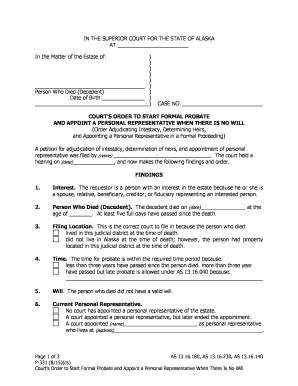
PPOINT A PERSONAL REPRESENTATIVE WHEN THERE IS NO WILL (Order Adjudicating Intestacy, Determining Heirs, and Appointing a Personal Representative in a Formal Proceeding) A petition for adjudication of intestacy, determination of heirs, and appointment of personal representative was filed by (name) . The court held a hearing on (date) , and now makes the following findings and order. FINDINGS 1. Interest. The requestor is a person with an interest in the estate because he or she is a spouse, rel.
Open form follow the instructions
Easily sign the form with your finger
Send filled & signed form or save
How to fill out the AK P-331 online
The AK P-331 form is essential for initiating formal probate proceedings when a person has passed away without a valid will. This guide will walk you through each section of the form, offering clear instructions to ensure a smooth online completion process.
Follow the steps to fill out the AK P-331 form effectively.
- Click the ‘Get Form’ button to access the form and open it in your online editor.
- Begin by entering the name of the person who has died in the 'Person Who Died (Decedent)' field. This information is critical as it identifies the subject of the probate process.
- Fill in the date of birth for the decedent in the specified field to provide necessary identification details.
- In the 'CASE NO.' section, include the assigned court case number, which helps track the case within the court system.
- Proceed to the findings section, starting with the 'Interest' field, where you must specify your relationship to the estate, whether you are a spouse, relative, or other interested party.
- Document the decedent's date of death and age in the appropriate fields, ensuring accurate submission of vital details.
- Indicate where the decedent lived at the time of death, which is essential for establishing the correct jurisdiction for the probate process.
- In the 'Time' section, confirm that the filing occurs within the required timeframe for probate; provide suitable explanations if the timeline surpasses three years.
- State whether a valid will exists or not, which is crucial for determining the probate process.
- List any current personal representatives appointed, along with their name and address, if applicable.
- Identify and provide the name of the person eligible to be appointed as a personal representative and clarify their qualifications.
- Fill in the heirs' information, noting their relationships to the decedent. This section may require additional pages if there are many heirs.
- Ensure all required notices have been provided as stipulated by Alaska law.
- Conclude the application by detailing the court's ruling and any necessary orders, including the appointment of the personal representative and any bond requirements.
- Finally, save your changes, download or print the form for your records, or share it as needed to complete the probate process.
Complete your AK P-331 form online today to initiate the probate process.
Experience a faster way to fill out and sign forms on the web. Access the most extensive library of templates available.
Related content
Order Starting Formal Probate and Appointing PR When There is No Will, P-331; Acceptance...
The probability that the ace of spades appears in the first trial is 1/52, hence P(X...
by E Dias-Tosta — Após sete meses houve melhora significativa no grupo que usou...
Get answers to your most pressing questions about US Legal Forms API.
What is exempt property in probate in Alaska?
Exempt property in Alaska refers to certain assets that are protected from being used to settle debts of the estate during probate. This can include personal items, a vehicle, or a primary residence, enabling beneficiaries to retain essential assets. Understanding what qualifies as exempt property can be critical for your estate planning. Look to AK P-331 for comprehensive guidance on protecting your assets.
What is the difference between a formal will and an informal will?
A formal will in Alaska follows specific legal requirements, such as being signed by witnesses, making it legally binding. In contrast, an informal will may lack these features and can be more easily contested. It’s important to ensure your will meets formal standards to prevent complications during probate. Resources like AK P-331 can aid in creating a formal will.
What are the rules for informal probate?
Informal probate in Alaska comes with specific rules, including the necessity of filing the will and a petition with the probate court. All interested parties must be notified, and the estate must be handled according to state laws. It is essential to follow these guidelines closely to expedite the process, and AK P-331 offers insights on best practices for compliance.
How to get a letter of testamentary in Alaska?
To obtain a letter of testamentary in Alaska, you must file the will with the probate court alongside a petition. The court will verify the will's validity before granting you the authority to act as executor. This document is crucial for managing the estate as specified in the will. AK P-331 provides detailed steps to simplify this process.
What is the difference between formal and informal probate in Alaska?
The key difference between formal and informal probate in Alaska lies in the level of court involvement. Informal probate allows for quicker resolution with minimal court intervention, while formal probate requires a judge's oversight and can involve hearings. Choosing the right type depends on the complexity of your estate, and utilizing AK P-331 can help clarify your decision.
How to avoid probate in Alaska?
You can avoid probate in Alaska by setting up trusts, holding assets in joint tenancy, or using payable-on-death accounts. These strategies allow your estate to bypass probate court, saving time and costs. Consider consulting the AK P-331 resources for effective methods tailored to your circumstances.
What is the difference between informal probate and formal probate?
Informal probate in Alaska is a streamlined process requiring less court oversight. It's typically suitable for uncomplicated estates and does not need a court hearing. On the other hand, formal probate involves court procedures and can be necessary for more complex cases. Understanding the distinction can help you decide which route is best for your situation with AK P-331.
How to contest a will in Alaska?
To contest a will in Alaska, you must file a petition with the probate court. Ensure you have legal standing, which generally means you must be an interested party. Gather evidence that supports your claims, such as proof of improper execution or lack of capacity. AK P-331 can guide you through this process efficiently.
Do you need a death certificate to open probate?
Yes, obtaining a death certificate is typically necessary to open probate in Alaska. The certificate serves as official proof of death and is required when filing a probate petition. This documentation is crucial for verifying your authority in handling the deceased person's estate under the guidelines of AK P-331.
What is a formal probate?
Formal / Informal Probate. Probate, whether formal or informal, is the process of winding up the affairs of the person who has died (the decedent), and includes asking the court to appoint a personal representative (sometimes called an "executor") of the decedent's estate, and to determine if there is a valid will.
Use professional pre-built templates to fill in and sign documents online faster. Get access to thousands of forms.
If you believe that this page should be taken down, please follow our DMCA take down process here.