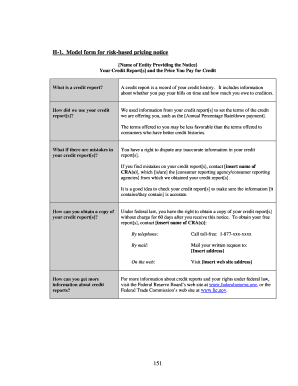
H1. Model form for riskbased pricing notice Name of Entity Providing the Notice Your Credit Report s and the Price You Pay for Credit What is a credit report? A credit report is a record of your credit.
Open form follow the instructions
Easily sign the form with your finger
Send filled & signed form or save
How to fill out the 151 H-1 Model Form For Risk-based Pricing Notice online
The 151 H-1 Model Form For Risk-based Pricing Notice is an important document that informs users about the impact of their credit reports on the credit offers they receive. This guide provides a step-by-step approach to filling out the form online, ensuring clarity and ease of use for all individuals.
Follow the steps to complete the 151 H-1 Model Form online
- Click the ‘Get Form’ button to access the form and open it in your preferred document editor.
- Begin by filling out the section labeled 'Name of Entity Providing the Notice.' Enter the legal name of the organization that is providing this notice.
- In the part titled 'Your Credit Report[s] and the Price You Pay for Credit,' provide a detailed explanation regarding the user's credit report and its implications.
- Next, address how the user's credit report was utilized to set the credit terms. Specify any terms such as 'Annual Percentage Rate' or 'down payment' that were influenced by the credit history.
- Include information on disputing inaccuracies found in the credit report. Offer clear guidance on how users can contact the relevant consumer reporting agencies.
- For obtaining a copy of credit reports, provide instructions based on the outlined methods: by telephone, by mail, and online.
- Lastly, remind users about their right to access their credit report for no charge within 60 days of receiving this notice. Save all changes made, and then you may choose to download, print, or share the completed form.
Complete your documents online to ensure prompt processing and compliance.
Experience a faster way to fill out and sign forms on the web. Access the most extensive library of templates available.
Related content
Dec 12, 2024 — Model forms for risk-based pricing and credit score disclosure exception...
by AM White · 2009 · Cited by 51 — Loan applicants, appraisers, and credit bureaus...
Jul 19, 2005 — The rules will further these goals by addressing communications related...
Get answers to your most pressing questions about US Legal Forms API.
What is risk-based loan pricing?
Risk-based pricing occurs when lenders offer different consumers different interest rates or other loan terms, based on the estimated risk that the consumers will fail to pay back their loans.
What is included in a risk-based pricing notice?
A risk-based pricing notice must tell the consumer: that a consumer report includes information about the consumer's credit history and the type of information included in that history. the terms offered were based on information from a consumer report.
Is a risk-based pricing disclosure is required anytime you obtain a consumer report?
Although credit scores are not being used, the lender is using information in a consumer report to set terms that are materially less favorable. In this circumstance, creditors are required to provide risk-based pricing notices.
What is a credit score disclosure mortgage?
Notice to Home Loan Applicant In short, this is a disclosures that includes things like the credit score of the applicant, the range of possible scores, key factors that adversely affected the credit score, the date of the score, and the name of the person or entity that provided the score.
What is a credit score disclosure exception notice?
In the credit score exception notices, creditors are required to disclose the distribution of credit scores among consumers who are scored under the same scoring model that is used to generate the consumer's credit score using the same scale as that of the credit score provided to the consumer.
What does it mean when you get a credit score disclosure?
A credit score disclosure alerts a consumer about their credit score and other sources of information as required by the Fair Credit Reporting Act (FCRA). The FCRA is a U.S. government legislation that aims to protect consumer information that is collected by consumer reporting agencies or credit bureaus.
Why did I get a credit score disclosure?
A creditor must disclose a consumer's credit score and information relating to a credit score on a risk-based pricing notice when the score of the consumer to whom the creditor extends credit or whose extension of credit is under review is used in setting the material terms of credit.
When must the credit score disclosure be provided?
The Dodd-Frank Act also amended FCRA to require disclosure of a credit score and related information when a credit score is used in taking an adverse action or in risk-based pricing. On December 21, 2011, CFPB restated FCRA regulations, named Regulation V (12 CFR Part 1022).
Use professional pre-built templates to fill in and sign documents online faster. Get access to thousands of forms.
If you believe that this page should be taken down, please follow our DMCA take down process here.