27 Jul 2016 ... Encl: (1) References. (2) Definitions. (3) Overseas, Remote Duty, and Operational Suitability Screening. (4) Medical Assignment Screening. (5) Exceptional FamilyMember Program Identification.
Loading

Open form follow the instructions

Easily sign the form with your finger

Send filled & signed form or save
How to fill out the Canada RCMP GRC 1980e online
Completing the Canada RCMP GRC 1980e form online is an essential step in your application process. This guide provides clear instructions to help you navigate each section of the form effectively and efficiently.
Follow the steps to fill out your application correctly.
- Click ‘Get Form’ button to obtain the form and open it in the editor.
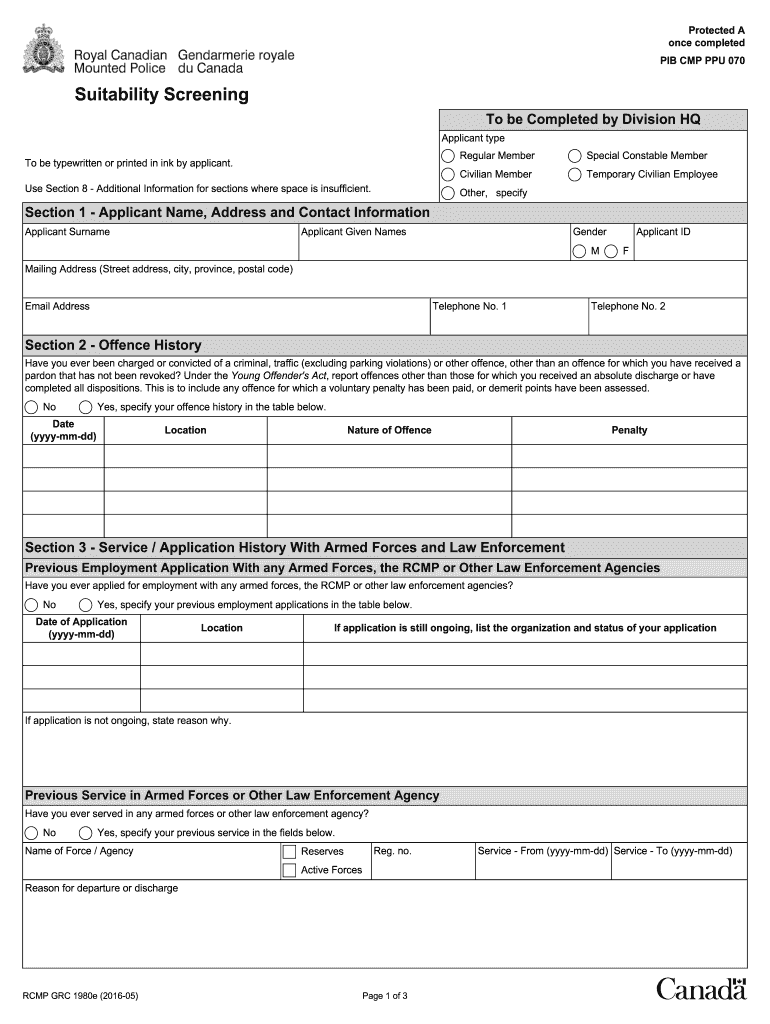
- Begin with Section 1. Fill in your name, address, and contact information. This includes your surname, given names, gender, applicant ID, mailing address, email address, and telephone numbers. Ensure all information is accurate.
- Proceed to Section 2 regarding your offence history. Answer whether you have been charged or convicted of any relevant offences. If yes, specify your offence history in the provided table detailing the date, location, nature of offence, and penalty.
- In Section 3, provide details of any previous employment applications with armed forces or law enforcement agencies. Answer whether you have applied previously and if yes, include the date of application, location, and current status.
- Continue in Section 3 with your previous service details if applicable. Include the name of the force or agency, whether you served in reserves or active forces, your registration number, and reason for departure.
- Move to Section 4 to disclose any personal, corporate, or business debts. Answer the question and specify details in the table if applicable.
- In Section 5, list the schools you attended in the last five years. Include the name of the school, location, and the dates you attended.
- Also in Section 5, provide information about any scholastic courses you are presently enrolled in or have completed since leaving school.
- Section 6 requires you to describe any particular skills or qualifications you possess.
- In Section 7, fill out the name of your present employer, current position, name of your immediate supervisor, and their contact details. Indicate whether your employment would be jeopardized if your employer is contacted.
- Section 8 allows for any additional information you may wish to include. Reference the relevant section numbers.
- Read through Section 9 carefully. Acknowledge the declaration by signing and dating the document, certifying that the information you provided is accurate.
- Finally, in Section 10, sign and date your acknowledgment of the mobility requirement as a member of the RCMP.
- Once all sections are completed, review your inputs for accuracy before deciding to save changes, download, print, or share the form.
Ensure all your documents are ready by completing forms online.
Experience a faster way to fill out and sign forms on the web. Access the most extensive library of templates available.
Related content
This study documents the emerging ~stem of services to victims of crime in Canada, and...
Restorative justice, community policing, and the Chicago school: Theory and context Two...
Jul 1, 2015 — New America is dedicated to the renewal of Ameri- can politics...
Get answers to your most pressing questions about US Legal Forms API.
How much does RCMP make in Canada?
Salaries for RCMP officers can vary widely based on rank, experience, and location. Generally, new recruits start with a salary of approximately $55,000, while experienced officers can earn over $100,000 annually. This compensation reflects the Canada RCMP GRC 1980e’s commitment to attracting and retaining skilled individuals in law enforcement.
What does RCMP do in Canada?
The RCMP fulfills a wide range of roles in Canada, from federal law enforcement to community policing. It investigates crimes, maintains peace, and engages with the community to build trust. The Canada RCMP GRC 1980e illustrates the versatility of the RCMP, emphasizing their commitment to serving and protecting all Canadians. For legal forms related to law enforcement and public safety, you can explore options on the US Legal Forms platform.
Who is eligible for RCMP in Canada?
Eligibility for joining the RCMP in Canada generally requires candidates to be Canadian citizens, at least 19 years old, and possess a valid driver's license. Furthermore, candidates must pass a rigorous selection process that includes a background check, physical fitness test, and medical examination. These criteria ensure that only the most qualified individuals can represent the values and standards of the Canada RCMP GRC 1980e.
How many references do you need for RCMP?
When applying to the Canada RCMP GRC 1980e, you typically need at least three references. These references should come from individuals who can vouch for your character, work ethic, and suitability for a career in law enforcement. Ensuring that your references provide positive and relevant information can significantly enhance your application. Reliable references indicate to the RCMP that you possess strong support from your community.
Do you have to be Canadian to be RCMP?
To join the Canada RCMP GRC 1980e, candidates must be Canadian citizens or have immigration status allowing them to work in Canada. The RCMP values a diverse workforce, and individuals from various backgrounds can bring unique perspectives into policing. As such, there are programs designed to encourage inclusivity while maintaining a strong commitment to Canadian values. This diversity enriches the community and enhances service delivery.
What's the highest rank in RCMP?
The highest rank in the Canada RCMP GRC 1980e is the Commissioner. This esteemed position leads the entire force and is pivotal in establishing priorities and policies. The Commissioner must possess a profound knowledge of public safety and law enforcement operations. Elevating to this rank requires years of dedication and exemplary performance within the RCMP.
What is the highest paying job in the RCMP?
In the Canada RCMP GRC 1980e, the highest paying position typically belongs to the Commissioner. This role involves overseeing all operations, budget allocation, and strategic direction of the RCMP. Individuals striving for this role often have extensive experience and a thorough understanding of law enforcement. As a leader, the Commissioner plays a vital role in shaping policies and practices within the RCMP.
Is RCMP equivalent to FBI?
The Royal Canadian Mounted Police (RCMP) is a federal as well as a national police force in Canada and constitutes the country's main force outside of Québec and Ontario. The RCMP is the Canadian equivalent of the American FBI.
How much do the RCMP get paid?
According to the RCMP's latest figures, last updated in 2016, a constable makes between $53,000 and $86,110, while a staff sergeant can make between $109,000 and just over $112,000.
How much do RCMP officers make in Canada?
Canada - RCMP The RCMP serve across the country, especially in smaller towns and communities. Their lowest salary is $53,144/year for an entry level constable. After three years, a constable can make $86,110/year. The absolute highest salary for officers in the RCMP is $146,735/year for a superintendent.
Use professional pre-built templates to fill in and sign documents online faster. Get access to thousands of forms.
If you believe that this page should be taken down, please follow our DMCA take down process here.