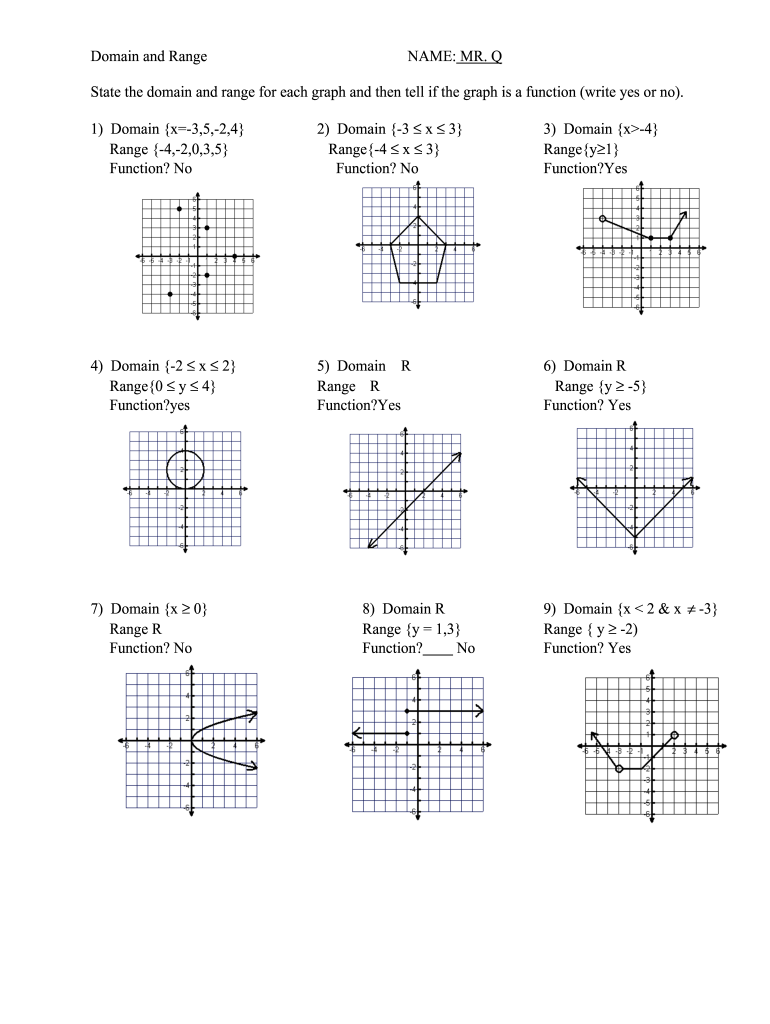
Domain and Range NAME: MR. Q State the domain and range for each graph and then tell if the graph is a function (write yes or no). 1) Domain x3,5,2,4 Range 4,2,0,3,5 Function? No 2) Domain 3 x 3 Range4.

Open form follow the instructions

Easily sign the form with your finger

Send filled & signed form or save
How to fill out the Domain and Range online
Filling out the Domain and Range form online can be straightforward when you know the necessary steps. This guide will assist you in accurately completing the form to analyze the relationships between variables.
Follow the steps to complete your Domain and Range form effectively.
- Click ‘Get Form’ button to access the form and open it in your chosen editor.
- Begin by entering your name in the designated field. This identifies who is completing the form.
- For each graph, review the Domain and Range sections. Clearly state the specific domain, which includes the set of x-values represented in the graph.
- Next, describe the range by detailing the set of y-values that correspond with the domain for that graph.
- Indicate whether the graph is a function by selecting 'Yes' or 'No' based on the criteria of passing the vertical line test.
- If applicable, state whether the function is discrete, continuous, or neither for those graphs identified as functions.
- Review all the inputs for accuracy before proceeding. Ensure domain, range, and function status are properly filled out.
- Once satisfied with your entries, save the changes made to the form, and utilize options to download, print, or share the completed document.
Start completing your Domain and Range form online now!
Experience a faster way to fill out and sign forms on the web. Access the most extensive library of templates available.
Related content
by S Arnold · 2004 · Cited by 5 — Now talk about domains and ranges of inverse...
The domain represents the inputs to a system or a function. The range is the set of...
Rather than expressing that an action has a fixed length of time we can express that an...
Get answers to your most pressing questions about US Legal Forms API.
How to write the domain and range of a step function?
To write the domain and range of a step function, first identify the input values at which the function changes. The domain typically consists of all real numbers within the defined intervals of the function. The range involves specifying the output levels that the function can take, often resulting in discrete values across different segments of the step function.
How do you work out domains and ranges?
Working out domains and ranges requires evaluating the function to locate its input and output values. Begin with the function's equation to determine permissible input values for the domain. Then, calculate the outputs for these inputs, allowing you to derive the range with a focus on accuracy and completeness.
How do you write the domain and range?
Writing the domain and range involves expressing the collected input and output values in a clear format. Use interval notation or set notation to list the domain, followed by a similar expression for the range. Ensuring clarity in your representation helps convey the relationship between inputs and outputs effectively.
How to set up domain and range?
Setting up the domain and range begins with analyzing the function's structure. Identify all possible input values to create the domain. Subsequently, evaluate the outputs produced by those inputs to establish the range, ensuring a comprehensive understanding of both aspects of the function.
How to arrange domain and range?
Arranging the domain and range involves systematic identification of all related values. Start by determining the domain through all viable input values of the function. Next, find the range by collecting each unique output that results from these inputs, thus providing a clear overview of all possible values.
How do you arrange domain and range?
To arrange the domain and range effectively, first identify the input values and their corresponding outputs from a function. List down all unique input values for the domain, ensuring that each value appears only once. Then, identify all output values to create the range, making sure that these values reflect the possible results of the input values.
How do you find the domain of a function of a function?
Finding the domain of a function of a function involves examining both the outer and inner functions. You need to ensure that every input for the outer function is also valid for the inner function. Familiarizing yourself with this concept is vital when analyzing complex functions, particularly when addressing the domain and range in advanced topics.
What is the domain of {( 2 3 4 6 4 6 5 1 5 0 0 6 4 3 )}?
For the set provided, the domain consists of unique values, which includes 0, 1, 2, 3, 4, 5, and 6. By disregarding duplicates, you can identify the domain effectively. Understanding how to extract unique inputs is essential for accurately determining the domain in any mathematical function.
What is the range of the given function {( 2 0 4 3 2 9 0 5 5 7 )}?
The range of the set reflects all unique output values obtained from the function. In this scenario, the unique outputs are 0, 2, 3, 4, 5, 7, and 9, leading to a range of these values. Noticing unique outputs helps clarify the concept of range in relation to domain and range analysis.
What is the domain of the given function {( 3 2 6 1 1 4 5 9 4 0 )}?
The domain for the function presented, which lists the numbers 0, 1, 2, 3, 4, 5, 6, and 9, includes all unique values. Thus, the domain consists of these unique inputs: 0, 1, 2, 3, 4, 5, 6, and 9. Recognizing these unique values helps you understand the fundamental concept of domain in this context.
Use professional pre-built templates to fill in and sign documents online faster. Get access to thousands of forms.
If you believe that this page should be taken down, please follow our DMCA take down process here.