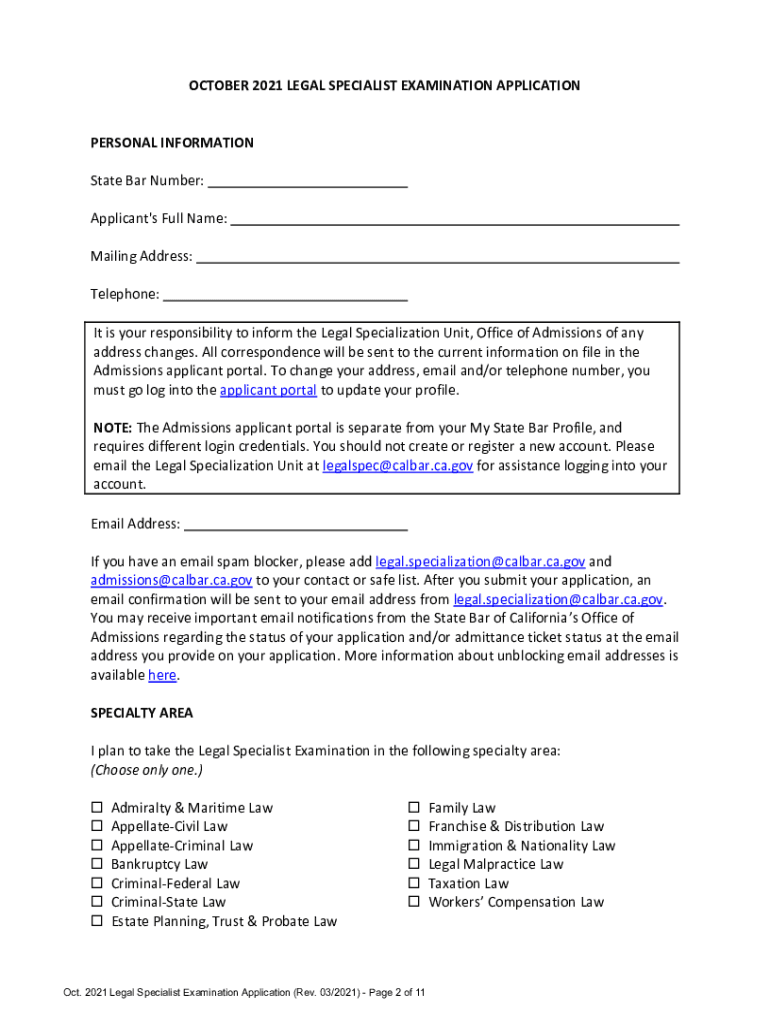
OFFICE OF ADMISSIONS CALIFORNIA BOARD OF LEGAL SPECIALIZATION OCTOBER 2021 LEGAL SPECIALIST EXAMINATION APPLICATIONPlease carefully read the instructions for application to take the Legal Specialist.

Open form follow the instructions

Easily sign the form with your finger

Send filled & signed form or save
How to fill out The Florida Bar 2023 Tax Law Application For Certification online
Filling out The Florida Bar 2023 Tax Law Application For Certification online is an essential step for practitioners seeking certification in tax law. This guide provides a clear breakdown of each component of the application, ensuring users can navigate the process with confidence.
Follow the steps to accurately complete your application.
- Click ‘Get Form’ button to obtain the form and access it in your preferred online editor.
- Begin by providing your personal information. This includes your full name, mailing address, and State Bar number. Ensure all information is accurate, as any discrepancies can delay processing.
- Next, select your specialty area for the Tax Law Certification. Choose only one option from the available specialties provided in the application.
- Indicate your eligibility by answering whether you have been practicing in the chosen specialty area since January 2020. Only those who answer 'YES' should proceed.
- Provide additional information on how you learned about the legal specialization program. This section allows you to check multiple sources if applicable.
- Select your examination method. Confirm your preference for a remote examination, in-person examination, or if you require specific accommodations.
- Acknowledge and accept the terms of the examination and testing conditions. Ensure you understand the requirements and adhere to them.
- Complete the certification declaration, ensuring all answers are truthful and compliant with the policies outlined for the examination.
- Finally, validate your application fee payment section. Make sure your payment method is correctly completed, and submit the form.
- After reviewing all sections for completeness, proceed to save your changes, download, print, or share the completed application as necessary.
Start your application process online today and ensure your certification in tax law.
Experience a faster way to fill out and sign forms on the web. Access the most extensive library of templates available.
Related content
Jan 1, 2023 — Applies to vehicles purchased and delivered between August 16, 2022, and...
The University of Miami School of Law offers seminars and workshops on bar preparation for...
Virtual Federal Tax Update Seminars 2023 ... Credits: 4; Format: OnDemand Webinar; Field...
Get answers to your most pressing questions about US Legal Forms API.
How do you transfer mineral rights after death in Texas?
Call the county where the minerals are located and ask how to transfer mineral ownership after death....They will probably require the following: Copy of the Death Certificate. Copy of the recorded will (or Affidavit of Heirship if there was no will) Probate documents. Completed W9 Form with the new owners' information.
How do I transfer ownership of mineral rights in Texas?
Transfer Your Mineral Rights Transfer by deed: You can sell your mineral rights to another person or company by deed. Transfer by will: You can specify who you want to inherit your mineral rights in your will. Transfer by lease: You can lease mineral rights to a third party through a lease agreement.
What happens to mineral rights when someone dies in Texas?
Like surface interests, mineral interests are passed down by inheritance. If there is a valid will, it controls who gets the property. If not, Texas laws of heirship controls.
Do mineral rights transfer with property in Texas?
Mineral rights are the rights to minerals and natural resources that are under the surface of a piece of property. Usually, the owner of the surface estate owns the mineral rights under the property. However, under Texas law, those rights can be sold or leased to another party.
Do mineral rights automatically convey in Texas?
While both surface and mineral rights are generally conveyed when the landowner acquires the land, it is far more common for the seller to retain mineral rights than surface rights (or for prior sellers in the chain of title of the property to have retained the mineral rights).
Do I own the mineral rights to my property?
Mineral rights are automatically included as a part of the land in a property conveyance, unless and until the ownership gets separated at some point by an owner/seller. An owner can separate the mineral rights from land by: Conveying (selling or otherwise transferring) the land but retaining the mineral rights.
How long can you keep mineral rights in Texas?
But, if after 10 years the mineral rights are not being exploited (there is no oil and gas exploration or production), then the mineral rights revert to the new surface owner.
Do you pay taxes on mineral rights in Texas?
Mineral interests are defined by the Texas Property Tax Code as real property and are subject to taxes the same as all other real property.
How long do mineral rights last in Texas?
In Texas, Oklahoma, Colorado and Montana, mineral owners can own the mineral rights indefinitely and there is no way for them to passively revert to the surface owner. If a surface owner wants to own the mineral rights under their land, they must find and contact the mineral owners and offer to purchase them.
Who owns the mineral rights to my property in Texas?
Usually, the owner of the surface estate owns the mineral rights under the property. However, under Texas law, those rights can be sold or leased to another party.
Use professional pre-built templates to fill in and sign documents online faster. Get access to thousands of forms.
If you believe that this page should be taken down, please follow our DMCA take down process here.