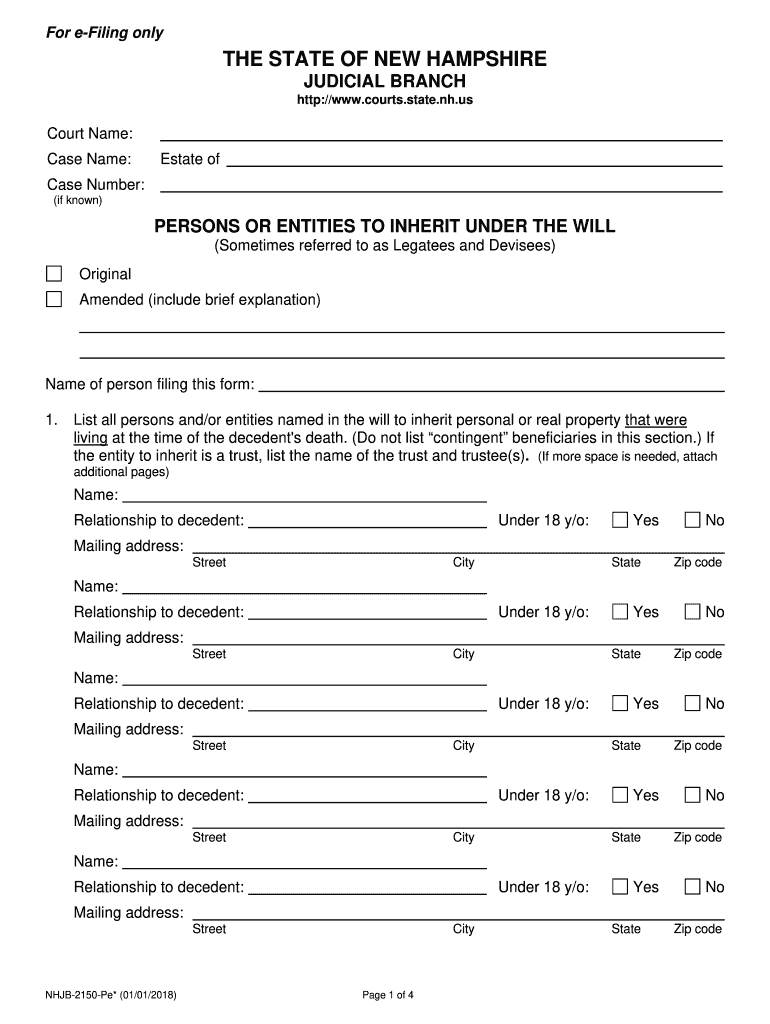
IES TO INHERIT UNDER THE WILL (Sometimes referred to as Legatees and Devisees) Original Amended (include brief explanation) Name of person filing this form: 1. List all persons and/or entities named in the will to inherit personal or real property that were living at the time of the decedent's death. (Do not list contingent beneficiaries in this section.) If the entity to inherit is a trust, list the name of the trust and trustee(s). (If more space is needed, attach additional pages) Na.
Loading

Open form follow the instructions

Easily sign the form with your finger

Send filled & signed form or save
How to fill out the NHJB-2150-Pe online
Filling out the NHJB-2150-Pe form is a necessary step in the estate management process. This guide provides clear, user-friendly instructions to help you accurately complete this form online.
Follow the steps to successfully fill out the NHJB-2150-Pe online.
- Click ‘Get Form’ button to obtain the form and open it in the editor.
- Begin by filling out the 'Court Name' and 'Case Name' sections at the top of the form. These details clarify the jurisdiction and the specific case related to the estate.
- In the 'Case Number' field, enter the case number if known. This aids in tracking and referencing your form accurately.
- In the 'Persons or Entities to Inherit Under the Will' section, specify whether your submission is an 'Original' or 'Amended' form. If it is amended, provide a brief explanation for the changes.
- List all individuals or entities specified in the will that were alive at the time of the decedent's death. Do not include contingent beneficiaries. Include the name of each person/entity, their relationship to the decedent, and if they were under 18 years old.
- Fill in the mailing address for each listed person or entity, ensuring correct details for effective communication.
- For any persons named in the will who were not alive at the decedent's death, enter their names with the date of death.
- Complete Section 2(1) by listing any contingent beneficiaries who must survive the decedent to inherit.
- If applicable, complete Section 2(2) by listing the children of the deceased beneficiaries who would have inherited under the will.
- In the next section, list the spouse and all known children of the decedent not mentioned as beneficiaries. Include any deceased children and their descendants, following the instructions carefully.
- Confirm that you have filled out the 'I state that on this date I am sending a copy of this document...' section accurately to comply with court rules.
- Finally, sign the form electronically, ensuring all your information, including contact details, is correct before submission.
- Once completed, save the changes, then download, print, or share the form as needed.
Complete your documents online today for a smooth filing process.
Experience a faster way to fill out and sign forms on the web. Access the most extensive library of templates available.
Related content
List of Interested Persons listing the names and addresses of those named in the Will, if...
When a person dies without a will, she is said to die “intestate. ... Those persons who...
Get answers to your most pressing questions about US Legal Forms API.
Who would inherit the estate?
If there is no surviving partner, the children of a person who has died without leaving a will inherit the whole estate. This applies however much the estate is worth. If there are two or more children, the estate will be divided equally between them.
Who to inherit from the will?
In terms of intestate succession law, only certain people, called beneficiaries, can inherit from the deceased's estate. These beneficiaries are: the deceased's legal spouse, children, blood relatives, and adopted children.
Who are the heirs of a deceased person?
An heir is a person who is entitled to inherit from a deceased estate because they are related. Heirs are a person's blood relatives, their surviving spouse (if applicable), and any adopted children.
Who will inherit the estate?
Heirs who inherit property are typically children, descendants, or other close relatives of the decedent. Spouses typically are not legally considered to be heirs, as they are instead entitled to properties via marital or community property laws.
Who inherits an estate in UK?
In England and Wales If the estate is worth less than £270,000, the spouse will inherit the entire estate. But if the estate is worth more than £270,000 and there are children: The spouse inherits up to £270,000 worth of assets, all the deceased's personal possessions, half of the remainder of the estate.
What is the order of inheritance in the UK?
In England and Wales, when someone dies intestate with no surviving spouse or civil partner, but with surviving children or other descendants, the whole estate passes to the children in equal shares. In cases where a son or daughter has died, their share of the inheritance will be divided among their children.
Who are the people who will inherit?
An heir is someone who's legally entitled to inherit your assets if you die intestate, meaning you pass away without a valid will or trust. Your heirs are people related to you by blood or marriage, like your spouse or children.
Who is a person who inherits?
An heir is a person who is legally entitled to collect an inheritance when a deceased person did not formalize a last will and testament. Generally speaking, heirs who inherit the property are children, descendants, or other close relatives of the decedent.
Use professional pre-built templates to fill in and sign documents online faster. Get access to thousands of forms.
If you believe that this page should be taken down, please follow our DMCA take down process here.