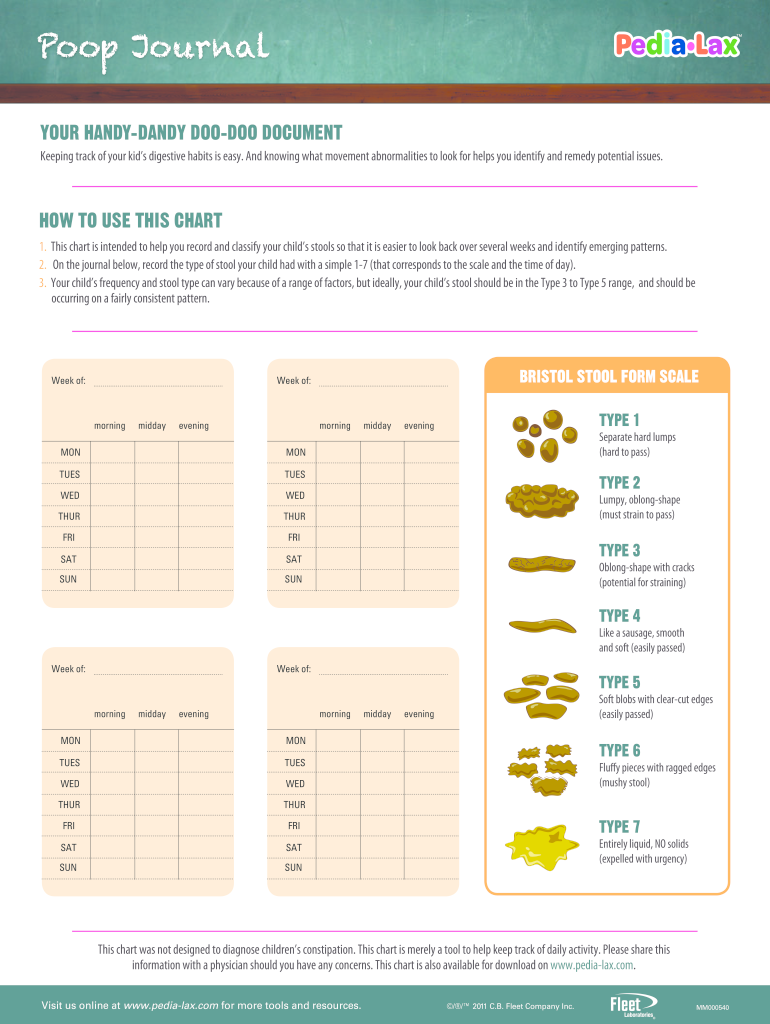
Issues. HOW TO USE THIS CHART 1. This chart is intended to help you record and classify your child s stools so that it is easier to look back over several weeks and identify emerging patterns. 2. On the journal below, record the type of stool your child had with a simple 1-7 (that corresponds to the scale and the time of day). 3. Your child s frequency and stool type can vary because of a range of factors, but ideally, your child s stool should be in the Type 3 to Type 5 range, and should.

Open form follow the instructions

Easily sign the form with your finger

Send filled & signed form or save
How to fill out the YOUR HANDY-DANDY DOO-DOO DOCUMENT online
Keeping track of your child’s digestive habits can be straightforward with the right tools. This guide aims to assist you in effectively filling out the YOUR HANDY-DANDY DOO-DOO DOCUMENT online, enabling you to monitor any changes and patterns in your child’s stool easily.
Follow the steps to accurately complete the form.
- Use the ‘Get Form’ button to access the document and open it in your preferred editor.
- Begin by entering the week of tracking at the top of the form. This will help you organize your records by date.
- For each day of the week, designate a specific section to record the type of stool your child had during the morning, midday, and evening. Use the Bristol Stool Form Scale to categorize each stool type.
- Observe and assign a simple number between 1 to 7 for the stool type based on the descriptions provided in the chart. Record your observations consistently throughout the week.
- Once you have completed filling out the chart for the week, review the entries to identify any patterns or areas of concern regarding your child's digestive health.
- Finally, ensure your changes are saved. You may choose to download, print, or share the document for better accessibility and consultation with your healthcare provider.
Start filling out the YOUR HANDY-DANDY DOO-DOO DOCUMENT online today to monitor your child's digestive health!
Experience a faster way to fill out and sign forms on the web. Access the most extensive library of templates available.
Related content
Repeat Chorus: Yankee Doodle keep it up, Yankee Doodle dandy! Mind the music and the step...
He's Got The Whole World In His Hands ............ 13 ... Going swimming, do do do do do...
Jan 3, 2023 — If you do, (Captain), a glorious future will surely await. Happy Birthday...
Get answers to your most pressing questions about US Legal Forms API.
How can I track my bowel movements?
You Might Also Like Bowelle - The IBS tracker. Health & Fitness. plop - poop tracker & analyzer. Health & Fitness. Happy Poop: Toilet Journal Log. Health & Fitness. Poo Keeper ◎ Log bowels & IBS. Health & Fitness. Simple Food Tracker Foodility. Health & Fitness. Bearable - Symptom Tracker. Health & Fitness.
What is the chart for bowel movements?
The Bristol Stool Chart is a tool used by your healthcare provider to assess your stool. The 7-point scale helps describe your stool shape and consistency. Based on the results, your provider can assess your bowel patterns and habits and order more tests as needed to figure out what may be causing your GI issues.
How do you keep a stool diary?
Fill in the diary for a whole week, or longer if your doctor or nurse asks for it. At the end of every day, check to make sure no poos were forgotten. Write in whatever laxatives have been taken that day, including the dose. Record the amounts of stool passed as small/medium/large etc. Poo Diary - ERIC eric.org.uk https://eric.org.uk › poo-diary eric.org.uk https://eric.org.uk › poo-diary
How do you document a bowel movement?
Document the amount (small, medium, or large), consistency (soft, formed, or hard) and color (brown or other color). Alterations in these characteristics can be caused by several conditions, such as infection, parasites, inflammatory conditions of the intestines, or gallbladder or liver conditions.
What is the chart to keep track of bowel movements?
The Bristol Stool Chart is a tool that helps people understand and describe different types of poop. It includes pictures and descriptions of seven different types of poop — ranging from watery and loose to hard and lumpy. By looking at the Bristol Stool Chart, you can get an idea of what might be normal or not normal. Bristol Stool Chart: Understanding the Different Types of Poop - GoodRx goodrx.com https://.goodrx.com › well-being › gut-health › bris... goodrx.com https://.goodrx.com › well-being › gut-health › bris...
What chart is used for assessing faeces?
The Bristol Stool Chart was developed in 1997 as a clinical assessment tool. There are seven types of stools (faeces) ing to the Bristol Stool Chart.
Use professional pre-built templates to fill in and sign documents online faster. Get access to thousands of forms.
If you believe that this page should be taken down, please follow our DMCA take down process here.