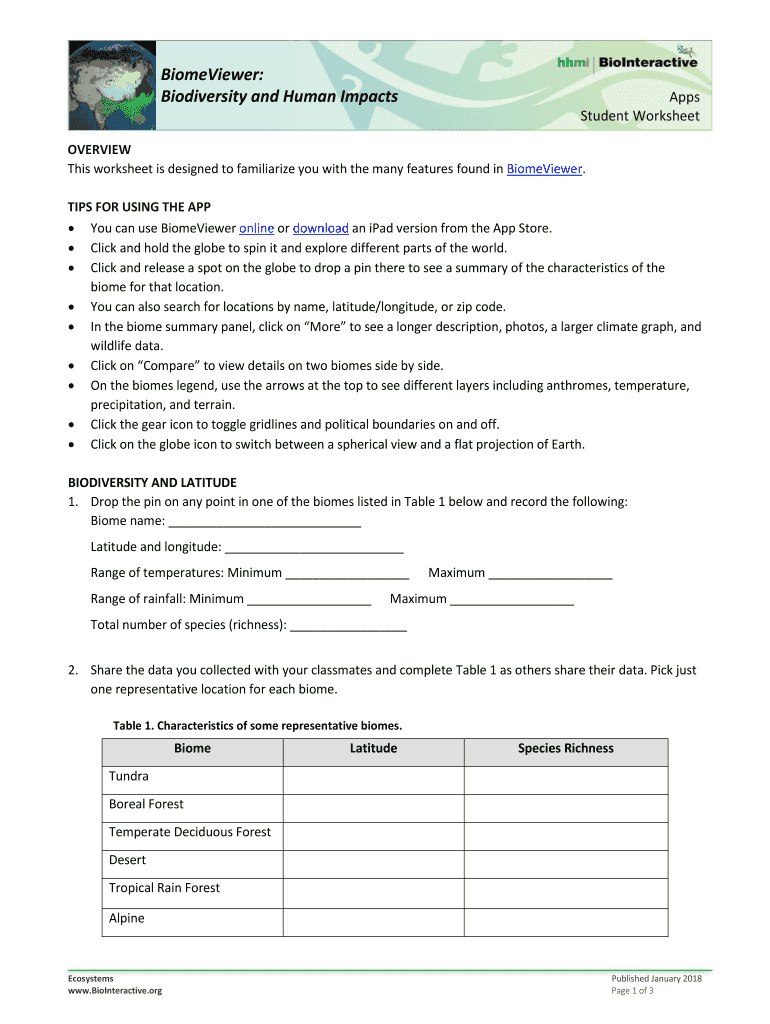
BiomeViewer: Biodiversity and Human ImpactsApps Student WorksheetOVERVIEW This worksheet is designed to familiarize you with the many features found in BiomeViewer. TIPS FOR USING THE APP You can.

Open form follow the instructions

Easily sign the form with your finger

Send filled & signed form or save
How to fill out the Biomeviewer Biodiversity And Human Impacts Answer Key online
The Biomeviewer Biodiversity And Human Impacts Answer Key is an essential tool for understanding the complex relationship between biodiversity and human impacts on various ecosystems. This guide will walk you through each step necessary to effectively complete this form online, ensuring a comprehensive understanding of your findings.
Follow the steps to successfully complete your answer key.
- Click the ‘Get Form’ button to obtain the Biomeviewer Biodiversity And Human Impacts Answer Key and access it in your document editor.
- Begin filling out the form by identifying a point in one of the biomes specified. Record the biome name, latitude and longitude, along with the minimum and maximum temperature and rainfall ranges as indicated.
- Share the data collected with your classmates to complete Table 1, ensuring that only one representative location is selected for each biome to compile accurate characteristics.
- Engage in an 'I see, I think, I wonder' activity by completing Table 2 based on the patterns observed from the data shared with classmates.
- Change to a flat map view and turn on gridlines. Use the compare function to analyze differences in rainfall and temperature patterns between the Sahara Desert and the Southeast Asia tropical rainforest.
- Return to your original biome and select the Anthrome layer for the year 2000. Identify the area with the highest human disturbance, and list the Anthromes for the years specified in the form.
- Summarize the human impacts on the environment over time, and record details regarding species richness and IUCN status for both the area with high disturbance and one with low disturbance.
- Complete any remaining sections of the form based on your analysis, then save changes, download the completed answer key, print it for physical submission, or share it as necessary.
Start filling out your Biomeviewer Biodiversity And Human Impacts Answer Key online today!
Experience a faster way to fill out and sign forms on the web. Access the most extensive library of templates available.
Related content
by EA Middlebrook · 2022 · Cited by 9 — Impacts. • Zoonoses caused by Brucella spp...
Based on BiomeViewer: Biodiversity and Human Impacts (hhmi BioInteractive) ... IN‐CLASS...
USAID Hay Tao will strengthen the capacity of key personnel in GOM institutions in...
Get answers to your most pressing questions about US Legal Forms API.
What patterns do you observe in biomes?
Biomes are regions showing similar temperature, elevation, humidity, precipitation, wind, and other rainfall patterns. It is more short term, and can change on an almost hourly basis! Weather-related climatic factors divide the climate into polar, temperate, arid, tropical, Mediterranean, and mountainous zones. Biomes and Climate Study Guide - Inspirit Learning Inc inspiritvr.com https://.inspiritvr.com › biomes-and-climate-study-g... inspiritvr.com https://.inspiritvr.com › biomes-and-climate-study-g...
Why there is a predictable pattern in terms of where biomes are located on Earth?
Explanation: Biomes are determined primarily by 1) temperature and 2) precipitation (see the image below). Thus, they are distributed throughout the planet in a somewhat predictable way. Generally speaking, temperatures decrease as we move away from the poles or as we increase in elevation. How are biomes distributed? - Socratic socratic.org https://socratic.org › questions › how-are-biomes-distribu... socratic.org https://socratic.org › questions › how-are-biomes-distribu...
What climatic patterns determine the type of biome an area will have?
Terrestrial biomes are distinguished primarily by their predominant vegetation, and are mainly determined by temperature and rainfall. Differences in temperature or precipitation determine the types of plants that grow in a given area (Figure 1). Terrestrial Biomes | Learn Science at Scitable - Nature nature.com https://.nature.com › scitable › knowledge › library nature.com https://.nature.com › scitable › knowledge › library
What are the characteristics of biomes?
A biome is an area classified ing to the species that live in that location. Temperature range, soil type, and the amount of light and water are unique to a particular place and form the niches for specific species allowing scientists to define the biome. However, scientists disagree on how many biomes exist. What Makes A Biome? - National Geographic Society nationalgeographic.org https://.nationalgeographic.org › article › what-mak... nationalgeographic.org https://.nationalgeographic.org › article › what-mak...
What can you infer from the patterns in biomes?
Expert-Verified Answer Patterns in biomes provide insights into how climate, geography, and biodiversity interplay, aiding our understanding of ecosystems and informing conservation efforts amid human impacts.
How do humans affect biodiversity?
The main direct cause of biodiversity loss is land use change (primarily for large-scale food production) which drives an estimated 30% of biodiversity decline globally. Second is overexploitation (overfishing, overhunting and overharvesting) for things like food, medicines and timber which drives around 20%.
Use professional pre-built templates to fill in and sign documents online faster. Get access to thousands of forms.
If you believe that this page should be taken down, please follow our DMCA take down process here.