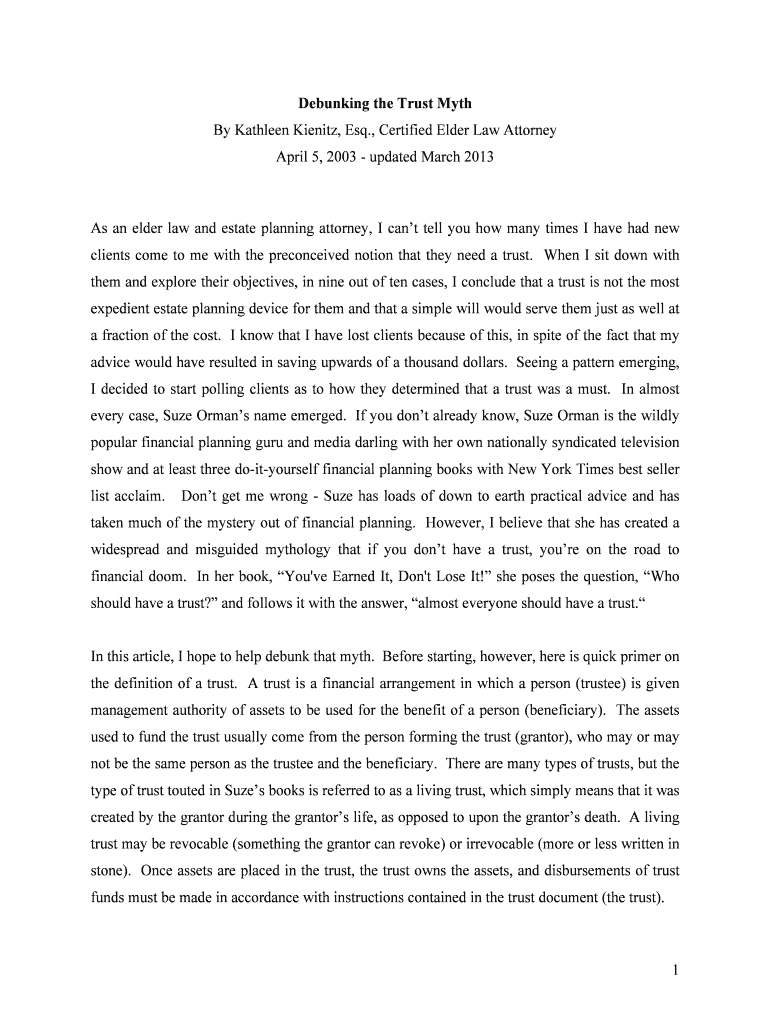
Debunking the Trust Myth By Kathleen Kienitz, Esq., Certified Elder Law Attorney April 5, 2003 updated March 2013As an elder law and estate planning attorney, I cant tell you how many times I have.
Loading

Open form follow the instructions

Easily sign the form with your finger

Send filled & signed form or save
How to fill out the Elder Law Attorney Debunking The Trust Myth online
Filling out the Elder Law Attorney Debunking The Trust Myth form is a valuable step in understanding the complexities of trusts and estate planning. This guide will provide you with a clear and straightforward method for completing the form to ensure you fully grasp the information presented.
Follow the steps to effectively complete the form.
- Press the 'Get Form' button to access and open the form in your preferred online platform.
- Begin by reviewing the introductory section of the form. This section outlines the purpose of the document and provides essential background information on trusts as discussed by the author.
- Next, fill in any personal information requested, such as your name, contact details, and any relevant identifiers. Ensure each field is completed accurately for effective communication.
- Read through the key points related to trusts that dispel common myths. Take notes or highlight sections that pertain to your situation to facilitate understanding.
- If applicable, answer any questions within the form regarding your current estate planning situation or beliefs about trusts. Be honest and thorough to make the most of the information provided.
- Once you have completed all relevant sections, review your entries for accuracy and completeness. Make necessary adjustments to ensure clarity and correctness.
- Finally, you can save your changes, download a copy for your records, or print the form for offline use. Sharing the completed document with relevant parties is also encouraged for collaborative discussions.
Take the next step and complete your documents online to enhance your understanding of estate planning.
Experience a faster way to fill out and sign forms on the web. Access the most extensive library of templates available.
Related content
DEBUNKING THE MYTHS ABOUT REVOCABLE TRUSTS. Several myths surround revocable trusts...
by CN Chatman · 2020 · Cited by 16 — ABSTRACT. Notwithstanding the political...
The idea is that an individual's debts, liabilities, taxes and legal responsibilities...
Get answers to your most pressing questions about US Legal Forms API.
What are the drawbacks of an alter ego trust?
Alter Ego and Joint Partner Trusts – Disadvantages The settlor must be at least 65 at the time the trust was created. The trust is created after 1999. In the case of an alter ego trust the settlor must be entitled to receive all the income of the trust that arises before his or her death.
How does a trust work in Maine?
When you create a living trust in Maine you are able to maintain control over your assets during life and also after you die. While you are alive, you can use, manage, spend, and give away the trust assets any way you wish. You can move assets into and out of the trust at any time.
What is the difference between joint spousal trust and alter ego trust?
In a joint partner trust, the settlor's spouse must also be a Canadian resident. In an alter ego trust, only the settlor is entitled to income. In a joint partner trust, only the settlor and the settlor's spouse are entitled to income.
What is the difference between inter vivos and alter ego trust?
The assets listed in an inter vivos trust are used for the benefit of the Settlor, being the individual creating the trust, and once the Settlor passes away, then the assets are distributed to the designated beneficiaries in ance with the trust. An Alter Ego Trust, is a special type of inter vivos trust.
What is an alter ego trust?
Alter Ego Trust is a special type of trust permitted under the Income Tax Act (Canada) (the “Act”), under which you are the Settlor, Trustee and Beneficiary for as long as you are living.
Who controls an alter ego trust?
With an alter ego trust, if you no longer wish to manage the assets or become incapacitated during your lifetime, the assets will continue to be managed by your co-trustee or named alternate trustee, in a seamless fashion.
Use professional pre-built templates to fill in and sign documents online faster. Get access to thousands of forms.
If you believe that this page should be taken down, please follow our DMCA take down process here.