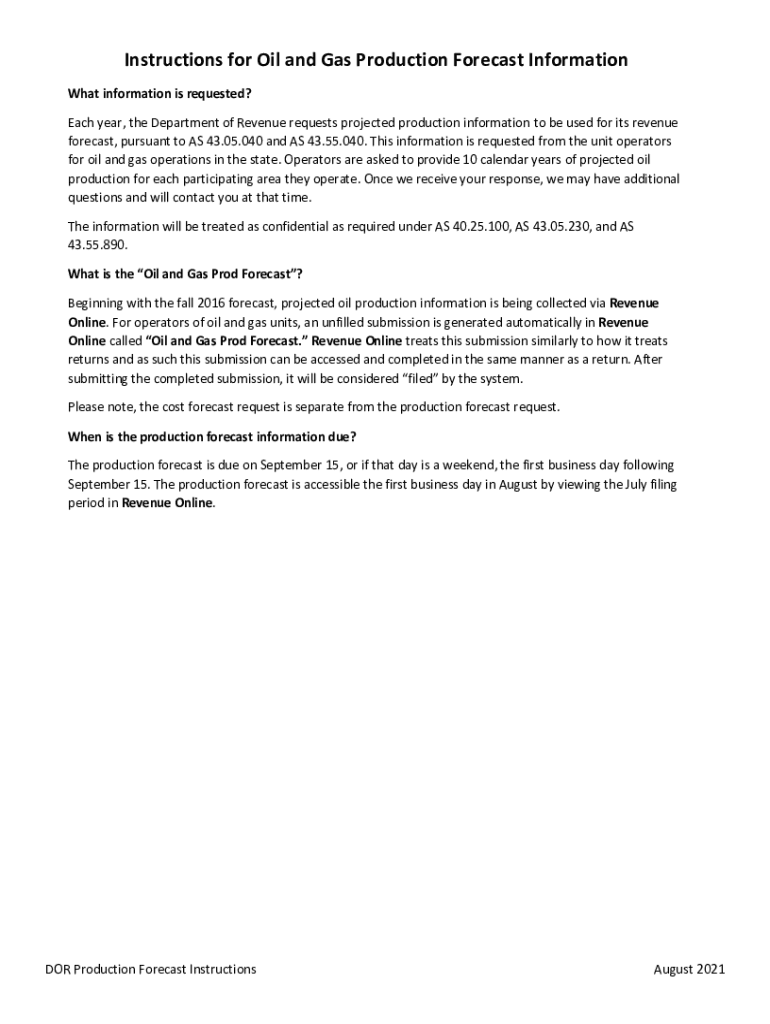
Instructions for Oil and Gas Production Forecast Information What information is requested? Each year, the Department of Revenue requests projected production information to be used for its revenue forecast,.
Loading

Open form follow the instructions

Easily sign the form with your finger

Send filled & signed form or save
How to fill out the EIA Forecasts Crude Oil Prices Will Decline During 2022 ... online
This guide provides clear and comprehensive instructions for completing the EIA Forecasts Crude Oil Prices Will Decline During 2022 form online. Whether you are familiar with the process or new to it, this step-by-step guide will support you in ensuring accurate and timely submission.
Follow the steps to successfully complete the EIA forecast form.
- Click the ‘Get Form’ button to access and open the EIA Forecasts Crude Oil Prices Will Decline During 2022 form in your document management system.
- Review the introductory information on the form to understand its purpose and the type of data required. Ensure you are familiar with the projected oil production data needed for completion.
- Begin filling out the user information section. This includes providing the name and contact details of the individual who will be responsible for any queries regarding the forecast. Ensure the company name, ID, and address fields are automatically populated or input them manually if not.
- If applicable, utilize the data import option for previous years' information. Click on the provided link to upload data in .xls or .xlsx format. If entering data manually, proceed to the next step.
- Enter the participating areas by selecting each area from the dropdown menu. Input the necessary unit and property codes you operate.
- Input your reserve estimate totals for each area. Ensure you provide the required original oil reserve estimates and any end-of-life projections.
- Detail your monthly production forecast. Enter average daily oil production figures for each month, and clarify whether these are included in the proved reserve estimate.
- Elaborate on your annual production forecast by providing average daily oil production projections for each calendar year. Again, indicate if these estimates are included in the proved reserves.
- Record any planned downtime for maintenance or expansion activities. Select ‘Add a Record’ to detail the required information. You can apply changes on a per-area basis or unit-wide.
- Document any instances of unplanned downtime. This should encompass both past occurrences and future estimates, entered as a percentage.
- Catalog planned drilling activities for the upcoming years by selecting ‘Add a Record’ and filling out the necessary details.
- If there are any plans for surface facility activities, such as exploration or transportation lines, select ‘Add a Record’ to provide the relevant details.
- Enter any planned activities for enhanced recovery methods, using the ‘Add a Record’ function to supply the necessary information.
- If there are additions or contractions in field expansions, select ‘Add a Record’ to capture this information.
- Detail the current rig activity, again using the ‘Add a Record’ option for completion.
- Complete your submission by reviewing all information for accuracy. Once verified, click ‘Submit’ and e-sign your document using your online access credentials.
Start completing your EIA Forecasts form online now for accurate oil price projections.
Experience a faster way to fill out and sign forms on the web. Access the most extensive library of templates available.
Related content
Nov 18, 2021 — EIA forecasts crude oil prices will decline during 2022 ... Since the...
Oct 1, 2021 — The Gulf Coast Energy Outlook (GCEO) would not have been possible without...
26 Nov 2019 — The World Energy Outlook does not provide a forecast of what will happen...
Get answers to your most pressing questions about US Legal Forms API.
What will EIA oil price be in 2023?
“We expect that the Brent crude oil spot price will fall from an average of $84 per barrel in the second quarter of 2023 to $81 per barrel in 4Q23, and then average $78 per barrel in 2024,” the EIA stated in its latest STEO.
What is the fuel forecast for EIA?
We forecast that retail prices for regular-grade gasoline will average $3.32 per gallon (gal) in 2023 and continue to decrease to average $3.09/gal in 2024, down from $3.96/gal in 2022. We expect on-highway diesel prices to decrease to average $4.23/gal in 2023 before decreasing further to $3.70/gal in 2024.
What will EIA say about oil production in 2023?
Despite the declines in March, recent petroleum exports from Russia have outpaced expectations, and we have revised our oil production forecast for Russia upwards by 0.4 million b/d in 2023. Overall, we expect global oil and liquid fuels production will average 101.5 million b/d in 2023, up 1.6 million b/d from 2022.
What is the EIA oil production outlook?
We expect that the Brent spot price will average $85/b in the first half of 2023 (1H23). However, we expect global oil production to continue to outpace demand over the forecast period, leading to persistent global oil inventory builds through 2024 and falling oil prices.
What is the forecast for crude oil prices 2022?
Slowing global growth and concerns about a global recession have thus far outweighed worries about insufficient oil supply. Oil prices are forecast to average $92/bbl in 2023 and $80/bbl in 2024, down from a projected $100/bbl in 2022.
What is the oil market outlook for 2023?
Following an 80 kb/d contraction in 4Q22, world oil demand growth is set to accelerate sharply over the course of 2023, from 710 kb/d in 1Q23 to 2.6 mb/d in 4Q23. Average annual growth is forecast to ease from 2.3 mb/d in 2022 to 2 mb/d, and global oil demand to reach a record 102 mb/d.
Are oil prices projected to go down?
In our January 2023 Short-Term Energy Outlook, we forecast the Brent crude oil price (the global benchmark) will rise from an average $81 per barrel (b) in December 2022 to average $83/b in the first quarter of 2023 (1Q23).
What is the outlook for EIA crude oil demand?
Globally, liquid fuels consumption in our forecast increases from an average of 99.4 million barrels per day (b/d) in 2022 to 100.9 million b/d in 2023, which is 0.4 million b/d higher than in last month's outlook. The higher consumption forecast is primarily driven by upward revisions to global economic growth.
Use professional pre-built templates to fill in and sign documents online faster. Get access to thousands of forms.
If you believe that this page should be taken down, please follow our DMCA take down process here.