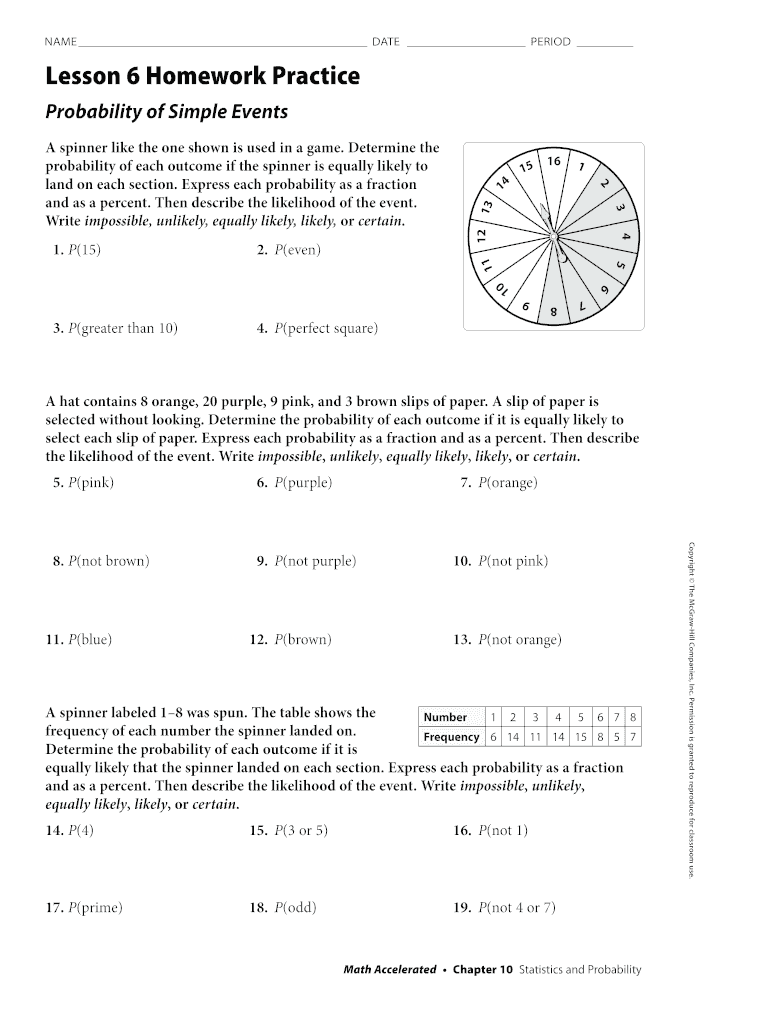
NAME DATE PERIOD Lesson 6 Homework Practice Probability of Simple Events1413 124. P(perfect square)6105113. P(greater than 10)142. P(even)1631. P(15)152A spinner like the one shown is used in a game.
Loading

Open form follow the instructions

Easily sign the form with your finger

Send filled & signed form or save
How to fill out the Lesson 1 Homework Practice Probability Of Simple Events online
This guide aims to provide clear and supportive instructions on how to effectively fill out the Lesson 1 Homework Practice Probability Of Simple Events form online. By following these steps, users can confidently navigate through the necessary fields and sections to complete their homework successfully.
Follow the steps to complete your homework practice effectively.
- Click the ‘Get Form’ button to acquire the Lesson 1 Homework Practice Probability Of Simple Events form and open it in your preferred online editor.
- Begin by entering your name in the designated field at the top of the form. This helps to identify your submission distinctly.
- Next, input the date on which you are completing the homework. This is usually required for tracking purposes.
- In the period field, specify the class or period during which you are undertaking this assignment.
- Proceed to answer each probability question listed in the form. For instance, questions like P(even) will require you to calculate the probability of drawing an even number. Make sure to express your answers as both fractions and percentages.
- For questions involving scenarios with spinners or colors, read the prompt carefully. For each scenario mentioned, calculate the probabilities according to the outcomes specified and articulate the likelihood (using terms like impossible, likely, etc.) in the provided space.
- Continue filling out the form by addressing all the questions sequentially. Ensure each response is complete before moving to the next.
- Once all fields are filled and checked for accuracy, you can save your changes. Most online editors offer options to either download, print, or share the completed form. Choose the option that suits your requirements.
Take action now and complete your Lesson 1 Homework Practice online!
Experience a faster way to fill out and sign forms on the web. Access the most extensive library of templates available.
Related content
Older students should understand the difference between simple and compound events, like...
Chapter 10. Probability and Statistics. Help with Homework. 1. VOCABULARY Explain how to...
Glencoe/McGraw-Hill, a division of The McGraw-Hill Companies, Inc. Word Problem Practice...
Get answers to your most pressing questions about US Legal Forms API.
What is an example of a simple event vs compound event?
Simple events are events where one experiment happens at a time and it will have a single outcome such as tossing a coin. Compound events are events where there is more than one possible outcome such as roll a five using a 6-sided die.
What is an example of a simple event in statistics?
An event that has a single point of the sample space is known as a simple event in probability. For example, the probability of getting a 3 when a die is tossed. In the case of a simple event, the numerator (number of favourable outcomes) will be 1.
What is the experimental probability of a simple event?
You can use experimental probability to approximate the probability of an event. An experimental probability of an event is found by comparing the number of times the event occurs to the total number of trials. When there is only one outcome for an event, it is called a simple event .
What is an example of a simple probability?
For example, if you throw a die, then the probability of getting 1 is 1/6. Similarly, the probability of getting all the numbers from 2,3,4,5 and 6, one at a time is 1/6.
How do you find the probability of a simple event?
How do you calculate the probability of an event? The probability of an event is given by, P(E) = number of favourable outcomes/total number of outcomes.
What is an example of a simple event?
A simple event is one that can only happen in one way - in other words, it has a single outcome. If we consider our previous example of tossing a coin: we get one outcome that is a head or a tail.
What is an example of a simple event quizlet?
An event with a single outcome in its most basic form that cannot be simplified. An example of a simple event is rolling a five with a single die.
What are the examples of probability of simple events?
In probability terms, a simple event refers to an event with a single outcome, for example, getting “heads” with a single toss of a coin, or rolling a 4 on a die.
Use professional pre-built templates to fill in and sign documents online faster. Get access to thousands of forms.
If you believe that this page should be taken down, please follow our DMCA take down process here.