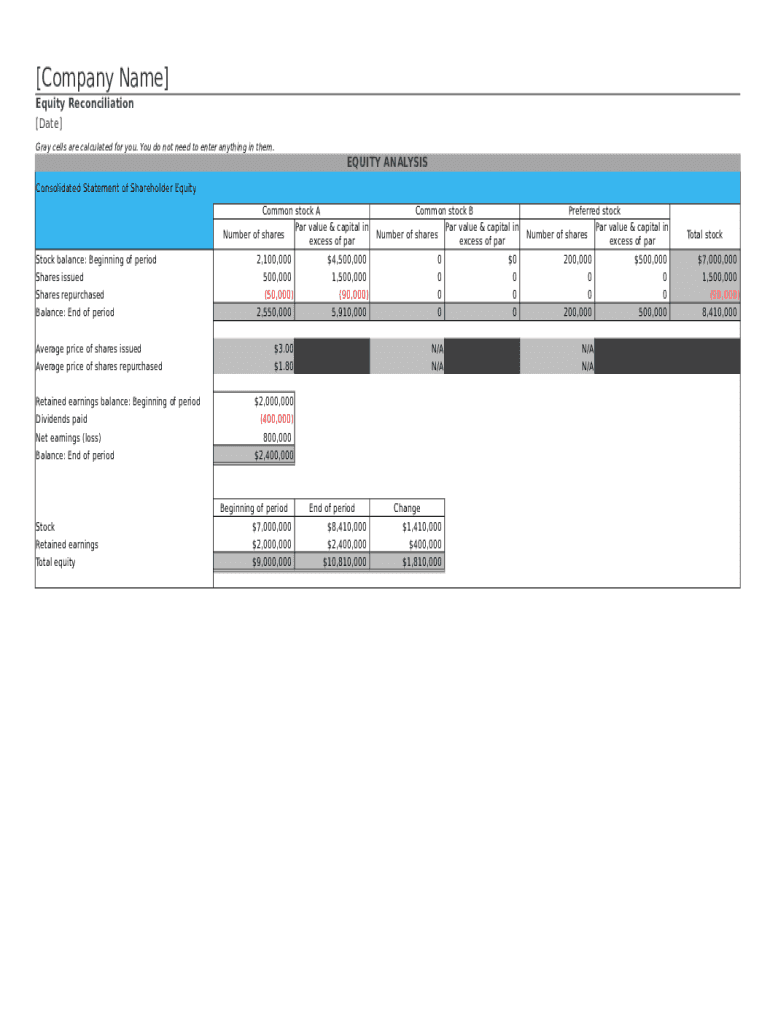
Company Name Equity Reconciliation Date Gray cells are calculated for you. You do not need to enter anything in them.EQUITY ANALYSIS Consolidated Statement of Shareholder Equity Common stock A Par.
Loading

Open form follow the instructions

Easily sign the form with your finger

Send filled & signed form or save
How to fill out the Shareholder Equity Report online
The Shareholder Equity Report is a vital document that reflects a company's equity position. This guide will assist you in accurately completing the report online, ensuring that all necessary information is recorded correctly.
Follow the steps to successfully complete the Shareholder Equity Report online.
- Click ‘Get Form’ button to obtain the form and open it in the editor.
- Begin by reviewing the consolidated statement of shareholder equity section. This section provides an overview of common stock A and common stock B, including details such as the number of shares, stock balance at the beginning of the period, shares issued, shares repurchased, and the ending balance.
- In the common stock A section, enter the par value and capital in excess of par for your common stock. Input the number of shares at the beginning of the period and any shares issued during the reporting period.
- Record the number of shares that were repurchased during the period. The balance at the end of the period will be automatically calculated for you.
- Next, move to the retained earnings section. Input your beginning balance of retained earnings, dividends paid during the period, and net earnings or loss. The ending balance will also be calculated for you.
- Repeat similar entries for common stock B, ensuring you fill out the par value, number of shares, and any issued shares accurately.
- Continue with the preferred stock section, recording the necessary values for par value, number of shares, and any changes during the reporting period.
- Lastly, review the total equity section to confirm that all calculations are correct. After ensuring accuracy in all fields, you can save your changes, download, print, or share the completed form.
Complete your Shareholder Equity Report online today to ensure accurate financial reporting.
Experience a faster way to fill out and sign forms on the web. Access the most extensive library of templates available.
Related content
... 2003, we have appraised the shareholders' equity of Telesp Celular Participações...
Chapter 11 - REPORTING AND ANALYZING STOCKHOLDERS' EQUITY. LO 1: Describe the major...
Financial · Internal · Firms · Report. show. People and organizations. Accountants ·...
Get answers to your most pressing questions about US Legal Forms API.
How is shareholders equity calculated?
Shareholders' equity may be calculated by subtracting its total liabilities from its total assets both of which are itemized on a company's balance sheet. Total assets can be categorized as either current or non-current assets.
What is reported on the statement of stockholders equity?
The statement of shareholders' equity is a financial document a company issues as part of its balance sheet. It highlights the changes in value to stockholders' or shareholders' equity, or ownership interest in a company, from the beginning of a given accounting period to the end of that period.
What is shareholders equity on a balance sheet?
Stockholders Equity (also known as Shareholders Equity) is an account on a company's balance sheet. These statements are key to both financial modeling and accounting that consists of share capital plus retained earnings. It also represents the residual value of assets minus liabilities.
Examples of stockholders' equity accounts include:
Common Stock.Preferred Stock.Paid-in Capital in Excess of Par Value.Paid-in Capital from Treasury Stock.Retained Earnings.Accumulated Other Comprehensive Income.Etc.
What is included in shareholders equity?
Shareholders equity is the difference between total assets and total liabilities. It is also the Share capital retained in the company in addition to the retained earnings minus the treasury shares. ... Shareholders equity is also called Share Capital, Stockholder's Equity or Net worth.
What are the two components of shareholders equity?
The shareholders' equity section of a corporate balance sheet consists of two major components: (1) contributed capital, which primarily reflects contributions of capital from shareholders and includes preferred stock, common stock, and additional paid-in capital3 less treasury stock, and (2) earned capital, which ...
How do you record shareholders equity?
Stockholders' equity refers to the assets remaining in a business once all liabilities have been settled. This figure is calculated by subtracting total liabilities from total assets; alternatively, it can be calculated by taking the sum of share capital and retained earnings, less treasury stock.
How do you find shareholders equity?
How to Calculate Shareholders' Equity. Shareholders' equity may be calculated by subtracting its total liabilities from its total assets both of which are itemized on a company's balance sheet. Total assets can be categorized as either current or non-current assets.
What is included in stockholders equity?
Stockholders' equity is the total amount of capital given to a company by its shareholders in exchange for stock, plus any donated capital or retained earnings. ... In other words, stockholders' equity is the total amount of assets that the investors will own once debts and liabilities are paid off.
Use professional pre-built templates to fill in and sign documents online faster. Get access to thousands of forms.
If you believe that this page should be taken down, please follow our DMCA take down process here.