Loading
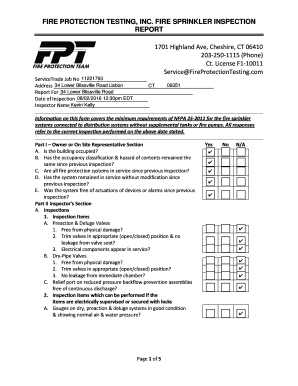
Get Fire Protection Testing, Inc. Fire Sprinkler Inspection Report
How it works
-

Open form follow the instructions
-

Easily sign the form with your finger
-

Send filled & signed form or save
How to fill out the FIRE PROTECTION TESTING, INC. FIRE SPRINKLER INSPECTION REPORT online
Filling out the FIRE PROTECTION TESTING, INC. FIRE SPRINKLER INSPECTION REPORT form online is essential for documenting the status of your fire sprinkler systems. This guide provides clear, step-by-step instructions to help users complete the form accurately and efficiently.
Follow the steps to complete the inspection report online:
- Click ‘Get Form’ button to access the report and open it in the editing interface.
- Begin filling out the top section of the form, which includes the address of the property being inspected along with the date and time of the inspection.
- In Part I, the Owner or On-Site Representative Section, answer the series of questions regarding the building's occupation and the status of fire protection systems.
- Proceed to Part II, the Inspector’s Section. Carefully inspect and record the condition of various components such as preaction and deluge valves, dry-pipe valves, and gauges.
- Continue through the inspection items ensuring all sections are filled out based on the physical inspection, including the control valves and fire department connections.
- Once the main checklist is completed, move to the Table section and provide necessary specifications about control valves, indicating whether they are open, secured, or closed.
- Complete the testing section by filling in data regarding various tests performed on the fire sprinkler system.
- After all sections are accurately completed, review the form for any errors or incomplete fields.
- Save your progress frequently and make sure to download or print the completed report for your records or for sharing as needed.
Begin filling out your FIRE SPRINKLER INSPECTION REPORT online today to ensure compliance and safety.
Weekly maintenance check and record all water and air pressure gauges. check and record all water levels. check and record the correct position of all stop valves. carry out a water flow alarm test (gong/bell) for 30 seconds and record results.