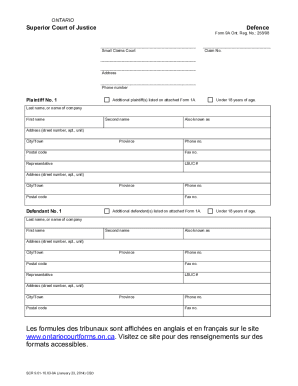
why, and if there is anything you agree with. Attach copies of any documents that help your case. If you want to pay all or part of the amount owing, state how much you will pay and when you will pay. If there is more than one plaintiff or defendant, complete an Additional Parties form (Form 1A) and put it right behind page one of your defence form. You can get the additional parties form and other forms at the court office or online at www.ontariocourtforms.on.ca. Step 2: SERVE your completed .
Open form follow the instructions
Easily sign the form with your finger
Send filled & signed form or save
How to fill out the Ontario SCR 9.01-10.03-9A online
Filling out the Ontario SCR 9.01-10.03-9A form can be a straightforward process when you follow the right guidelines. This guide provides step-by-step instructions to help you navigate each section effectively.
Follow the steps to complete your form online.
- Click 'Get Form' button to obtain the Ontario SCR 9.01-10.03-9A form and open it in your preferred document editor.
- Verify that your name and address are correct in the designated fields. This ensures that you receive any important documents related to your case.
- Clearly state the points you disagree with regarding the claim and provide an explanation for each disagreement. If you agree with any part of the claim, be sure to note this as well.
- Attach any relevant documents that support your case. Ensure you indicate why any missing evidence cannot be provided.
- If you intend to propose a payment plan, specify how much you are willing to pay and when the payments will commence.
- If there are multiple plaintiffs or defendants involved, complete the Additional Parties form (Form 1A) and attach it immediately behind the first page of your defence form.
- Once you have completed the Defence form, serve it along with all attachments to every other party involved in the case. You will also need to fill out the Affidavit of Service (Form 8A).
- Next, file your Defence form and Affidavit of Service at the court office where the claim was initially filed. Ensure that you do this within 20 days of receiving the claim.
- Pay the court filing fee associated with your submission. Check with the court office for the current fees and the acceptable payment methods.
- After completing these steps, you may save changes, download, print, or share the form as needed for your records or further actions.
Complete your documents online today to ensure a smooth and efficient process.
Experience a faster way to fill out and sign forms on the web. Access the most extensive library of templates available.
Related content
Nov 7, 2023 — renewable sources of power. Demand for fossil fuels surely will overrun...
Apr 22, 1982 — ... Ontario Kl A 0R6, Canada. G.P. GOPAL. Rutherford and Appleton...
Get answers to your most pressing questions about US Legal Forms API.
Is Ontario Small Claims Court worth it?
Yes, Ontario Small Claims Court can be a practical option for resolving disputes, particularly for claims under a specific monetary limit. It provides a more accessible and less formal environment than higher courts, as outlined in the Ontario SCR 9.01-10.03-9A. This approach allows individuals and businesses to seek justice without extensive legal knowledge or resources, making it worth considering for those with straightforward cases.
How to collect on a judgement in Ontario?
Collecting on a judgment in Ontario involves understanding your rights and available methods under the Ontario SCR 9.01-10.03-9A. Start by checking the debtor's financial status to identify reachable assets. Employ garnishment or pursue asset seizure through the courts if necessary. Additionally, consider seeking assistance through legal aid or services like uslegalforms to streamline your collection efforts.
How do I collect a judgement in Ontario?
To collect a judgment in Ontario, you can employ various methods as established in the Ontario SCR 9.01-10.03-9A. This includes garnishing the debtor's wages, placing liens on properties they own, or seeking a court order for asset seizure. Document every step you take, as this evidence may be useful in further legal proceedings. If needed, legal platforms like uslegalforms can guide you through the necessary steps.
What happens if you ignore a statement of claim in Ontario?
Ignoring a statement of claim in Ontario means you risk losing by default. Under the Ontario SCR 9.01-10.03-9A, the plaintiff may pursue default judgment, which allows them to collect the amount claimed without your input. This outcome typically results in additional legal costs for you, making it beneficial to respond promptly rather than ignoring the claim.
Are Judgments hard to collect?
Collecting a judgment can pose challenges, and many factors influence the process. The debtor's financial situation plays a significant role, as judgments are easier to collect when the debtor has available assets. Additionally, navigating the legalities of Ontario SCR 9.01-10.03-9A may require assistance. It's wise to seek help from legal professionals or resources like uslegalforms to simplify the process.
What is the best way to collect a Judgment?
To effectively collect a judgment, start by identifying the assets of the judgment debtor. Under the Ontario SCR 9.01-10.03-9A, you can take various actions such as garnishment of wages or bank accounts. You may also consider seizing property, but this process requires compliance with specific legal procedures. Utilizing professional services might enhance your chances of collecting your judgment successfully.
How do I file a notice of intent to defend in Ontario?
Filing a notice of intent to defend in Ontario under the Ontario SCR 9.01-10.03-9A requires clear steps. First, you need to complete the appropriate form, which is available from the courthouse or online. Next, ensure you file it with the court where the statement of claim was issued, along with any required documents. Finally, serve a copy of your notice to the plaintiff to formally indicate your intent to defend.
How to note defendant in default in Ontario?
To note a defendant in default in Ontario, you must file Form 48D with the court and serve it on the defendant, in line with Ontario SCR 9.01-10.03-9A. Ensure that you meet all required deadlines and procedures for this process. Noting a defendant in default allows you to seek a default judgment, thereby reinforcing your position in the litigation.
How to set matter down for trial in Ontario Small Claims Court?
To set a matter down for trial in Ontario Small Claims Court, you must file a Notice of Trial, as prescribed in Ontario SCR 9.01-10.03-9A. This notice should include relevant details like the case number and the preferred dates for trial. Ensure that all parties involved are notified of the trial date. This initiative helps in progressing your claim towards resolution.
How do I fill out an Affidavit of service Ontario?
Filling out an Affidavit of service in Ontario requires you to provide specific details about the service process. Start by including the case number, parties involved, and details about how and when you served the documents. Make sure to comply with Ontario SCR 9.01-10.03-9A to ensure the affidavit is valid and actionable. Utilizing platforms like uslegalforms can streamline this process.
Use professional pre-built templates to fill in and sign documents online faster. Get access to thousands of forms.
If you believe that this page should be taken down, please follow our DMCA take down process here.
This form is available in several versions. Select the version you need from the drop-down list below.