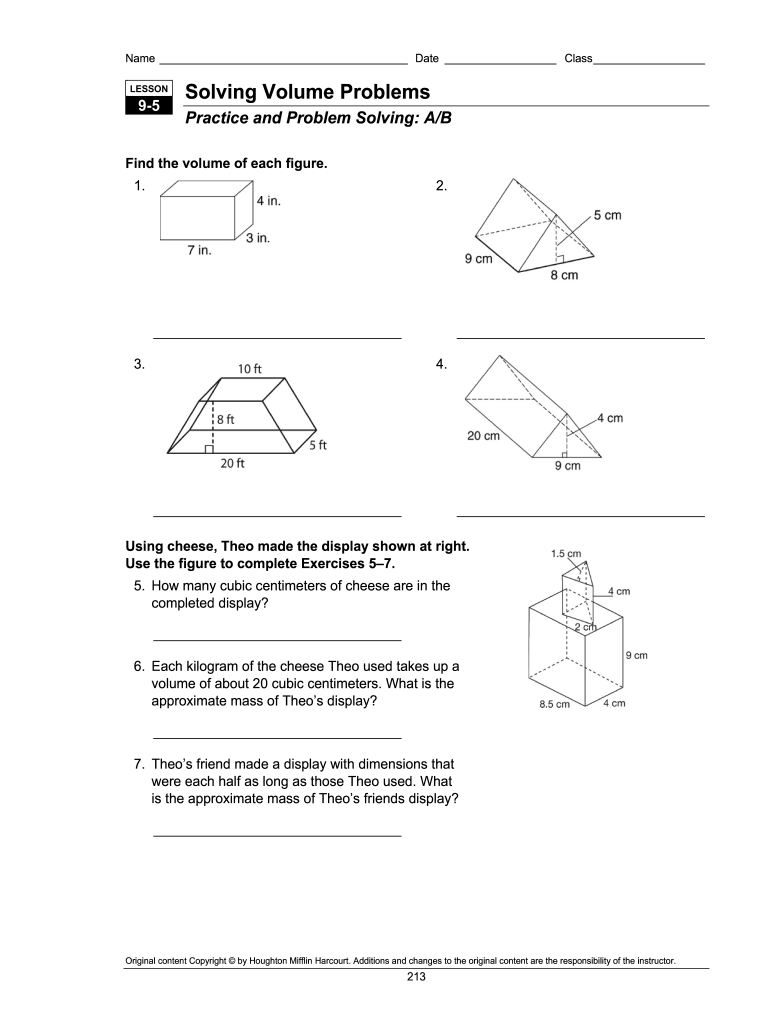
Name Date Class LESSON 9-5 Solving Volume Problems Practice and Problem Solving A/B Find the volume of each figure. Using cheese Theo made the display shown at right. Use the figure to complete Exercises 5 7. 5. How many cubic centimeters of cheese are in the completed display 6. Each kilogram of the cheese Theo used takes up a volume of about 20 cubic centimeters. What is the approximate mass of Theo s display 7. Theo s friend made a display with dimensions that were each half as long as those Theo used* What is the approximate mass of Theo s friends display Original content Copyright by Houghton Mifflin Harcourt. Using cheese Theo made the display shown at right. Use the figure to complete Exercises 5 7. 5. How many cubic centimeters of cheese are in the completed display 6. Each kilogram of the cheese Theo used takes up a volume of about 20 cubic centimeters. What is the approximate mass of Theo s display 7. Each kilogram of the cheese Theo used takes up a volume of about 20 cubic c....
Loading

Open form follow the instructions

Easily sign the form with your finger

Send filled & signed form or save
How to fill out the Solving Volume Problems Answer Key online
This guide provides step-by-step instructions for completing the Solving Volume Problems Answer Key. Whether you are a teacher or a student, this comprehensive approach ensures a smooth and efficient process.
Follow the steps to fill out the form accurately and effectively.
- Press the ‘Get Form’ button to access the document and open it in your preferred editor.
- In the first section, fill in your name, date, and class information. This helps identify the user of the answer key.
- Next, locate the area designated for finding the volume of each figure. Carefully write down your calculations for each figure, using the lines provided.
- In Exercise 5, determine the volume of cheese used in the display. Write your answer on the appropriate line provided.
- For Exercise 6, calculate the approximate mass of Theo's display using the information that each kilogram of cheese takes up about 20 cubic centimeters. Record this on the line provided.
- In Exercise 7, analyze the dimensions for Theo's friend's display, which are half the size of Theo's. Calculate the approximate mass and complete the answer on the provided line.
- Once all fields are filled out accurately, you can save your changes, download the document, print it, or share it accordingly.
Complete your documents online today for a seamless experience.
Experience a faster way to fill out and sign forms on the web. Access the most extensive library of templates available.
Related content
MP.1 Make sense of problems and persevere in solving them. ... two copies of the worksheet...
EXAMPLE 3.9.1 solution. We need to find the volume of the pedestal, in cubic yards, and...
Volume is the quantity of three-dimensional space enclosed by a closed surface, for...
Get answers to your most pressing questions about US Legal Forms API.
How to do volume sums?
3:41 6:22 So we know the volume formula is the length multiplied by the width multiplied by the height. And weMoreSo we know the volume formula is the length multiplied by the width multiplied by the height. And we're told in this case that the length L is six centimeters the width W is two centimeters.
What is the formula for the volume word problem?
Well, V=lwh, which means volume is equal to length*width*hight (depth). Since we know the length, width, and volume; all we need to know is the depth. In order to figure that out, divide length*width on both sides of the equation (V=lwh to V/lw=h).
How do you solve volume problems?
1:55 6:22 So multiplying these together our volume would be 2 times 2 times 6. And of course we'd want toMoreSo multiplying these together our volume would be 2 times 2 times 6. And of course we'd want to consider our units too but we can put that at the end. So this is 4 times 6 which is 24.
How to calculate the volume of a rectangle?
Volume (V) = Area of base × height of the prism is the formula for calculating the volume of a rectangular prism. Volume = l × w × h is another way to express this formula, where 'l' is the length, 'w' is the width, and 'h' is the prism's height.
How do you calculate volume?
In math, volume is the amount of space in a certain 3D object. For instance, a fish tank has 3 feet in length, 1 foot in width and two feet in height. To find the volume, you multiply length times width times height, which is 3x1x2, which equals six. So the volume of the fish tank is 6 cubic feet.
Use professional pre-built templates to fill in and sign documents online faster. Get access to thousands of forms.
If you believe that this page should be taken down, please follow our DMCA take down process here.