Y bacteria, fungi or viruses. Tuberculosis It is important to note that if a patient has a positive tuberculosis skin test and has not been adequately and completely treated, there is always the risk of active TB. In those patients who have a positive skin test, it is important to document a recent CXR result (inactive or negative) or obtain a new CXR. TA-6a 822-4 (11/06) 2.
Loading

Open form follow the instructions

Easily sign the form with your finger

Send filled & signed form or save
How to fill out the 822 4 Communicable Disease Risk Assessment online
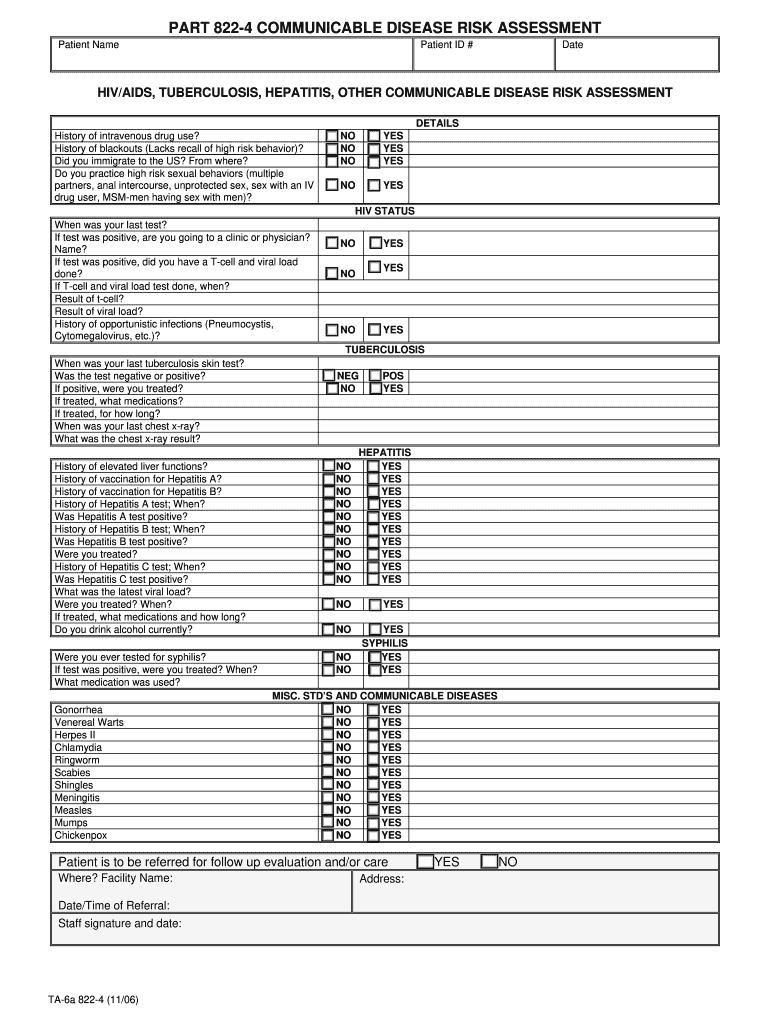
Completing the 822 4 Communicable Disease Risk Assessment online is essential for assessing communicable disease risks in individuals. This guide will walk you through each section of the form, ensuring you understand the information required and how to submit it accurately.
Follow the steps to successfully complete the assessment form.
- Press the ‘Get Form’ button to access the assessment form and open it for editing.
- Begin with the patient's name and patient ID number. Enter the relevant details in the provided fields.
- Indicate the date on which you are filling out the form.
- In the section regarding past medical history related to communicable diseases, answer the questions about intravenous drug use, blackouts, immigration status, and high-risk sexual behaviors. Select 'Yes' or 'No' as applicable.
- For the HIV status inquiries, provide the date of the last test, any clinic or physician that is being visited for a positive result, and details regarding T-cell counts and viral loads.
- Complete the tuberculosis section by entering the date of your last tuberculosis skin test and whether the result was positive or negative. Include any treatments received and details of your last chest x-ray.
- Proceed to the hepatitis section, where you will answer questions about history of elevated liver functions, vaccinations for hepatitis A and B, as well as testing and treatment history.
- Answer the questions regarding other sexually transmitted diseases, including syphilis, and any other communicable diseases listed.
- Provide the referral information if necessary, including the facility name, date and time of referral, and staff signature with the corresponding date.
- Review all entries for accuracy. Once verified, save the changes, and download, print, or share the completed form as required.
Start filling out the 822 4 Communicable Disease Risk Assessment online today to ensure comprehensive health assessment!
Experience a faster way to fill out and sign forms on the web. Access the most extensive library of templates available.
Related content
Communicable Disease Risk Assessment. Revision Date: 11-1-12. Page 1 of 4. Organization...
Feb 5, 2018 — Risks arising from some NCDs, like pneumoconioses, ... environmental...
his/her own best interest. (4) Prior to admission, all programs must: (i) conduct a...
Get answers to your most pressing questions about US Legal Forms API.
How do I fill out a risk assessment form?
Filling out a risk assessment form, such as the 822 4 Communicable Disease Risk Assessment, involves several key steps. Begin by accurately identifying the individuals involved and the context of the assessment. Follow the form's sections methodically, entering information about potential risks, exposure scenarios, and existing controls. For a streamlined experience, you can utilize US Legal Forms, which offers structured forms and expert support to help you complete your assessment.
What should I write for risk assessment?
When writing for the 822 4 Communicable Disease Risk Assessment, focus on describing the specific risks and potential impacts of communicable diseases on your population. Clearly outline the preventive measures already in place and any additional actions needed to mitigate risks. Remember to use clear and concise language, making the information accessible and understandable. The US Legal Forms platform provides helpful resources to aid you in drafting a comprehensive risk assessment.
How do you fill out a risk assessment?
To fill out the 822 4 Communicable Disease Risk Assessment, start by gathering the necessary information about the individuals or groups involved. Ensure you clearly understand the potential risks associated with communicable diseases. Next, carefully complete each section of the assessment form, providing detailed information as required. If you need assistance, consider using the US Legal Forms platform, which offers easy-to-use templates and guidance.
What are 5 examples of communicable diseases?
Common examples of communicable diseases include influenza, tuberculosis, HIV/AIDS, hepatitis, and COVID-19. Understanding these diseases is crucial when completing the 822 4 Communicable Disease Risk Assessment, as it allows for targeted risk evaluation and management. By identifying these diseases, you can help implement effective prevention strategies within your community.
Who is a high risk group of communicable disease?
Who is at higher risk? Older adults who are 65 years of age or older. Infants under 2 years of age. Those experiencing health and social inequities – including people identifying with certain racial and ethnic minority groups and people with disabilities.
What is an example of a communicable disease?
Some examples of the communicable disease include HIV, hepatitis A, B and C, measles, salmonella, measles, and blood-borne illnesses. Most common forms of spread include fecal-oral, food, sexual intercourse, insect bites, contact with contaminated fomites, droplets, or skin contact.
What are the 10 communicable diseases?
Communicable Diseases Neglected, Tropical and Vector Borne Diseases. Tuberculosis. Coronavirus infections. Dengue. Hepatitis. Climate Change and Health. Measles. HIV/AIDS.
What is the definition of a communicable disease?
Communicable diseases, also known as infectious diseases or transmissible diseases, are illnesses that result from the infection, presence and growth of pathogenic (capable of causing disease) biologic agents in an individual human or other animal host.
What are the top 3 communicable diseases?
"Big Three" Infectious Diseases: Tuberculosis, Malaria and HIV/AIDS.
What is an example of communicable or non-communicable disease?
Communicable diseases comprise infectious diseases such as tuberculosis and measles, while non-communicable diseases (NCDs) are mostly chronic diseases such as cardiovascular diseases, cancers, and diabetes.
Use professional pre-built templates to fill in and sign documents online faster. Get access to thousands of forms.
If you believe that this page should be taken down, please follow our DMCA take down process here.