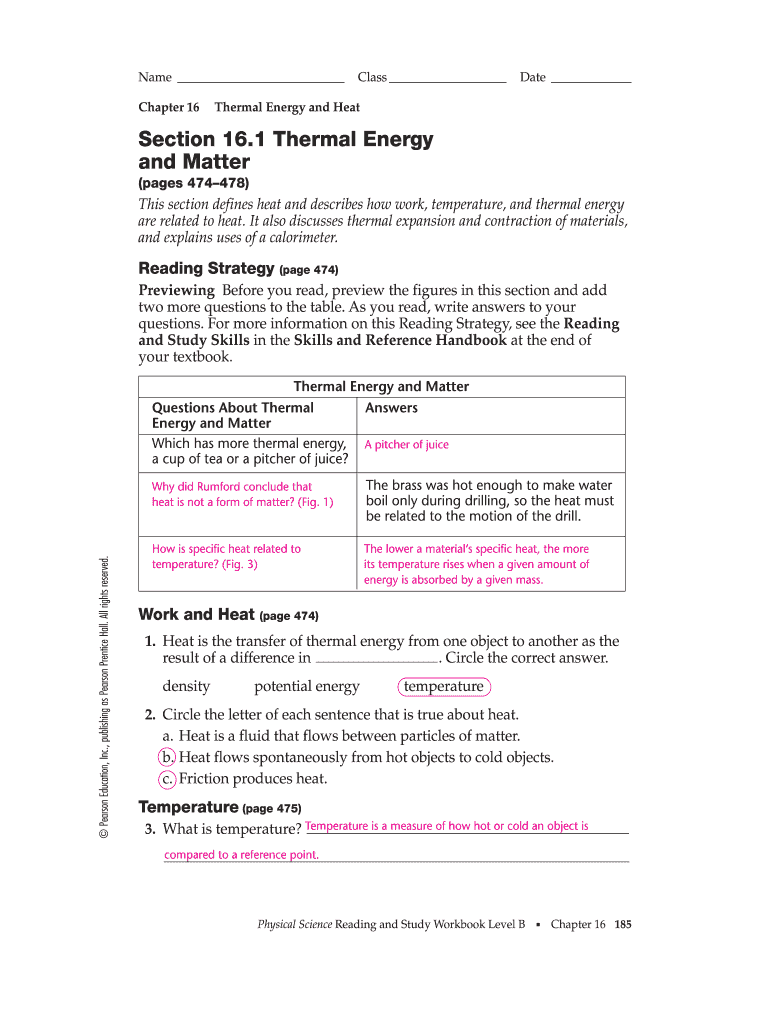
Y and Matter (pages 474 478) This section defines heat and describes how work, temperature, and thermal energy are related to heat. It also discusses thermal expansion and contraction of materials, and explains uses of a calorimeter. Reading Strategy (page 474) Previewing Before you read, preview the figures in this section and add two more questions to the table. As you read, write answers to your questions. For more information on this Reading Strategy, see the Reading and Study Skills i.
Loading

Open form follow the instructions

Easily sign the form with your finger

Send filled & signed form or save
How to fill out the Section 16 1 Thermal Energy and Matter online
This guide provides a comprehensive overview of how to effectively fill out the Section 16 1 Thermal Energy and Matter. Whether you are new to digital document management or have some experience, this guide will assist you in completing the form with clarity and confidence.
Follow the steps to complete the form accurately.
- Click the ‘Get Form’ button to obtain the form and open it in the editor.
- Provide your name in the designated field at the top of the form.
- Enter your class information in the corresponding field next to your name.
- Insert the current date in the specified date field.
- Proceed to read through the section titled 'Thermal Energy and Heat'. Familiarize yourself with the core concepts presented.
- Address the questions regarding thermal energy and matter, ensuring you provide thoughtful answers prompted by the text.
- Complete the questions that pertain to work and heat, making sure to circle the correct answers as indicated.
- Move on to the section about temperature and accurately fill in the responses to how temperature relates to thermal energy.
- Continue with the thermal expansion and contraction section, filling out the related queries and completing the table as indicated.
- Complete the specific heat section and provide necessary definitions to the queries presented.
- In the measuring heat changes section, respond to the queries about calorimeters and the principles they work on.
- Finally, review all entries for accuracy. Once complete, you can save changes, download, print, or share the form as needed.
Start filling out your document online today!
Experience a faster way to fill out and sign forms on the web. Access the most extensive library of templates available.
Related content
... section 16-1. Such ratepayers shall include: Any domestic or qualified nonprofit...
Heat transfer processes are classified into three types. The first is conduction, which is...
Dec 26, 2025 — This guide provides detailed information as to recommended equipment and...
Get answers to your most pressing questions about US Legal Forms API.
How to find how much thermal energy is lost?
Finding how much thermal energy is lost requires measuring the initial and final temperatures along with the mass of the object. Use the equation derived from Section 16 1 Thermal Energy And Matter to determine the change in thermal energy. This approach can clarify the concept of energy loss due to heat transfer. For more in-depth explanations and examples, consider using the uslegalforms platform to enhance your learning experience.
How to get thermal energy equation?
To access the thermal energy equation, refer to Section 16 1 Thermal Energy And Matter for a comprehensive understanding. The equation usually involves the mass, specific heat capacity, and the temperature change of the material. You can easily find this equation on educational platforms or through resources that break down complex concepts into simpler terms. This will help you apply the equation confidently in various scenarios.
How do you obtain thermal energy?
You can obtain thermal energy through various processes in daily life. For instance, heating an object can increase its thermal energy, as seen in cooking or heating water. You might also capture thermal energy from surrounding environments, which involves understanding the principles discussed in Section 16 1 Thermal Energy And Matter. Utilizing platforms like uslegalforms can guide you through this more effectively.
How do you determine the thermal energy of an object in CK12?
To determine the thermal energy of an object in CK12, you can use the concepts outlined in Section 16 1 Thermal Energy And Matter. Start by identifying the mass of the object and its temperature. You then need to apply the relevant formulas to calculate thermal energy based on its specific heat and the change in temperature. This interactive platform makes the learning experience engaging and easy to understand.
What is the correct order of thermal energy in three states of matter?
In general, the order of thermal energy in the three states of matter is gas, liquid, and solid. Gases have the highest thermal energy because molecules are far apart and move freely. Section 16 1 Thermal Energy And Matter explores this hierarchy in detail, emphasizing how thermal energy influences changes in state and heat circulation.
How to calculate thermal energy formula?
To calculate thermal energy, you can use the formula Q = mc∆T. This formula allows you to find the heat absorbed or released by an object based on its mass, specific heat capacity, and temperature change. For in-depth applications of this formula, refer to Section 16 1 Thermal Energy And Matter, which provides clear examples and explanations.
How is thermal energy stored in matter?
Thermal energy is stored in matter as internal energy, primarily due to the motion of molecules. As temperature increases, molecules move faster and store more thermal energy. In Section 16 1 Thermal Energy And Matter, you'll discover how different states of matter affect the storage of thermal energy and how this influences heat transfer.
What is the formula to calculate thermal energy?
The commonly used formula for thermal energy is Q = mc∆T. In this equation, Q represents the thermal energy transferred, m is the mass, c is the specific heat, and ∆T is the change in temperature. This formula, discussed in Section 16 1 Thermal Energy And Matter, shows how thermal energy relates to the physical properties of matter.
How do you find the total thermal energy?
To find the total thermal energy of an object, you need to consider both the mass and specific heat capacity involved. Total thermal energy can be easily calculated using the equation U = mcT, where T represents the temperature of the substance. Concepts from Section 16 1 Thermal Energy And Matter are essential for grasping this process effectively.
How to use the formula q = mc ∆t?
The formula q = mc ∆t calculates the amount of thermal energy transferred. In this equation, q represents heat energy, m stands for mass, c is the specific heat capacity, and ∆t is the change in temperature. Section 16 1 Thermal Energy And Matter covers practical examples that help you visualize how to apply this formula in different scenarios.
Use professional pre-built templates to fill in and sign documents online faster. Get access to thousands of forms.
If you believe that this page should be taken down, please follow our DMCA take down process here.