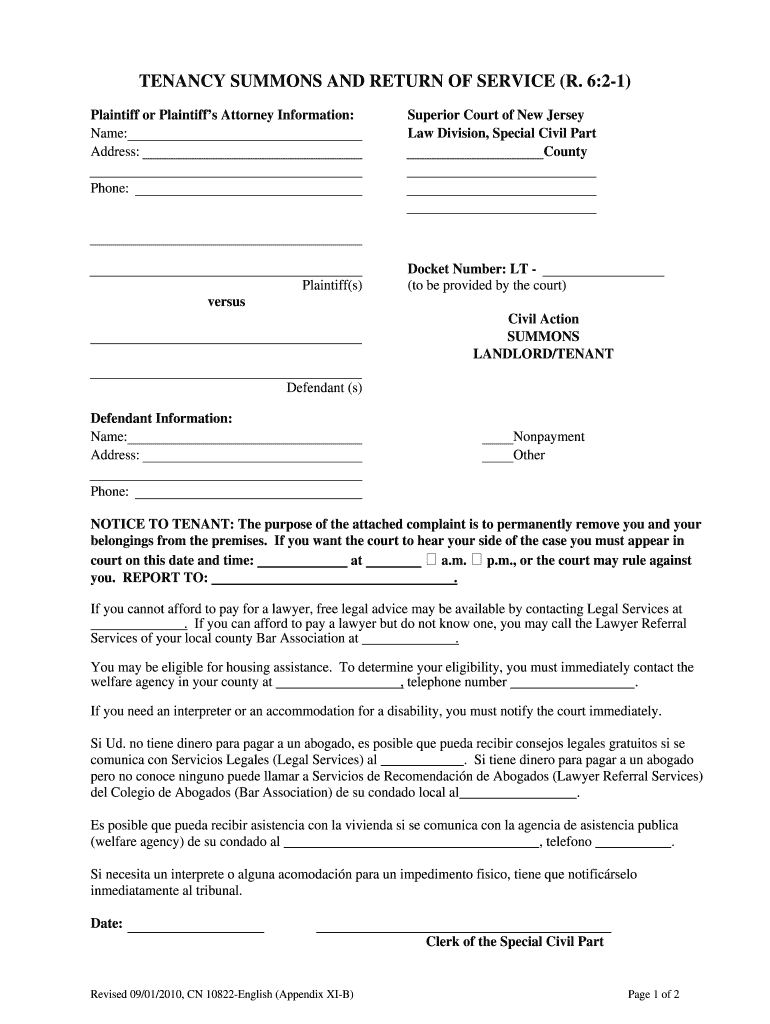
Print Form Clear Form TENANCY SUMMONS AND RETURN OF SERVICE R. 6 2-1 Plaintiff or Plaintiff s Attorney Information Name Address Superior Court of New Jersey Law Division Special Civil Part County Phone Plaintiff s Docket Number LT to be provided by the court versus Civil Action SUMMONS LANDLORD/TENANT Defendant s Defendant Information Nonpayment Other NOTICE TO TENANT The purpose of the attached complaint is to permanently remove you and your belongings from the premises. If you want the court to hear your side of the case you must appear in at a*m* p*m* or the court may rule against court on this date and time you. REPORT TO. If you cannot afford to pay for a lawyer free legal advice may be available by contacting Legal Services at. If you can afford to pay a lawyer but do not know one you may call the Lawyer Referral Services of your local county Bar Association at You may be eligible for housing assistance. To determine your eligibility you must immediately contact the welfare agenc....
Loading

Open form follow the instructions

Easily sign the form with your finger

Send filled & signed form or save
How to fill out the Nj Landlord Tenant Summons online
Completing the Nj Landlord Tenant Summons online is an important step in the landlord-tenant legal process. This guide offers clear instructions to help you successfully navigate each section of the form.
Follow the steps to complete the Nj Landlord Tenant Summons online
- Press the ‘Get Form’ button to acquire the summons and open it in your preferred editor.
- Provide the plaintiff or plaintiff’s attorney information, including full name, address, and phone number. Ensure all details are accurate.
- Fill in the docket number, which will be provided by the court. This is essential for tracking your case.
- Enter the name and address of the defendant(s). Double-check for accuracy to prevent any delays.
- Select the reason for the summons, indicating whether it is due to nonpayment or other issues.
- Complete the section regarding court appearance, including date, time, and location of the hearing. Make sure this aligns with the court's schedule.
- Review the notice to tenant section carefully. This includes important information about legal representation and assistance.
- At the bottom of the form, provide the date and sign it to certify accuracy. This step is crucial for the legal validity of the summons.
- Once all sections are filled out, you can save your changes, download, print, or share the completed form as needed.
Complete your documents online today to ensure a smooth filing process.
Experience a faster way to fill out and sign forms on the web. Access the most extensive library of templates available.
Related content
SUMMONS. LANDLORD TENANT. Defendant (s). Defendant Information: Name: Nonpayment. Address:...
The manual describes a landlord's legal duties in renting apartments or homes to tenants...
Get answers to your most pressing questions about US Legal Forms API.
How to serve a summons in New Jersey?
Serving a summons in New Jersey requires following specific legal procedures, starting with accurately completing the Nj Landlord Tenant Summons. You can serve the summons personally to the tenant, or you may choose certified mail. If personal service is unsuccessful, consider substituted service as an alternative. It's important to document the service properly to ensure that the court recognizes it as valid.
How long does it take to get an eviction notice in NJ?
The timeframe to obtain an eviction notice in NJ can vary, but it typically involves a few steps. After filing an Nj Landlord Tenant Summons, the tenant has a specified amount of time to respond, often 5 to 15 days. Once a judgment is awarded, the execution of the eviction can take additional time based on local court schedules. Staying informed about these timelines helps both tenants and landlords understand the eviction process.
What are the different ways to serve the summons?
In NJ, there are several ways to serve a summons, including personal service, certified mail, and substituted service. Personal service involves handing the Nj Landlord Tenant Summons directly to the tenant. Certified mail requires sending the summons with a return receipt to confirm delivery. Substituted service allows for delivery to another adult at the tenant’s residence or posting the summons on the property if direct contact fails.
How to serve a summons in NJ?
To serve a summons in NJ, you must deliver the Nj Landlord Tenant Summons to the tenant following state guidelines. This may involve personal delivery, service by a designated process server, or certified mail with a return receipt. The serving individual must complete a proof of service document to confirm successful delivery. It is vital to adhere to these rules to ensure the court recognizes the service as valid.
What happens if you can't serve someone court papers in NJ?
If you cannot serve someone court papers in NJ, alternatives must be employed, such as substituted service or constructive service methods. For an Nj Landlord Tenant Summons, this could mean leaving the summons with a household member or posting it on the property. If these methods fail, you may need to request permission from the court for an alternative service. Ensuring proper service is crucial to the success of your case.
Can a landlord evict you without a court order in NJ?
No, a landlord cannot legally evict a tenant in NJ without a court order. The state requires that proper procedures be followed, including the filing of an Nj Landlord Tenant Summons to initiate the eviction process. Self-help evictions, such as changing locks or shutting off utilities, are illegal and can result in penalties for the landlord. It is essential for landlords to adhere to legal protocols for a valid eviction.
What is the process to evict a tenant in NJ?
The eviction process in NJ starts with the landlord filing an Nj Landlord Tenant Summons with the court. The landlord must provide valid grounds for eviction, give appropriate notice, and serve the summons to the tenant. After the tenant receives the summons, they may respond or attend a court hearing. If the court rules in favor of the landlord, a judgment is issued, which allows for the physical eviction by law enforcement if necessary.
What is proof of service in NJ?
Proof of service in NJ refers to the documentation that confirms court papers were delivered to the individual involved in a legal proceeding. In the case of an Nj Landlord Tenant Summons, this proof ensures that the tenant has received notice of the eviction process. It typically includes details such as the method of delivery and the date the summons was served. This documentation is crucial in court to validate that the tenant had a fair opportunity to respond.
How to write a response to an eviction summons?
When writing a response to an eviction summons, it's important to address each claim made in the summons clearly and concisely. You should acknowledge receipt of the summons, outline your defense, and include any supporting documents. Crafting a well-structured response is essential to effectively present your case in the NJ Landlord Tenant Summons proceedings.
How to fill out an eviction notice template?
To fill out an eviction notice template, start by including the tenant's name and the address of the rental property. Specify the reason for eviction and provide a clear deadline for the tenant to vacate the premises, ensuring to comply with NJ law. Utilizing an eviction notice template can help streamline this process, making it easier to follow the legal requirements inherent in an NJ Landlord Tenant Summons.
Use professional pre-built templates to fill in and sign documents online faster. Get access to thousands of forms.
If you believe that this page should be taken down, please follow our DMCA take down process here.