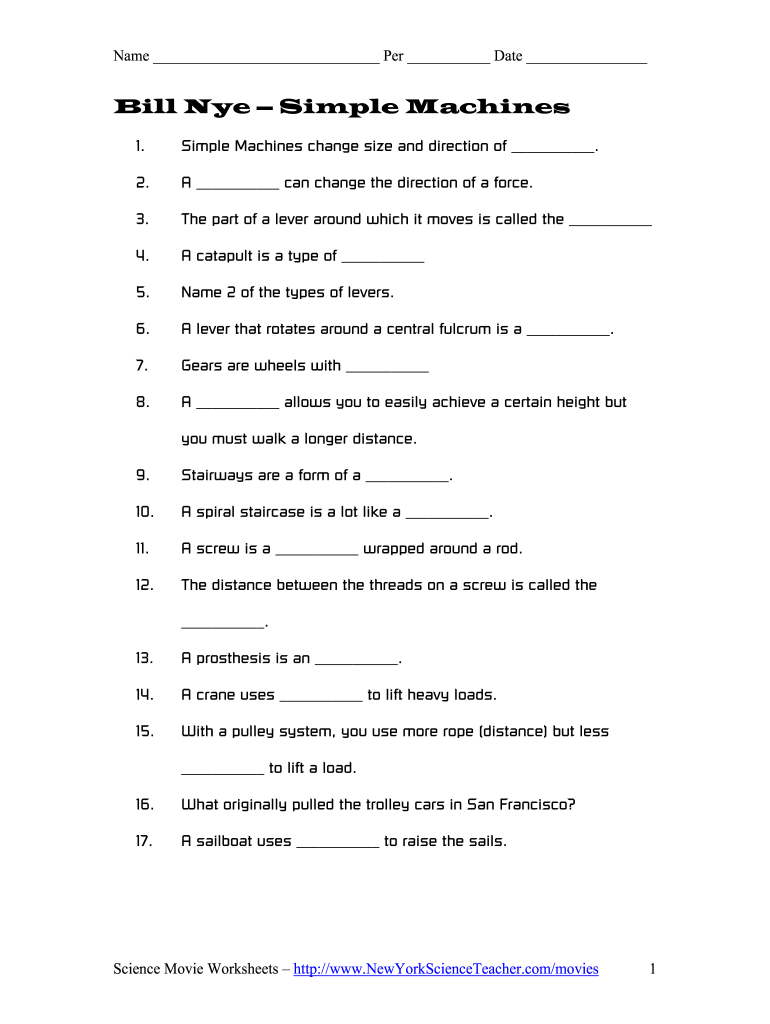

Open form follow the instructions

Easily sign the form with your finger

Send filled & signed form or save
How to fill out the Bill Nye Simple Machines Worksheet online
Filling out the Bill Nye Simple Machines Worksheet online can be a straightforward process with the right guidance. This guide provides step-by-step instructions to help users complete the worksheet effectively.
Follow the steps to complete the worksheet successfully.
- Click 'Get Form' button to obtain the worksheet and open it in the editing environment.
- Begin with the first section, where you will enter your name, period, and date. These fields are essential for identifying the submission.
- Proceed to question one, where you will fill in the blank regarding what simple machines change. Use terms related to force for a complete answer.
- Continue with the second question that asks for a simple machine that can change the direction of a force. Consider mechanical devices you might be familiar with.
- For the third question, identify the part of a lever around which it moves. Accurate terminology is crucial for your response.
- Move on to the question about a catapult and provide its classification type. Think about various launching mechanisms.
- In the next step, list two types of levers in question five. Be succinct but clear in your response.
- Answer the sixth question about levers that rotate around a central fulcrum, ensuring you use the appropriate terminology.
- For the seventh question, describe what is characteristic of gears. Your answer should reflect mechanical knowledge.
- Complete the eighth question about mechanisms that allow you to gain height while walking a distance. Think of inclined planes.
- Identify that stairways are a specific form of incline in the next question and provide a precise answer.
- When answering the question about spiral staircases, connect it to a concept you’ve learned about mechanical advantage.
- In completing the twelfth question, define what a screw is in relation to its physical attributes.
- Document the distance between screw threads accurately in response to the following question.
- As you proceed, define what a prosthesis is in relation to its function and utility.
- Discuss materials used by cranes for heavy lifting as you fill out question fourteen.
- For the penultimate question regarding pulley systems, analyze the trade-off between distance and effort. This understanding is key to your answer.
- Finally, reflect on the original mechanism that pulled trolley cars in San Francisco, answering the last question with historical understanding.
- Once all fields are completed, review your responses for accuracy. Finally, save changes, and download, print, or share the form as needed.
Start filling out the Bill Nye Simple Machines Worksheet online today and enhance your learning experience.
Experience a faster way to fill out and sign forms on the web. Access the most extensive library of templates available.
Related content
Bill Nye Simple Machines Worksheet is an educational resource designed to accompany the...
Get answers to your most pressing questions about US Legal Forms API.
What is the 6th simple machine?
Name the six simple machines. The six simple machines are an inclined plane, wheel and axle, pulley, lever, screw and wedge.
What are the six 6 simple machines?
They are the simplest mechanisms known that can use leverage (or mechanical advantage) to increase force. The simple machines are the inclined plane, lever, wedge, wheel and axle, pulley, and screw.
How to make a simple machine for a science project at home?
3 Ideas for Building Simple Machines at Home The Lever. The lever is a rigid bar that is free to move around at a fixed point. ... The Wheel and Axle. The wheel and axle have two disks or cylinders, each with a different radius. ... Gears. ... The Inclined Plane. ... The Wedge. ... The Screw. ... The Pulley.
What are the six simple machines explained?
The six most common simple machines – inclined plane, wedge, screw, lever, pulley and wheel-and-axle – are designed to change the magnitude/direction of the force (remember, work = force x distance), ultimately making the task easier to perform.
What is the 7th simple machine?
Fluid foils are unique among simple machines because they not only change the direction of an applied force (wheel and axle); they convert fluid energy into mechanical energy (wind and Kaplan turbines) or vice versa, mechanical energy into fluid energy (fans and propellers).
What are the six simple machines and their names?
The six most popular simple machines—pulley, screw, inclined plane, wedge, lever, axle, and wheel—are made to alter the force's direction or strength (consider that work is equal to force times distance). Effective implementation of these simple machines makes the task easier.
What type of simple machine is a catapult Bill Nye?
29:38 30:52 Bill Nye The Science Guy Simple Machines - YouTube YouTube Start of suggested clip End of suggested clip This is a catapult. It's the lever same thing you ready three two one that's the way we always do itMoreThis is a catapult. It's the lever same thing you ready three two one that's the way we always do it. There's a lever everyone see it's a lever there's weights on this end.
Can you name all six simple machines?
Learn more about the six types of simple machines; lever, pulley, wheel and axel, inclined plane, wedge and screw, and how they make work easier.
Use professional pre-built templates to fill in and sign documents online faster. Get access to thousands of forms.
If you believe that this page should be taken down, please follow our DMCA take down process here.