Open form follow the instructions
Easily sign the form with your finger
Send filled & signed form or save
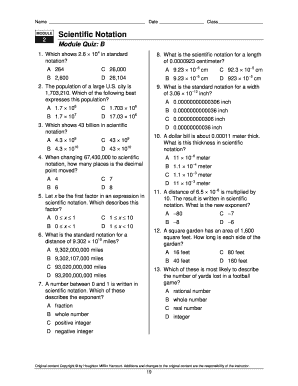
How to fill out the Module 14 Rational Exponents And Radicals Module Quiz B Answers online
This guide provides users with a detailed, step-by-step approach to completing the Module 14 Rational Exponents And Radicals Module Quiz B Answers online. By following these instructions, users can ensure accurate and efficient submission of their answers.
Follow the steps to complete the Module Quiz B answers.
- Click the 'Get Form' button to obtain the form, which will open it in the editor for completion.
- Begin by entering your name, date, and class in the designated fields at the top of the form.
- Proceed to the quiz questions, where you will read each question carefully.
- Select the appropriate answer for each question by marking the corresponding option (A, B, C, or D) as you go through the quiz.
- After completing all questions, double-check your answers to ensure accuracy.
- Once you are satisfied with your responses, save the changes made to the form.
- You may choose to download, print, or share the completed form as needed.
Complete your Module Quiz B answers online today for efficient submission.
Experience a faster way to fill out and sign forms on the web. Access the most extensive library of templates available.
Related content
This Item and Scoring Sampler includes the test directions, scoring guidelines, and...
If a2 : b, then a is a square root ofD. lf a3 : b,thena is the cube root ofb. Raising a...
Get answers to your most pressing questions about US Legal Forms API.
How are the properties of exponents used on expressions having rational exponents?
The properties of exponents are vital when handling expressions with rational exponents, as they allow you to manipulate the expressions into a more manageable form. By applying these properties, you can simplify complex terms effectively. When studying for challenges like the Module 14 Rational Exponents And Radicals Module Quiz B Answers, understanding these properties can significantly boost your problem-solving abilities.
How to simplify powers with rational exponents?
Simplifying powers with rational exponents involves rewriting the expression using the relevant exponent laws. Convert the rational exponent into a radical when applicable, allowing you to work with simpler terms. This approach aligns closely with the exercises in the Module 14 Rational Exponents And Radicals Module Quiz B Answers, making it a valuable skill for any learner.
How to apply the properties of exponents to simplify powers with rational exponents?
To apply properties of exponents when simplifying powers with rational exponents, use the laws such as the product of powers, quotient of powers, and power of a power. These properties ensure that you can combine and simplify expressions effectively. Mastering these strategies can enhance your performance on tasks similar to those found in the Module 14 Rational Exponents And Radicals Module Quiz B Answers.
How to do power rule with rational exponents?
The power rule for rational exponents states that when you have a base raised to a rational exponent, you can simplify it by converting the exponent to a fraction. For example, x^(m/n) can be expressed as the n-th root of x raised to the m power. Understanding this rule is key to successfully navigating the challenges presented in the Module 14 Rational Exponents And Radicals Module Quiz B Answers.
How to solve radical functions and rational exponents?
Solving radical functions and rational exponents often involves rewriting the expression in terms of rational exponents. For instance, the square root of x can be expressed as x^(1/2). This technique simplifies the solving process and aligns well with concepts found in the Module 14 Rational Exponents And Radicals Module Quiz B Answers, helping you approach similar problems with confidence.
How do you simplify exponents using powers of a power?
To simplify exponents using the powers of a power rule, you multiply the exponents together. For example, if you have (a^m)^n, it simplifies to a^(mn). This process allows you to consolidate your calculations, making it easier to work with complex expressions, such as those covered in the Module 14 Rational Exponents And Radicals Module Quiz B Answers.
Use professional pre-built templates to fill in and sign documents online faster. Get access to thousands of forms.
If you believe that this page should be taken down, please follow our DMCA take down process here.