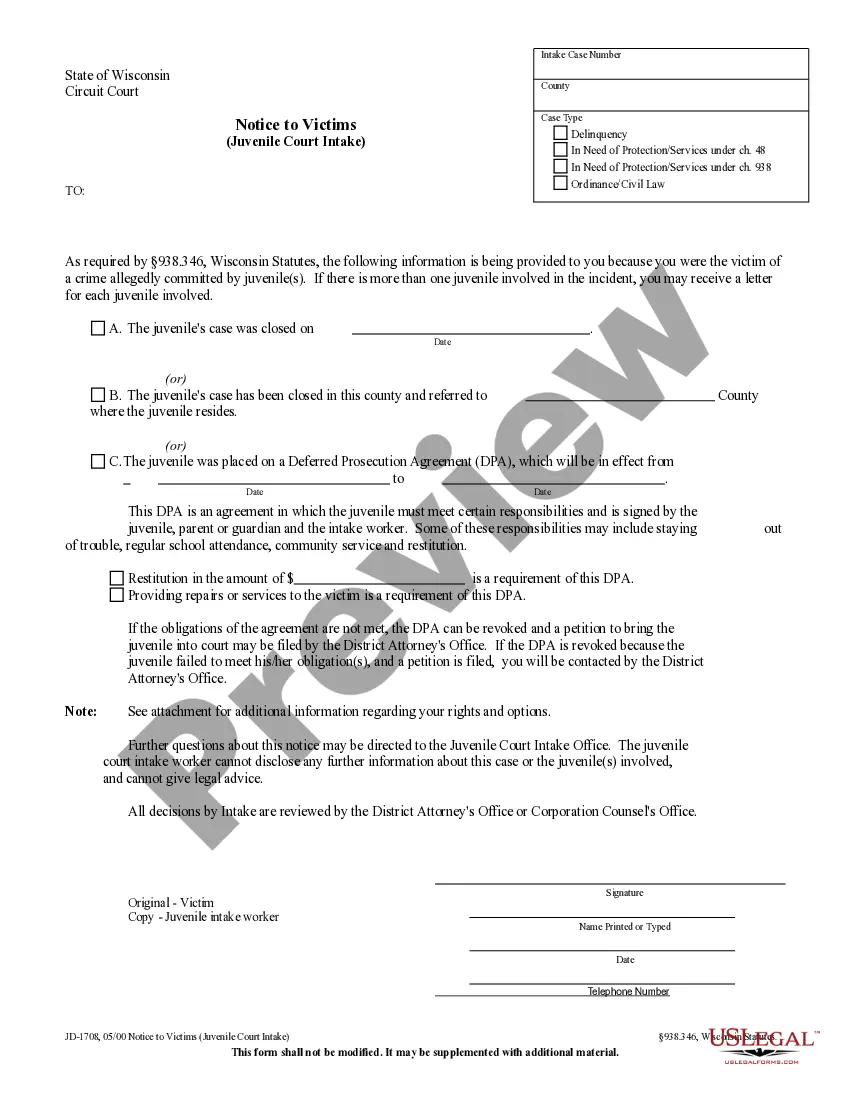
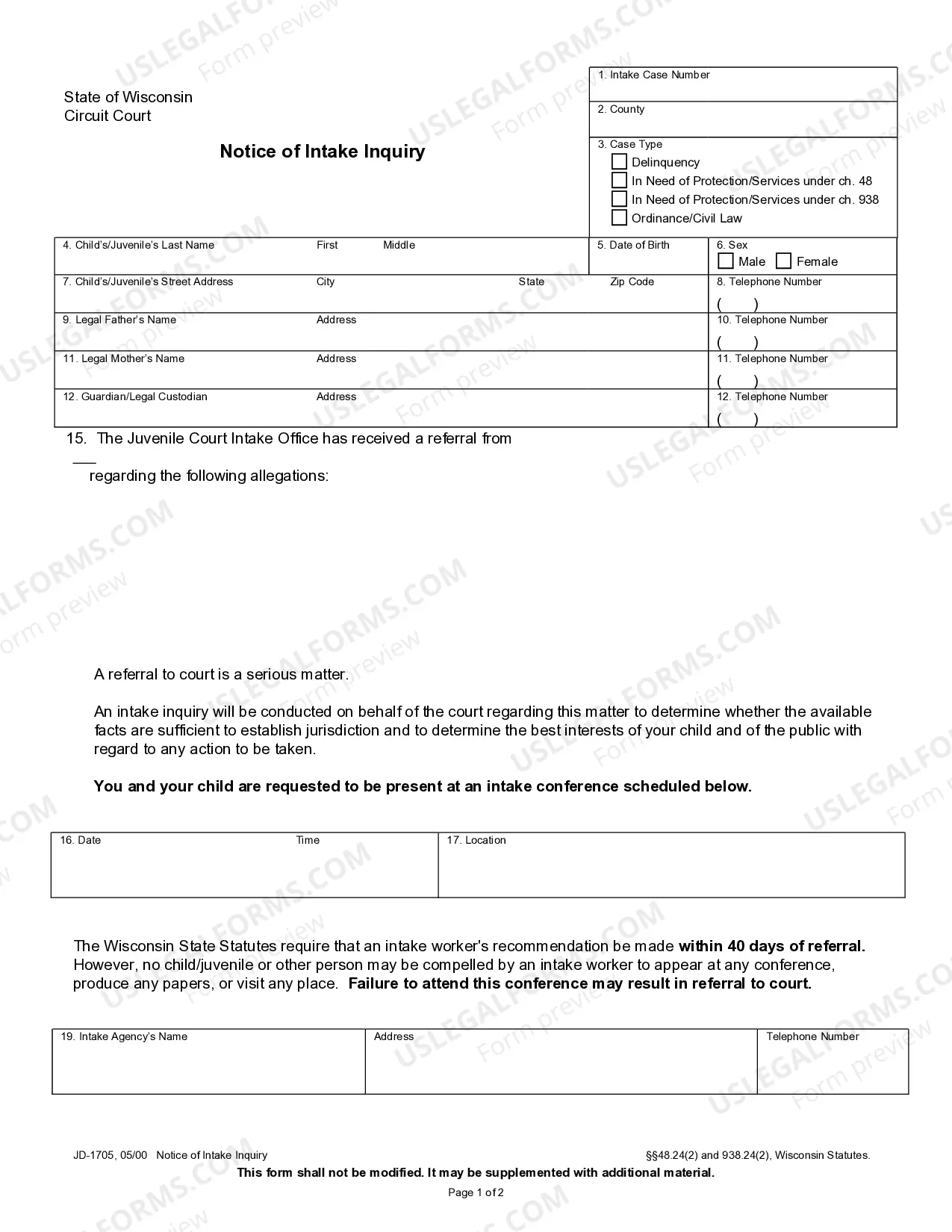
This is a Notice to Victims, to be used by the Courts in the State of Wisconsin. This form is used to notify the victims of their rights and options as required by state statutes.
Wisconsin Notice to Victims - Juvenile Court Intake
State:
Wisconsin
Category:
Control #:
WI-JD-1708
Format:
Word;
PDF;
Rich Text
Instant download
This website is not affiliated with any governmental entity
Public form
Description
Get your form ready online
Our built-in tools help you complete, sign, share, and store your documents in one place.
Built-in online Word editor
Make edits, fill in missing information, and update formatting in US Legal Forms—just like you would in MS Word.
Export easily
Download a copy, print it, send it by email, or mail it via USPS—whatever works best for your next step.
E-sign your document
Sign and collect signatures with our SignNow integration. Send to multiple recipients, set reminders, and more. Go Premium to unlock E-Sign.
Notarize online 24/7
If this form requires notarization, complete it online through a secure video call—no need to meet a notary in person or wait for an appointment.
Store your document securely
We protect your documents and personal data by following strict security and privacy standards.
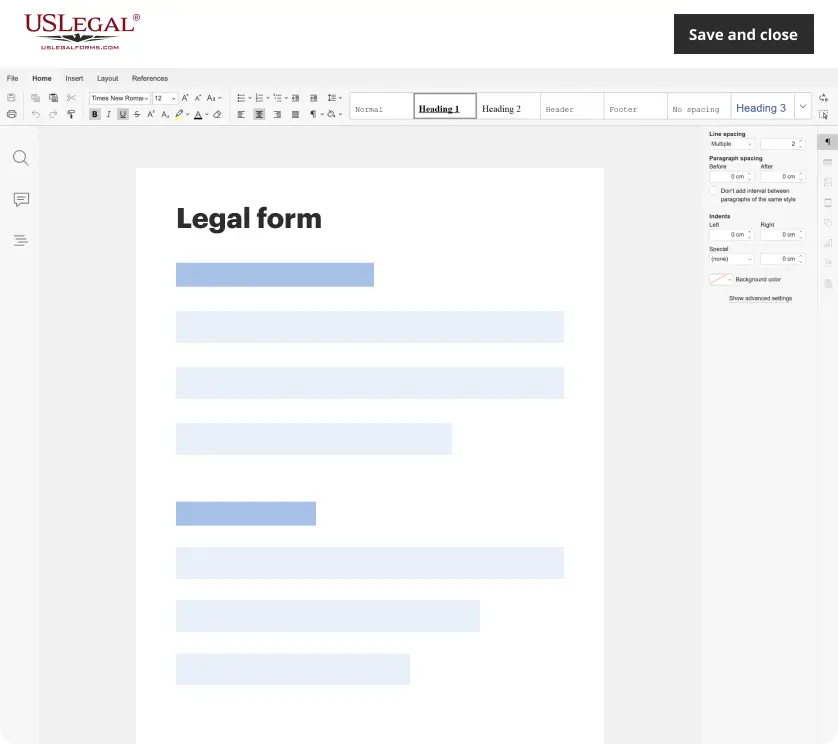
Make edits, fill in missing information, and update formatting in US Legal Forms—just like you would in MS Word.
Download a copy, print it, send it by email, or mail it via USPS—whatever works best for your next step.
Sign and collect signatures with our SignNow integration. Send to multiple recipients, set reminders, and more. Go Premium to unlock E-Sign.
If this form requires notarization, complete it online through a secure video call—no need to meet a notary in person or wait for an appointment.
We protect your documents and personal data by following strict security and privacy standards.
Looking for another form?
How to fill out Wisconsin Notice To Victims - Juvenile Court Intake?
Out of the multitude of services that provide legal templates, US Legal Forms provides the most user-friendly experience and customer journey while previewing templates before purchasing them. Its extensive library of 85,000 templates is grouped by state and use for efficiency. All of the forms on the platform have been drafted to meet individual state requirements by accredited legal professionals.
If you have a US Legal Forms subscription, just log in, search for the form, hit Download and get access to your Form name from the My Forms; the My Forms tab holds all of your saved forms.
Stick to the tips below to obtain the document:
- Once you discover a Form name, make sure it’s the one for the state you need it to file in.
- Preview the form and read the document description prior to downloading the sample.
- Look for a new template using the Search field in case the one you have already found isn’t proper.
- Click Buy Now and choose a subscription plan.
- Create your own account.
- Pay using a card or PayPal and download the template.
Once you have downloaded your Form name, you are able to edit it, fill it out and sign it in an web-based editor that you pick. Any document you add to your My Forms tab can be reused many times, or for as long as it continues to be the most up-to-date version in your state. Our service offers quick and easy access to templates that fit both legal professionals and their clients.
Form popularity
FAQ
The juvenile justice process involves nine major decision points: (1) arrest, (2) referral to court, (3) diversion, (4) secure detention, (5) judicial waiver to adult criminal court, (6) case petitioning, (7) delinquency finding/adjudication, (8) probation, and (9) residential placement, including confinement in a
The juvenile justice system underwent a process that has been described as the four Ds: (1) Decriminalization, that is, taking status offenders out from delinquency definitions and constraining court authority with these youths; (2) Diversion from the court of lesser offenders, including status offenders; (3) Due
The term intake court generally refers to a scheduled court session where the defendants in newly filed cases appear for the first time, bond is set, and further scheduling is done.
Instead of filing a formal petition in juvenile court, the intake department (or prosecutor) may decide that a case should be removed from juvenile court and waived to criminal (adult) court.The juvenile court judge then decides whether the case merits criminal prosecution.
Essential Duties: Facilitates the intake process for clients entering the Department of Corrections or Court Services; reviews the Order of Probation; ensures forms are completed and secure necessary signatures with the client; explains probation process and gives client community resources information.
The primary responsibility of the Intake Officer is to interview and screen arrestees in order to gather information for the bail evaluation process and pretrial services. The position will also assist in obtaining background information and determining the level of pretrial services intervention required.
Juvenile intake officers handle minors who are referred to their offices by families, law enforcement officials, or other agents. They work with court systems, families, and underage offenders to gather information and make punishment or rehabilitation recommendations.
Intake: The process used for every youth referred to juvenile court. Intake involves screening each youth to determine the appropriateness for release or referral to a diversionary program or agency for nonofficial or nonjudicial handling.