Washington Owner's or Seller's Affidavit of No Liens

State:
Washington
Control #:
WA-CLOSE8
Format:
Word; 
Rich Text
Instant download

Description

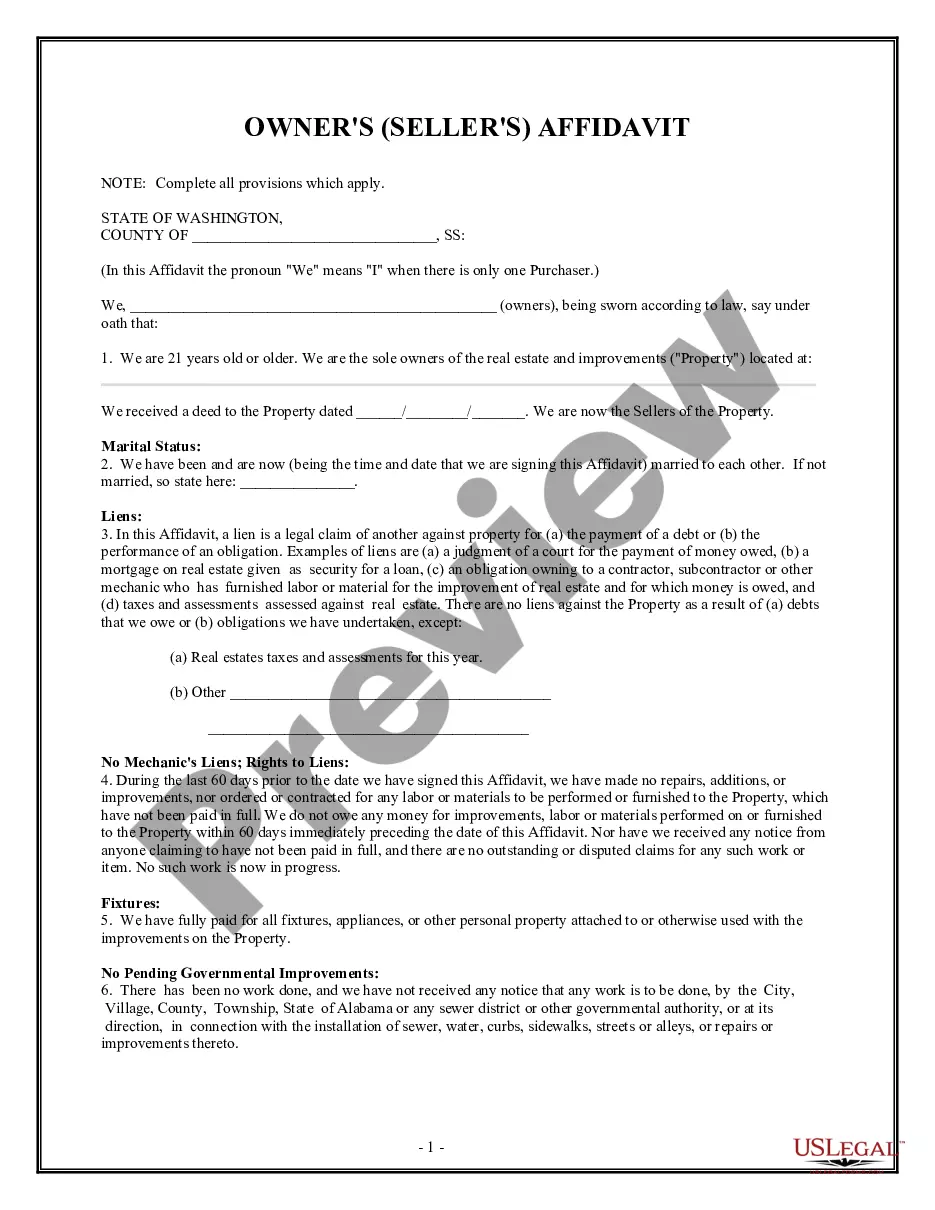
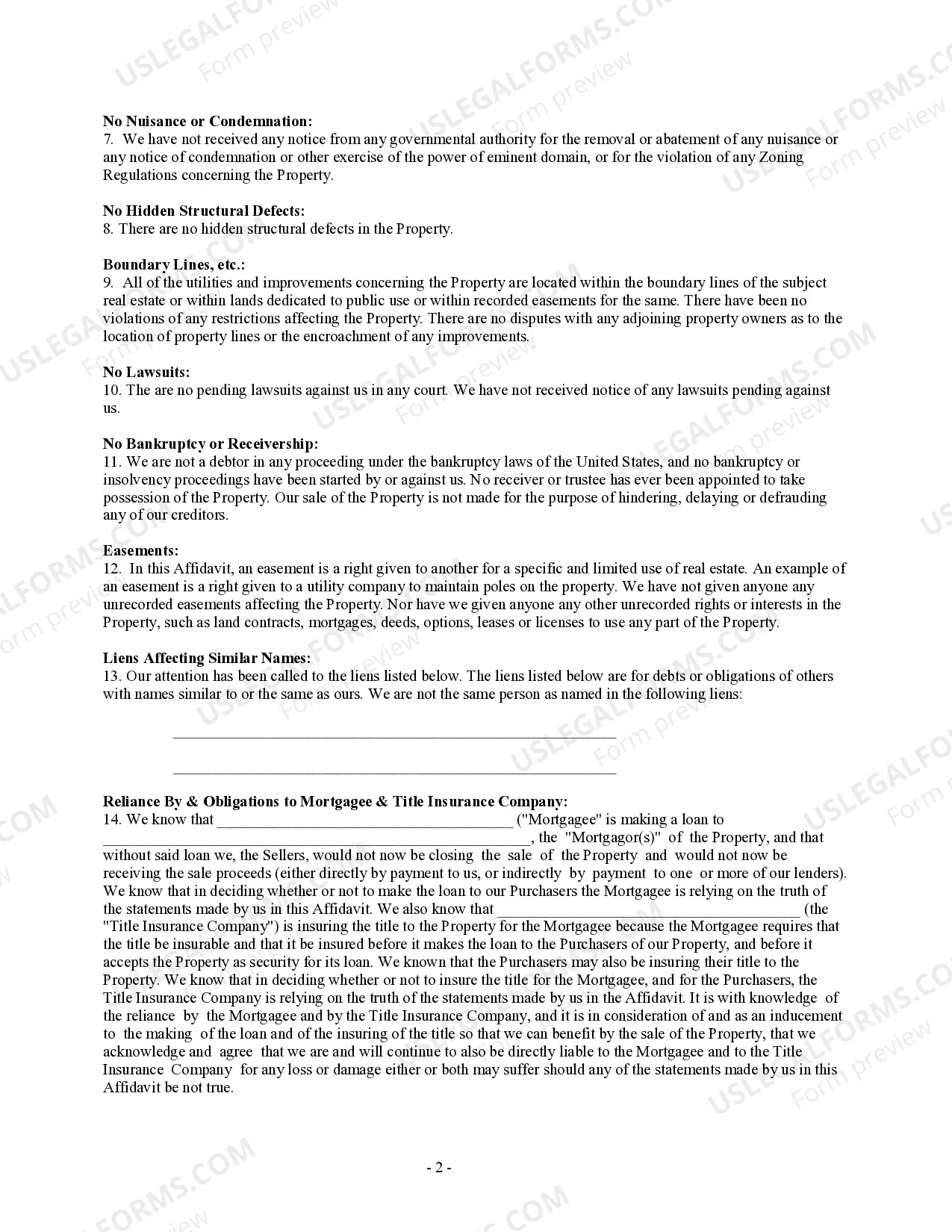
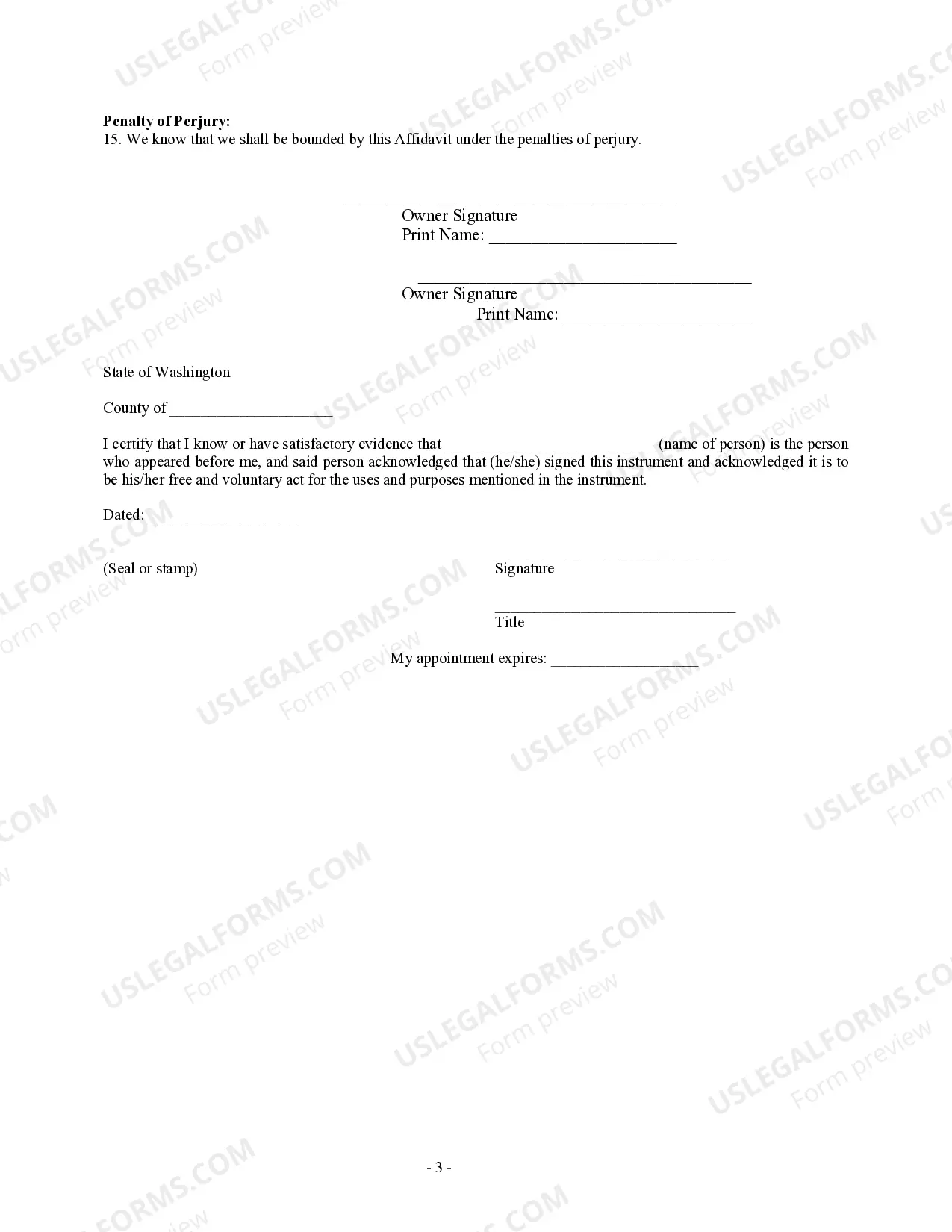
This Owner/Seller Affidavit is for seller(s) to sign at the time of closing certifying that, among other assurances, there are no liens on the property being sold, that they are the owners of the property, that there are no mechanic liens on the property and other certifications. This form must be signed and notarized.

Free preview
  • Preview Owner's or Seller's Affidavit of No Liens
  • Preview Owner's or Seller's Affidavit of No Liens
  • Preview Owner's or Seller's Affidavit of No Liens

How to fill out Washington Owner's Or Seller's Affidavit Of No Liens?

Out of the large number of services that provide legal templates, US Legal Forms offers the most user-friendly experience and customer journey while previewing forms prior to buying them. Its extensive catalogue of 85,000 samples is grouped by state and use for simplicity. All of the documents on the service have already been drafted to meet individual state requirements by accredited legal professionals.

If you have a US Legal Forms subscription, just log in, look for the form, press Download and gain access to your Form name from the My Forms; the My Forms tab holds all your saved forms.

Keep to the guidelines below to get the document:

  1. Once you find a Form name, make sure it’s the one for the state you need it to file in.
  2. Preview the template and read the document description just before downloading the template.
  3. Look for a new sample using the Search field in case the one you have already found isn’t proper.
  4. Simply click Buy Now and select a subscription plan.
  5. Create your own account.
  6. Pay using a credit card or PayPal and download the template.

Once you’ve downloaded your Form name, you are able to edit it, fill it out and sign it in an online editor that you pick. Any form you add to your My Forms tab can be reused multiple times, or for as long as it remains the most up-to-date version in your state. Our service offers quick and simple access to templates that fit both legal professionals and their clients.

Form popularity

FAQ

An Owner Affidavit is a document used by title and closing agencies to ensure that the current owner of a property is in ownership of the property free and clear of any encumbrances.The Owner Affidavit places the seller on the hook for any claims that may arise that are not covered by the title insurance policy.

Who you are. The services or materials you provided. The last date you provided the services or materials. How much payment should be. The date on which you will file a lien if you do not receive payment. How the debtor should pay.

A property lien is a legal claim to specific assets that have been granted by the courts. A creditor must file and receive approval for a property lien through a county records office or state agency. Each jurisdiction has its own rules and regulations governing property liens.

Unpaid taxes: If you fail to pay your income or property taxes, the IRS or county may issue a tax lien against the house. Owed child support: Unpaid child or spousal support, if ruled necessary by a court, can result in a property lien.

A judicial lien is created when a court grants a creditor an interest in the debtor's property, after a court judgment.The lien is the first step by the judgment creditor in a process that will culminate in a sale of the attached property, to satisfy the judgment debt.

A mortgage creates a lien on your property that gives the lender the right to foreclose and sell the home to satisfy the debt. A deed of trust (sometimes called a trust deed) is also a document that gives the lender the right to sell the property to satisfy the debt should you fail to pay back the loan.

The Indian Contract Act, 1872 classifies the Right of Lien into two types: Particular Lien and General Lien. Section 170 of the aforesaid Act gives the exact definition of Particular Lien which states that the Bailee is free to hold control of a precise property with position to the charge which is due.

The subcontractor would file a lien waiver before a lien is filed. By doing so, the subcontractor is giving up his or her right to a lien against the property. In comparison, a lien release (also known as release of lien, cancellation of lien, or a lien cancellation) would come into play after the filing of a lien.

Voluntary and Involuntary Liens. Creditors, such as a mortgage or car lender, can ask borrowers to put up the purchased property as collateral as part of the condition of the loan. Creditors With Involuntary Liens. Judgment Liens. Other Types of Involuntary Liens.

Trusted and secure by over 3 million people of the world’s leading companies

Washington Owner's or Seller's Affidavit of No Liens