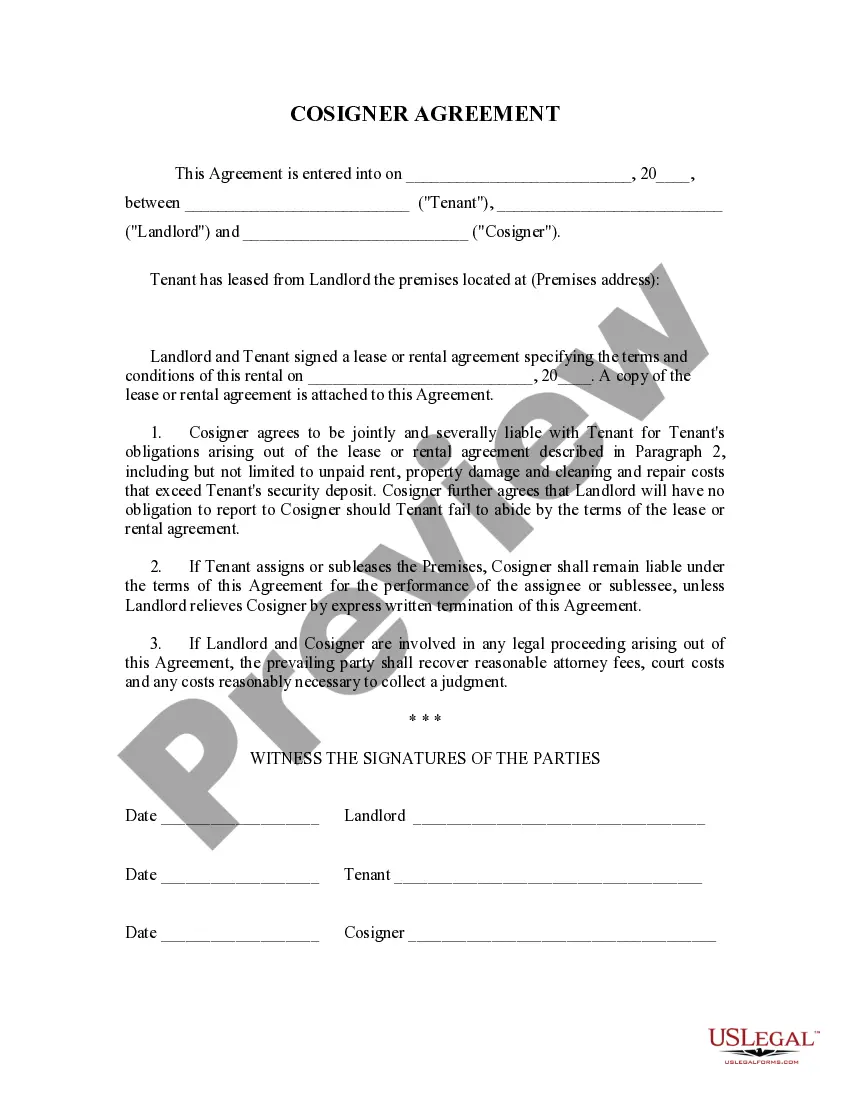
Vermont Landlord Tenant Lease Co-Signer Agreement

State:
Vermont
Control #:
VT-831-11
Format:
Word; 
Rich Text
Instant download

Understanding this form

The Landlord Tenant Lease Co-Signer Agreement is a legal document that allows a landlord to include a co-signer in a rental agreement. This form establishes the co-signer's obligation to cover rent and damages if the tenant fails to fulfill their financial responsibilities. It is essential in situations where the landlord seeks additional security from someone willing to guarantee payment, thus protecting their investment.

Key components of this form

  • Date of agreement: Specifies when the agreement is entered into.
  • Parties involved: Identifies the tenant, landlord, and co-signer.
  • Property details: States the address of the leased premises.
  • Liability terms: Outlines the co-signer's responsibility for payment and damages.
  • Signature sections: Provides spaces for the landlord, tenant, and co-signer to sign and date the agreement.

Common use cases

Who should use this form

  • Landlords seeking additional assurance when renting property.
  • Tenants required to have a co-signer due to their financial status.
  • Co-signers willing to take on the financial responsibility of the lease.
  • Property management companies managing leases requiring a lower-risk profile.

Completing this form step by step

  • Identify the parties: Fill in the names of the tenant, landlord, and co-signer.
  • Specify the property: Enter the address of the leased premises.
  • Date the agreement: Write the date the agreement is being made.
  • Review liability terms: Ensure all parties understand their obligations under the agreement.
  • Gather signatures: Have the landlord, tenant, and co-signer sign and date the form to make it legally binding.

Notarization guidance

In most cases, this form does not require notarization. However, some jurisdictions or signing circumstances might. US Legal Forms offers online notarization powered by Notarize, accessible 24/7 for a quick, remote process.

Get your form ready online

Our built-in tools help you complete, sign, share, and store your documents in one place.

Built-in online Word editor

Make edits, fill in missing information, and update formatting in US Legal Forms—just like you would in MS Word.

Export easily

Download a copy, print it, send it by email, or mail it via USPS—whatever works best for your next step.

E-sign your document

Sign and collect signatures with our SignNow integration. Send to multiple recipients, set reminders, and more. Go Premium to unlock E-Sign.

Notarize online 24/7

If this form requires notarization, complete it online through a secure video call—no need to meet a notary in person or wait for an appointment.

Store your document securely

We protect your documents and personal data by following strict security and privacy standards.

Form selector

Make edits, fill in missing information, and update formatting in US Legal Forms—just like you would in MS Word.

Form selector

Download a copy, print it, send it by email, or mail it via USPS—whatever works best for your next step.

Form selector

Sign and collect signatures with our SignNow integration. Send to multiple recipients, set reminders, and more. Go Premium to unlock E-Sign.

Form selector

If this form requires notarization, complete it online through a secure video call—no need to meet a notary in person or wait for an appointment.

Form selector

We protect your documents and personal data by following strict security and privacy standards.

Common mistakes to avoid

  • Failing to include all necessary parties in the agreement.
  • Leaving the premises address blank or incomplete.
  • Not specifying the date of the agreement.
  • Missing signatures from any party involved.

Benefits of using this form online

  • Convenience: Download and complete the form at your own pace.
  • Editability: Easily make changes to the form as needed.
  • Accessibility: Available 24/7 from any device with internet access.
  • Time-saving: Quickly obtain a legally binding document without needing to consult a lawyer for basic agreements.

Looking for another form?

This field is required
Virginia
Select state

Form popularity

FAQ

Some landlords agree to consider cosigners as long as they pass a background check, while other landlords don't allow them at all. Since there are no laws that require you to accept a cosigner, according to RentPrep, it's up to you to determine what makes the most sense for your property.

It's common for apartment complexes to accept a co-signer on your rental application if you don't qualify on your own.

According to Nolo, a cosigner is a person designated to make the rental payments if the tenant does not pay.However, if a lease doesn't have this provision, then the only people who need to sign the lease are the people responsible for paying the rent.

Only the owner/landlord can evict. Tenants and co-signors do not have the authority. If you want your ex GF out, there must be a basis for the eviction and a cooperative landlord.

Any adult can act as a cosigner provided they meet the landlord's qualifications. Often, tenants ask a family member or trusted friend to cosign for them. However, keep in mind that your cosigner will also have to submit an application and be put through a credit and background check.

As a parent, you may have the best intentions when co-signing for a child on a loan, a credit card or an apartment lease. But doing so opens you up to risk.If you can't absorb the expense without compromising your future financial security, you may want to think twice about co-signing for a loan.

Sometimes, a landlord might require a co-signer in order to lease the apartment to you. This is usually the case if you have low income, poor or no rental history, or bad credit. For any of these situations, having a co-signer will give the landlord a lot more peace of mind about letting you rent the apartment.

Co-signers have equal responsibility for payment of monthly rental costs, while a guarantor is generally sought for payment only when the primary signer is unable to make the rental payment.

A co-signer is a third party who is responsible if you are unable to pay rent. This person does not typically live in the apartment with you, but he or she is equally liable for your lease.

Trusted and secure by over 3 million people of the world’s leading companies

Vermont Landlord Tenant Lease Co-Signer Agreement