• US Legal Forms

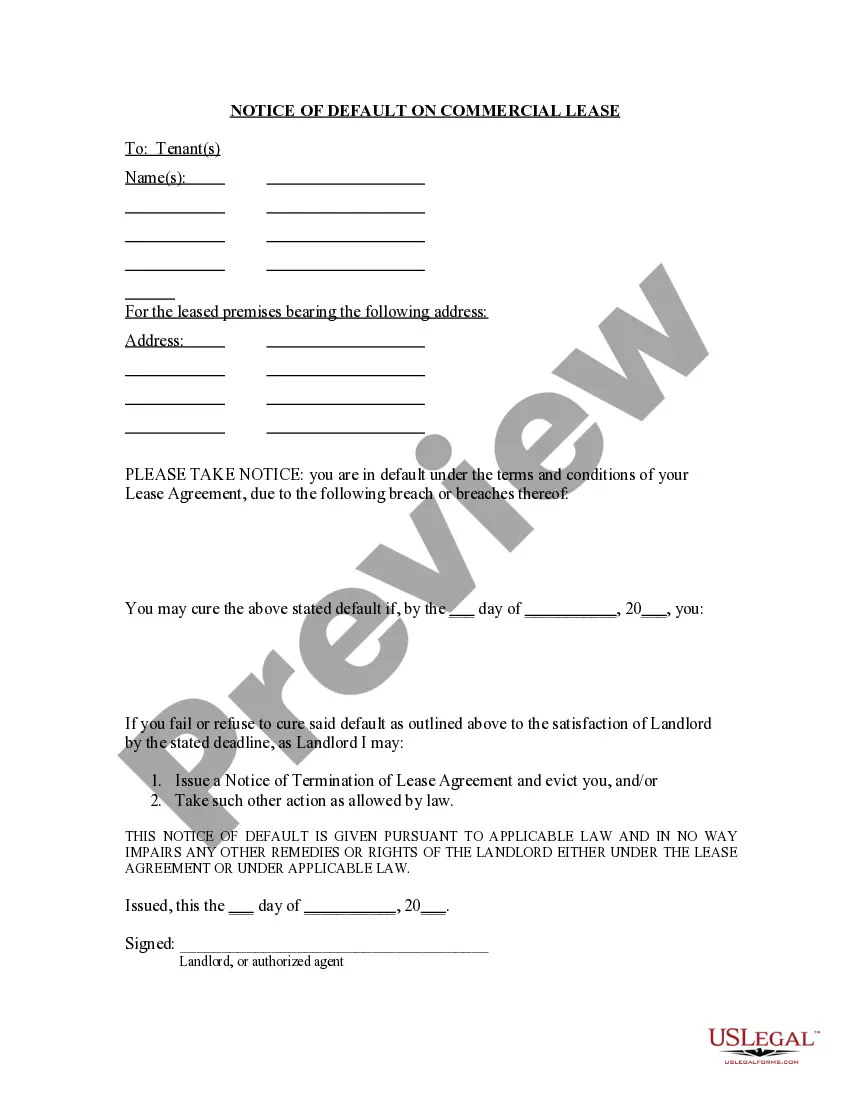
New York Letter from Landlord to Tenant as Notice of Default on Commercial Lease

State:
New York
Control #:
NY-824LT
Format:
Word; 
Rich Text
Instant download

Description

This is a notice between a Tenant and Landlord. It is a Notice of Default to Tenant, listing specific breaches and deadline for cure of breaches. If tenant refuses to cure the breach then landlord may execute his/her rights under applicable law, including the right to evict tenant.


In landlord-tenant law, default refers to the failure of a tenant to timely pay rent due. In anticipation of such an occurence, landlords commonly require a new tenant to pay a security deposit, which may be used to remedy defaults in payment of rent and other monetary obligations under the rental agreement. In general, the landlord is required to give the tenant notice of the default before bringing eviction proceedings or applying security deposit proceeds to the payment in default. The fixing of a definite default date for payment of rent can be critical if it becomes necessary to evict a tenant for a default in the payment of rent. Landlords often require a background and/or reference check on prospective tenants in an attempt to minimize defaults in rent payments.

Get your form ready online

Our built-in tools help you complete, sign, share, and store your documents in one place.

Built-in online Word editor

Make edits, fill in missing information, and update formatting in US Legal Forms—just like you would in MS Word.

Export easily

Download a copy, print it, send it by email, or mail it via USPS—whatever works best for your next step.

E-sign your document

Sign and collect signatures with our SignNow integration. Send to multiple recipients, set reminders, and more. Go Premium to unlock E-Sign.

Notarize online 24/7

If this form requires notarization, complete it online through a secure video call—no need to meet a notary in person or wait for an appointment.

Store your document securely

We protect your documents and personal data by following strict security and privacy standards.

Form selector

Make edits, fill in missing information, and update formatting in US Legal Forms—just like you would in MS Word.

Form selector

Download a copy, print it, send it by email, or mail it via USPS—whatever works best for your next step.

Form selector

Sign and collect signatures with our SignNow integration. Send to multiple recipients, set reminders, and more. Go Premium to unlock E-Sign.

Form selector

If this form requires notarization, complete it online through a secure video call—no need to meet a notary in person or wait for an appointment.

Form selector

We protect your documents and personal data by following strict security and privacy standards.

Looking for another form?

This field is required
Virginia
Select state

Key Concepts & Definitions

Letter from Landlord to Tenant as Notice of - This is a formal document, often dictated by legal statutes, which a landlord sends a tenant to address changes, issues, or updates in tenancy terms such as eviction, lease amendments, maintenance requirements, or even lease terminations. Key terms related to this topic include Lease Agreement, Security Deposit, Eviction Laws, and Maintenance Concerns.

Step-by-Step Guide to Writing a Letter from Landlord to Tenant

  1. Identify the Purpose: Clearly define the reason for the letter eviction, security deposit issues, or maintenance concerns.
  2. Review Lease Agreement: Refer back to the original lease agreement for any clauses that support the notice.
  3. Include Specific Details: Mention the property address, tenants and landlords contact information, and specifics about the lease term or any breach.
  4. Refer to State Laws: Ensure that the content of the notice adheres to the local eviction laws and regulations regarding tenant notices.
  5. Use a Template: Employ a template free from legal databases or services to structure the letter correctly.
  6. Send Officially: Send the notice via certified mail or other verifiable methods to ensure the tenant receives it.

Risk Analysis

  • Non-compliance with Eviction Laws: Incorrect adherence to state laws can result in legal repercussions or invalidation of the notice.
  • Poor Documentation: Inadequate record-keeping of communications may affect legal standing in disputes.
  • Misinterpretation of Terms: Ambiguities in the letter can cause misunderstandings or misinterpretations, potentially leading to legal challenges.

Key Takeaways

  • Ensure proper legal advice is consulted when drafting any formal notice to tenants.
  • Follow state-specific eviction and tenancy laws to avoid potential legal issues.
  • Keep the tone professional and the details clear and concise to prevent any misunderstandings.

How to fill out New York Letter From Landlord To Tenant As Notice Of Default On Commercial Lease?

In terms of submitting New York Letter from Landlord to Tenant as Notice of Default on Commercial Lease, you most likely think about an extensive procedure that involves getting a perfect sample among numerous similar ones and then needing to pay out legal counsel to fill it out for you. In general, that’s a sluggish and expensive option. Use US Legal Forms and select the state-specific template in just clicks.

In case you have a subscription, just log in and then click Download to have the New York Letter from Landlord to Tenant as Notice of Default on Commercial Lease sample.

In the event you don’t have an account yet but need one, keep to the step-by-step manual listed below:

  1. Make sure the file you’re downloading applies in your state (or the state it’s needed in).
  2. Do this by reading through the form’s description and through clicking the Preview function (if available) to find out the form’s content.
  3. Click on Buy Now button.
  4. Find the proper plan for your budget.
  5. Subscribe to an account and select how you would like to pay out: by PayPal or by credit card.
  6. Download the file in .pdf or .docx format.
  7. Get the record on your device or in your My Forms folder.

Skilled attorneys work on drawing up our samples to ensure that after saving, you don't have to worry about modifying content outside of your personal details or your business’s information. Sign up for US Legal Forms and get your New York Letter from Landlord to Tenant as Notice of Default on Commercial Lease document now.
Decorative icon for this block

Commercial Lease and Related Forms

Get good Commercial Lease and related forms fast! Answer a few simple questions and receive professionally drafted templates that fit your case.

Form popularity

FAQ

The law in New York allows commercial landlords to evict a tenant for specific reasons. These reasons include the non-payment of rent, substantial violation of lease terms (typically as provided in the lease agreement), holding over long after lease expiration, and creating a public nuisance.

If the commercial tenant is a shell corporation and/or does not have any assets of value, the commercial tenant may choose to walk away from its commercial lease obligations.Often the landlord will require guarantees in order to prevent a commercial tenant from walking away from its lease obligations.

If you're an assured tenant or a protected tenant Your landlord will have to give you notice if they want you to leave. They have to give the reasons why they want to evict you - for example, if you have rent arrears or you've damaged the property. Your landlord will have to go to court and get a court order.

So a tenant is likely to have to give between 3 and 4 months notice if rent is paid monthly, and 3 and 6 months notice if rent is paid quarterly.

Break rights can only be exercised on reasonable prior written notice and usually a minimum of 6 months' notice is required.It is therefore prudent for a landlord or tenant to ask its professional advisors to serve a break notice on its behalf and to review the validity of any such notice served by the other party.

In NYC, it usually takes about three weeks for a marshal to get their paperwork ready from the courts and serve the Notice of Eviction.

Surrender the Lease. One option for getting out of your commercial lease early is to approach your landlord and request to surrender the lease. Early Termination Clause. Some lease agreements will contain an early termination clause (commonly called a break clause). Assignment of Lease. Subletting the Premises. Licensing.

Landlords can try and forfeit a lease if a tenant is in breach of their obligations (this assumes that the lease document includes a right to forfeit).If a commercial lease contains a break clause, either or both parties to the agreement may seek to terminate the lease before its fixed period has ended.

Trusted and secure by over 3 million people of the world’s leading companies

New York Letter from Landlord to Tenant as Notice of Default on Commercial Lease