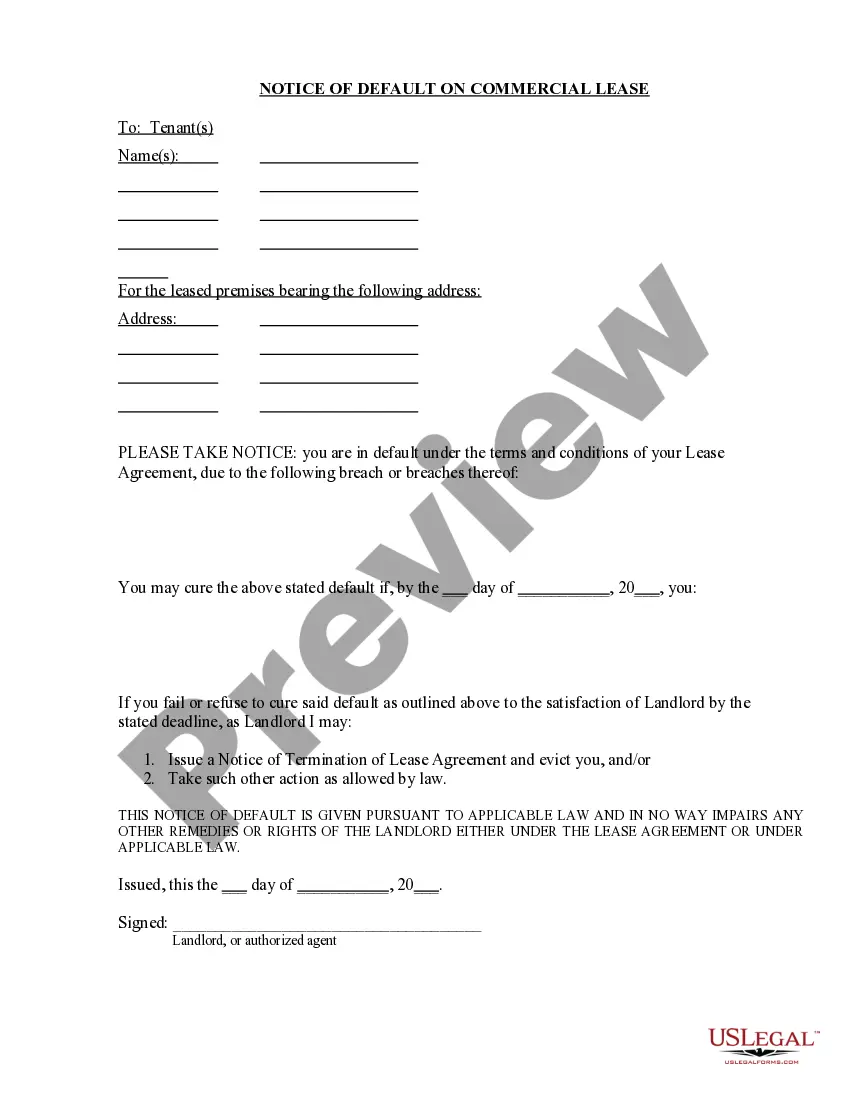
This form is a Letter from Landlord to Tenant as Notice of Default on Commercial Lease. It serves to officially notify the tenant of specific breaches of the lease agreement, such as failure to pay rent, and sets a deadline for resolving these issues. Unlike other notifications, this letter outlines the landlordâs rights under the lease and applicable law if the tenant does not take corrective action.
This form usually doesn’t need to be notarized. However, local laws or specific transactions may require it. Our online notarization service, powered by Notarize, lets you complete it remotely through a secure video session, available 24/7.
Our built-in tools help you complete, sign, share, and store your documents in one place.
Make edits, fill in missing information, and update formatting in US Legal Forms—just like you would in MS Word.
Download a copy, print it, send it by email, or mail it via USPS—whatever works best for your next step.
Sign and collect signatures with our SignNow integration. Send to multiple recipients, set reminders, and more. Go Premium to unlock E-Sign.
If this form requires notarization, complete it online through a secure video call—no need to meet a notary in person or wait for an appointment.
We protect your documents and personal data by following strict security and privacy standards.

Make edits, fill in missing information, and update formatting in US Legal Forms—just like you would in MS Word.

Download a copy, print it, send it by email, or mail it via USPS—whatever works best for your next step.

Sign and collect signatures with our SignNow integration. Send to multiple recipients, set reminders, and more. Go Premium to unlock E-Sign.

If this form requires notarization, complete it online through a secure video call—no need to meet a notary in person or wait for an appointment.

We protect your documents and personal data by following strict security and privacy standards.
Set Up Rental Payment Reminders The most polite way to ask for payment is to ask before anyone is late! When you send a reminder a few days before the rent is due, you can be very polite. Sending a reminder about an upcoming payment rather than a request for a late payment is always going to be a more welcome message.
Dear Name of Tenant: This letter is to inform you that as of the date of this notice, I have not received your rental payment that was due on DATE. Because rent is due on the first of the month and will cover the rental unit for the dates of DATE through DATE, you are living in a unit you have not paid for.
Just be sincere and polite, which is what will get you sympathy. Inform the landlord about your plan for resolving your current situation. Develop an installment plan that you think you can afford. Indicate if you will be missing any future rent payments and, if so, how the shortfall be paid over time.
Paying the remainder of the rent still owed on the lease in full; Paying a specified amount of liquidated damages as outlined in the contract terms; Paying an additional amount of punitive damages, dependent on local state laws; and/or.
For example, the lease may provide that in case of default, the landlord can recover late fees and interest. If the lease is a net lease, it may provide for the landlord to recover such things as property taxes, insurance, utilities, maintenance and repairs.
A break-early fee is a lump sum payment. The amount of the break-early fee will vary greatly depending upon the commercial tenant's specific circumstances. In exchange for the break-early fee, the landlord will agree to release the commercial tenant from all of its obligations under the commercial lease.
Let the tenant know what day the rent is due and how much is owed. Remind the tenant of how they can pay rent; i.e., which payment methods are accepted. Ask the tenant to contact you if there are going to be any delays as soon as possible so you can work on a solution together.
One option for getting out of your commercial lease early is to approach your landlord and request to surrender the lease. A surrender of lease is when both you and the landlord agree to end the lease.However, if the landlord agrees to surrender your lease, you will often have to pay their legal costs.
A lease is automatically void when it is against the law, such as a lease for an illegal purpose. In other circumstances, like fraud or duress, a lease can be declared void at the request of one party but not the other.