• US Legal Forms

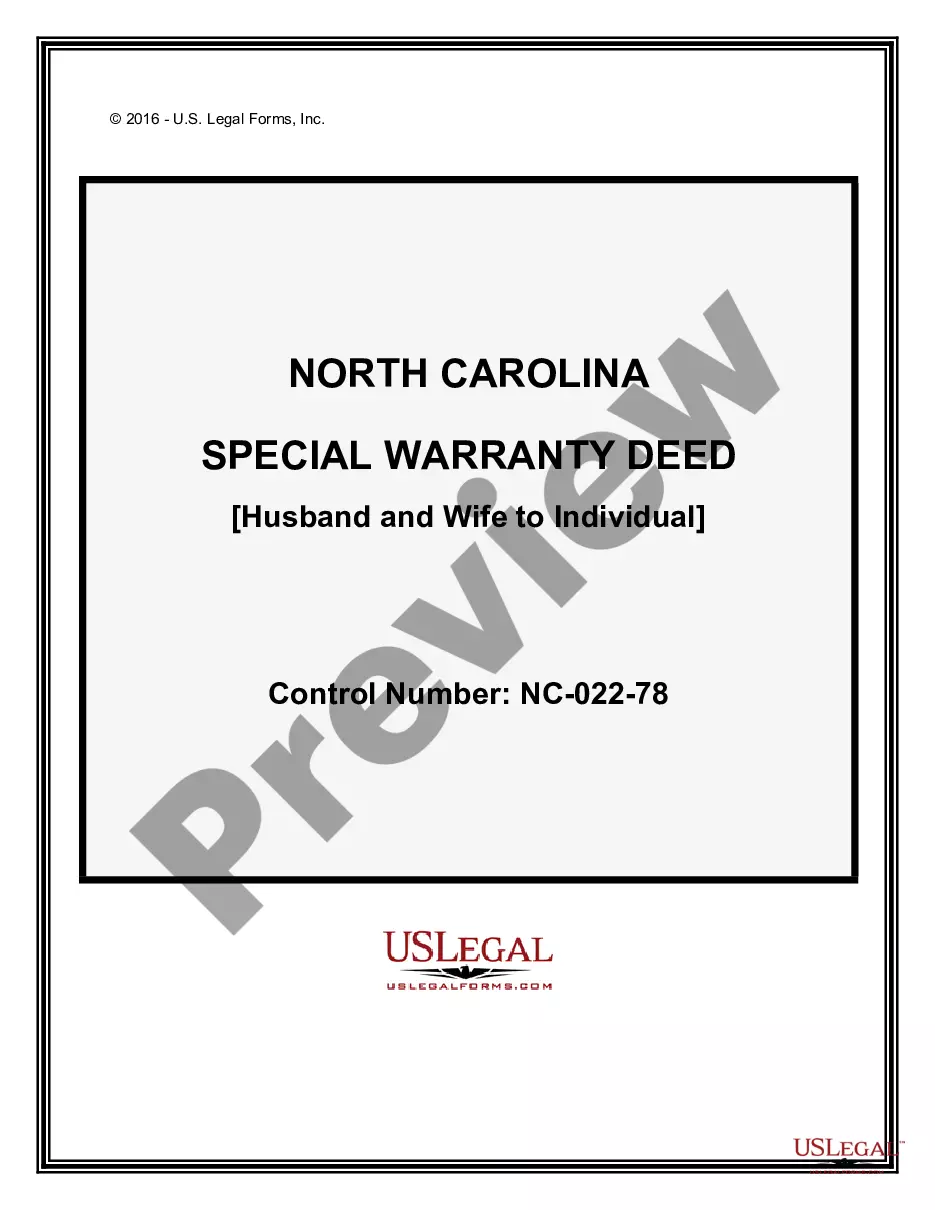
North Carolina Special Warranty Deed - Husband and Wife to Individual

State:
North Carolina
Control #:
NC-022-78
Format:
Word; 
Rich Text
Instant download

About this form

The Special Warranty Deed - Husband and Wife to Individual is a legal document that allows a married couple, as grantors, to transfer property ownership to an individual, the grantee. This deed includes a special warranty of the title, meaning that grantors only guarantee against claims that arise from their own ownership of the property, not claims from other sources. This form is essential for ensuring a clear title while protecting the interests of the parties involved, making it distinct from a general warranty deed which offers broader protections.

Form components explained

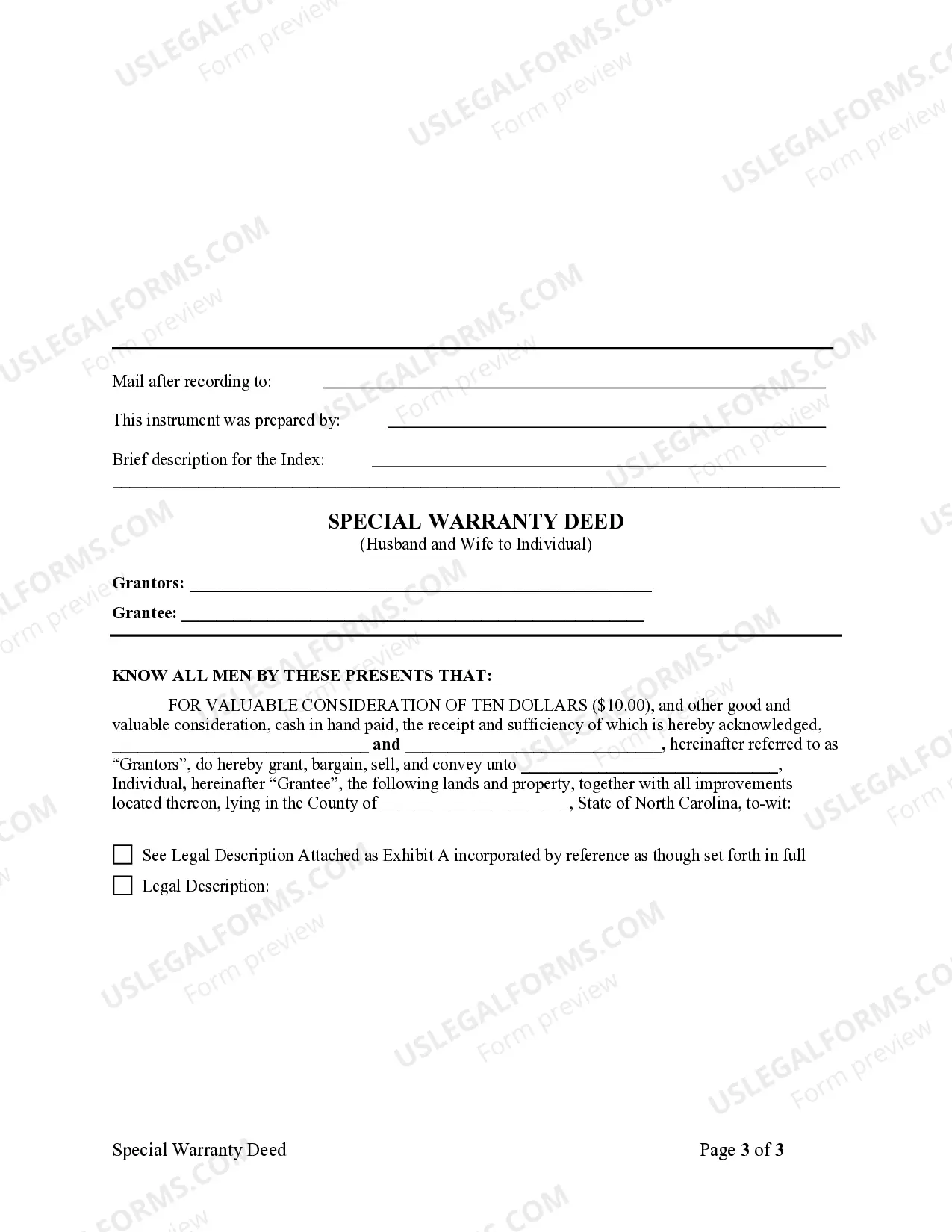
  • Identifies the grantors (husband and wife) and grantee (individual).
  • Describes the property being transferred, including its location.
  • Contains a covenant that the grantors are seized of the property in fee simple and have the right to convey it.
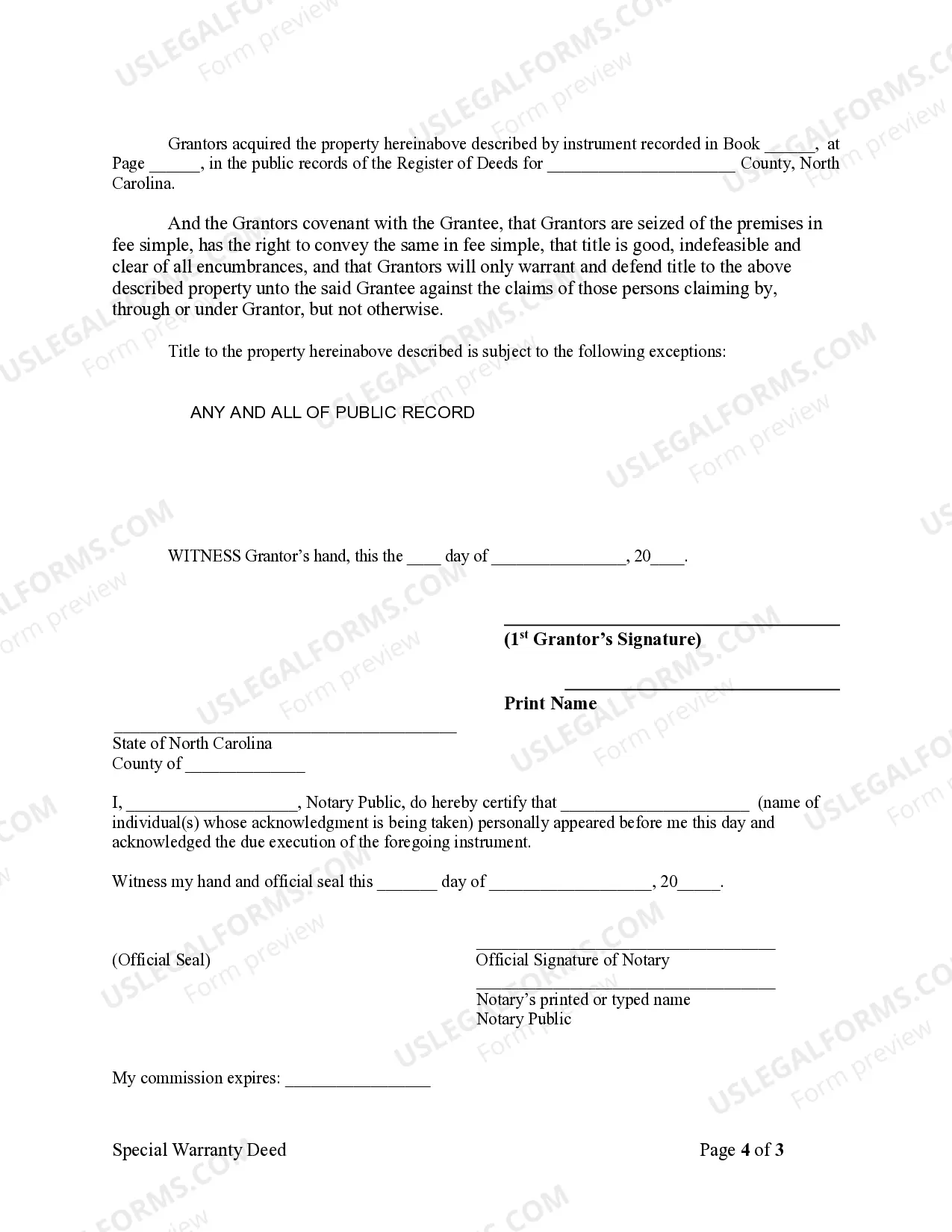
  • Outlines the specific warranty, limiting the grantors' liability to claims made by those claiming through them.
  • Includes signature lines for the grantors and the date of execution.
Free preview
  • Preview Special Warranty Deed - Husband and Wife to Individual
  • Preview Special Warranty Deed - Husband and Wife to Individual
  • Preview Special Warranty Deed - Husband and Wife to Individual
  • Preview Special Warranty Deed - Husband and Wife to Individual
  • Preview Special Warranty Deed - Husband and Wife to Individual
  • Preview Special Warranty Deed - Husband and Wife to Individual

Common use cases

This form should be used when a married couple wishes to convey property to an individual. Practical situations include transferring ownership to a relative, selling property to a friend, or gifting a property to a non-spouse. It is particularly useful in scenarios where the grantors want to limit their liability to claims made only by other individuals deriving their rights from them.

Who can use this document

  • Married couples looking to transfer property to a single individual.
  • Individuals involved in real estate transactions where limited warranty protection is preferred.
  • Anyone intending to ensure a clear title while transferring property ownership.

Completing this form step by step

  • Identify the grantors by entering the full names of the husband and wife.
  • Specify the grantee's name as the individual receiving the property.
  • Describe the property being conveyed, including its location and any improvements.
  • Enter the date of the property transfer in the appropriate section.
  • Have both grantors sign the form in the designated spaces to finalize the deed.

Notarization guidance

To make this form legally binding, it must be notarized. Our online notarization service, powered by Notarize, lets you verify and sign documents remotely through an encrypted video session.

Typical mistakes to avoid

  • Failing to properly describe the property, which can lead to disputes later.
  • Not having both grantors sign the document, rendering the deed invalid.
  • Neglecting to date the form, which is essential for legal records.
  • Using incorrect names for the parties involved, which can void the deed.

Why use this form online

  • Easy access to professionally drafted legal forms from the comfort of home.
  • Ability to fill out the form on your computer, making it easier to ensure accuracy.
  • Instant download allows for quick use in legal transactions.
  • Editability ensures you can adjust the form as needed before finalizing it.

Form popularity

FAQ

A In order to make your partner a joint owner you will need to add his name at the Land Registry, for which there is a fee of £280 (assuming you transfer half the house to him). You won't, however, have to pay capital gains tax, as gifts between civil partners (and spouses) are tax free.

Adding someone to your house deed requires the filing of a legal form known as a quitclaim deed. When executed and notarized, the quitclaim deed legally overrides the current deed to your home. By filing the quitclaim deed, you can add someone to the title of your home, in effect transferring a share of ownership.

If you've recently married and already own a home or other real estate, you may want to add your new spouse to the deed for your property so the two of you own it jointly. To add a spouse to a deed, all you have to do is literally fill out, sign and record a new deed in your county recorder's office.

Joint Tenancy Two or more people, including spouses, may hold title to their jointly owned real estate as joint tenants. There is a so-called right of survivorship, which means that when one dies, the property automatically transfers to the survivor without the necessity of probating the estate.

Special warranties allow the transfer of property title between seller and buyer. The purchase of title insurance can mitigate the risk of prior claims to the special warranty deed.

A special warranty deed to real estate offers protection to the buyer through the seller's guarantee that the title has been free and clear of encumbrances during their ownership of the property. It does not guarantee clear title beyond their ownership.

In California, all property bought during the marriage with income that was earned during the marriage is deemed "community property." The law implies that both spouses own this property equally, regardless of which name is on the title deed.

If you live in a common-law state, you can keep your spouse's name off the title the document that says who owns the property.You can put your spouse on the title without putting them on the mortgage; this would mean that they share ownership of the home but aren't legally responsible for making mortgage payments.

Trusted and secure by over 3 million people of the world’s leading companies

North Carolina Special Warranty Deed - Husband and Wife to Individual